The end-to-end role of Chapter 25
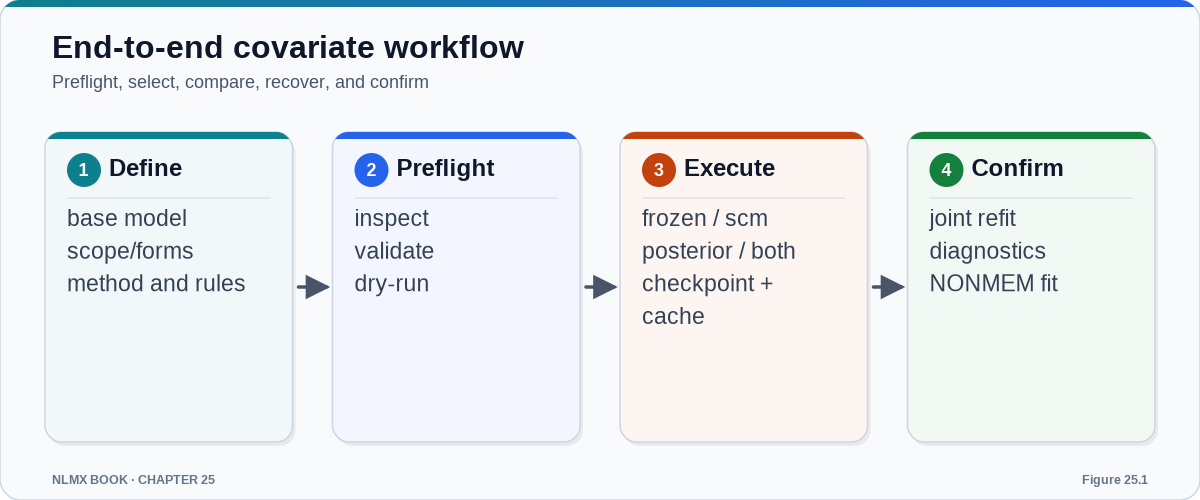
Chapters 22–24 and 23A explain the statistical engines. This chapter explains how to operate them as one reproducible workflow: define a single scientific scope, resolve the model inputs, preflight the analysis, choose an engine, preserve recoverable state, compare evidence without collapsing unlike quantities, and confirm a fitted endpoint.
The five operational commands have different stopping points. inspect resolves and prints what nlmx believes; validate challenges inputs and numerics; cov performs selection with frozen, scm, posterior, or both; posterior reconstructs/ingests subject posteriors and stops before stability selection; resume continues a compatible interrupted posterior schedule or frozen/SCM refit cache. schema supplies the versioned configuration reference used by all of them.
The governing rule is that selection is not confirmation. Frozen evidence is local, SCM evidence is path-conditional, and posterior evidence is stability under a perturbation design. The final joint refit, diagnostics, clinical effect interpretation, and explicit reference-software fit remain separate obligations. The chapter uses real 4.14.3 output and preserves every command so a novice can trace each conclusion to an executable artifact.
Common mistakes
- Changing the scientific question after seeing the result while presenting it as the original run.
- Reading one engine's summary without checking its prerequisites, failures, normalized settings, and fitted endpoint.
- Treating a generated draft, comparison label, or completed checkpoint as a substitute for model diagnostics and reference-software confirmation.
Page checklist
- The exact command, version, inputs, resolved settings, and output directory are identifiable.
- Engine-specific evidence is interpreted on its own scale before cross-method comparison.
- Recovery state, final refit, diagnostics, and remaining confirmation work are explicit.