23.31 Linearized versus exact uncertainty propagation
Configuration key uncertainty.recompute_scores selects linearized or exact. Linearized mode updates the efficient score using candidate–nuisance cross-information:
U(ψ̂ + δ) ≈ U* − Iβψδ.
It is fast because no complete score recomputation is needed at each draw. Exact mode perturbs the base parameters and recomputes candidate score changes by likelihood evaluations. For baseline candidates, shared target-score work makes exact mode scale with draws and targets more than with the number of candidates, but it remains more expensive.
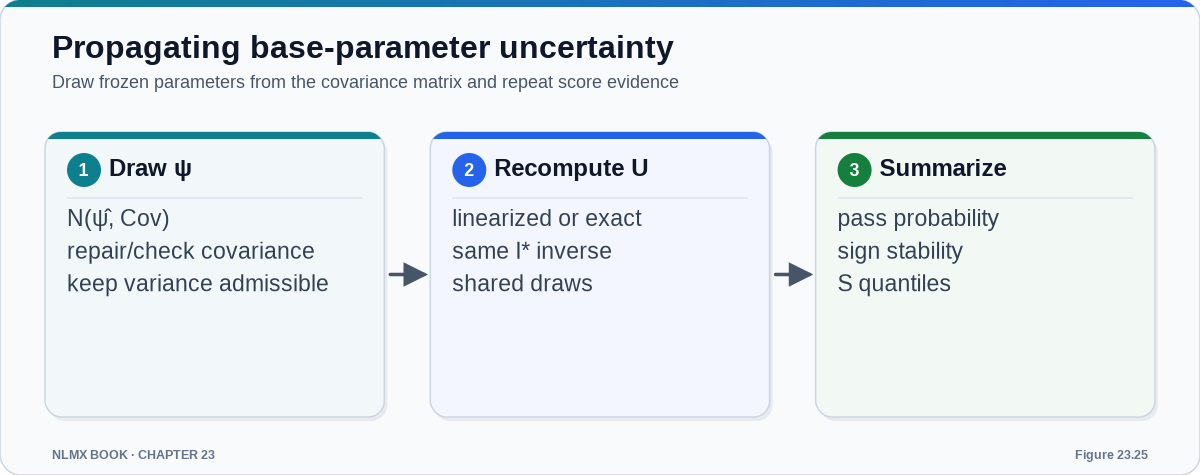
The Chapter 23 exact run used 200 shared draws. True continuous effects had pass probabilities of 1.00, while null SEX effects were 0.065 and 0.09. In the linearized refined run the same null effects had 0.25 and 0.35, demonstrating that mode can matter for weak candidates even though final classifications were unchanged.
Use linearized mode for routine broad screening after qualification. Use exact sensitivity for nonlinear models, large covariance, near-threshold candidates, or validation. Neither mode re-estimates the model at every draw; they measure score sensitivity around perturbed frozen parameters.
When exact mode adds the most value
Prioritize exact recomputation when covariance draws are large relative to parameter scale, the model contains strong nonlinearities, a candidate sits near the threshold, linearized pass probability is intermediate, or score/refit disagreement is already visible. Exact mode is less informative when the covariance matrix itself is unqualified; recomputing a score accurately at invalid draws does not repair a poor uncertainty model. Compare modes with the same covariance, draws, seed, and alpha so differences reflect recomputation rather than Monte Carlo sampling. Preserve both result bundles because the comparison is part of the evidence, not a reason to delete the less convenient mode.
Common mistakes
- Calling exact uncertainty a full parametric bootstrap.
- Assuming linearized and exact probabilities must match.
- Comparing runs with different seeds or draws without accounting for Monte Carlo error.
- Ignoring invalid exact evaluations.
- Selecting the mode according to the preferred result.
Checklist
- State mode explicitly in the report.
- Use identical draws/seed where comparison is intended.
- Escalate nonlinear or borderline effects to exact mode.
- Review invalid draws and covariance repairs.
- Confirm decisions with refits, not uncertainty mode alone.
Further reading
Open the exact-uncertainty report, then read classification.