Inputs, scientific scope, and equation forms
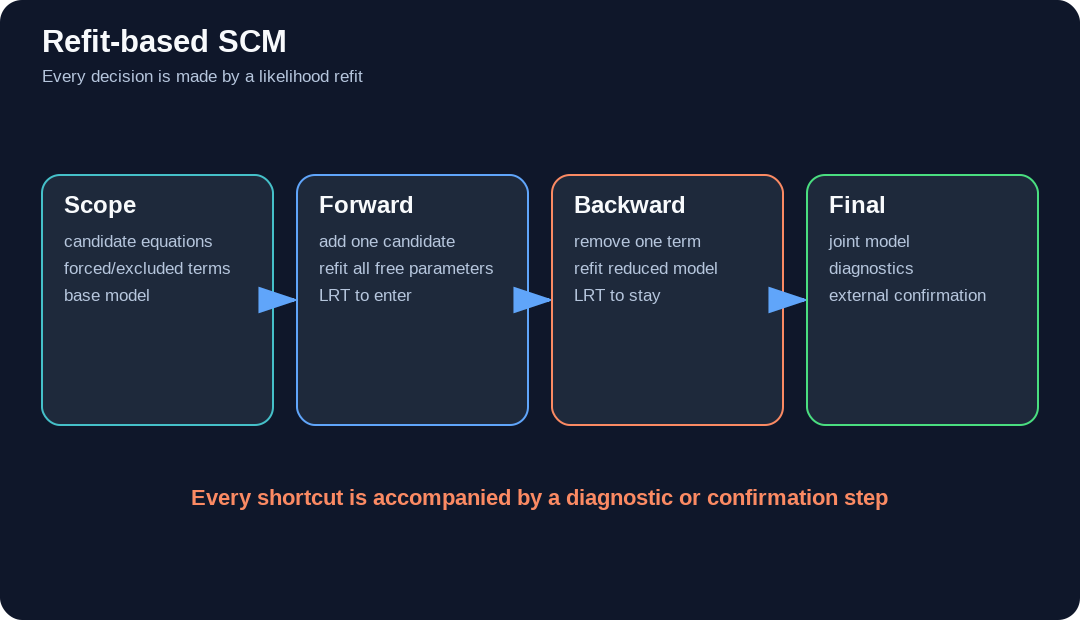
The scope is the set of relationships nlmx is permitted to consider. For example, --covariates "CL=WT,EGFR,SEX;V=WT,SEX" creates five parameter–covariate relationships. Type detection and equation rules then turn each relationship into a candidate block. A binary proportional effect is one coefficient; a multi-level categorical proportional effect can be several coefficients and degrees of freedom.
Use --covariate-type, --covariate-reference, and --covariate-forms when automatic choices are not scientifically adequate. Continuous defaults use power; binary/categorical defaults use proportional. --all-equations expands the form search, while --compare-forms auto|refit|score controls how a winner is chosen for each pair. Form selection happens before the SCM path; once the winning form represents a relationship, its alternative forms are not independently re-entered later.
Keep the scope causal and clinically motivated. Adding every measured column inflates multiplicity, computation, collinearity, and path dependence. Document units, transformations, reference values, missing-value policy, time varying versus baseline interpretation, and prohibited relationships before execution.
Common mistakes
- Treating a stepwise p-value as clinical importance or causal proof.
- Reading a candidate comparison without its active model, convergence state, degrees of freedom, and exact threshold.
- Reporting only the terminal relationship list while discarding failed models, path decisions, configuration, and provenance.
Page checklist
- The scientific question, model identities, and comparison direction are explicit.
- Numerical validity is reviewed before interpreting statistical evidence.
- The result is linked to the complete trace and final joint-model diagnostics.