17.9 Transit-compartment absorption
Transit absorption represents a distributed delay. Drug passes through a chain or equivalent transit-time distribution before reaching the absorption compartment, usually parameterized by mean transit time and a shape/count parameter. Unlike a fixed lag, input begins according to a smooth distribution and can reproduce rounded, delayed peaks.
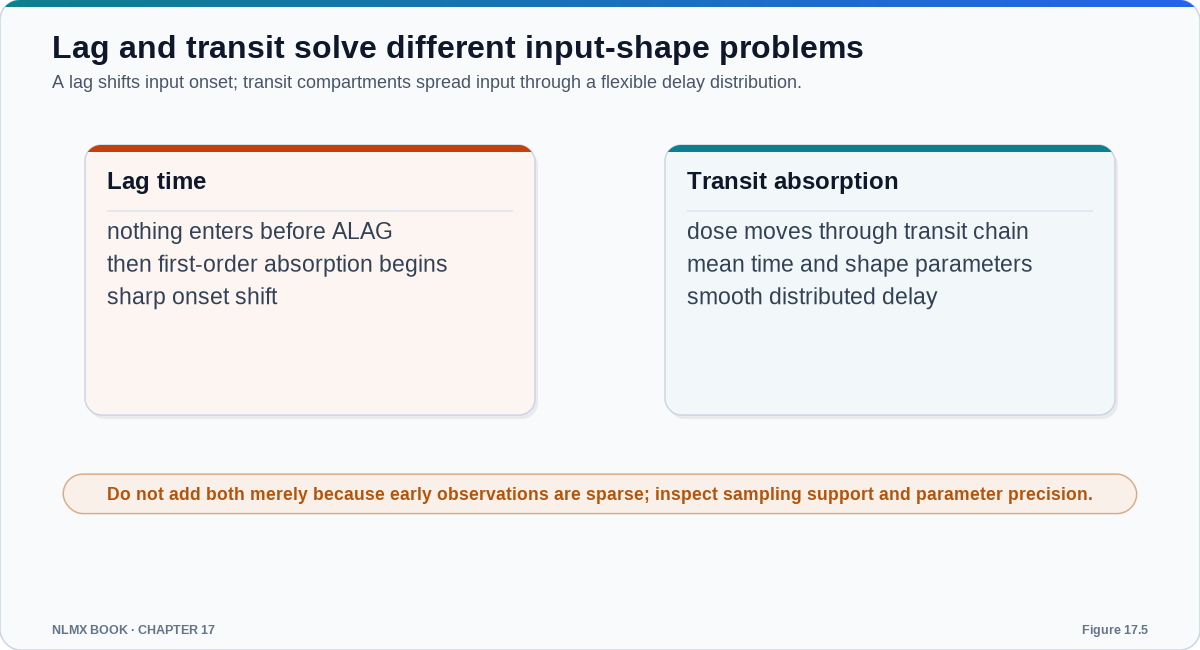
Request transit candidates with --absorption transit, or compare them with first-order input using both. The exact generated candidate name and parameter block should be checked in the current build. Transit parameters need dense early samples across subjects; otherwise mean time, shape, KA, residual error and between-subject variability can trade off.
Choose the candidate set based on a prespecified shape question. A delayed but abrupt onset suggests examining lag; a dispersed onset suggests transit. Food effects, formulation changes and gastric-emptying heterogeneity can create subgroups that one population transit distribution does not capture. A better criterion value may reveal a systematic shape, but it does not identify the biological cause.
When initializing, use route-aware autoinit values for disposition and absorption, then inspect the additional transit starts. Parent warm starts help disposition parameters remain comparable. If the transit candidate fails, vary scientifically reasonable transit starts before concluding the family is unsupported.
Common mistakes
Avoid treating the nominal number of transit compartments as directly observed anatomy. Do not add transit solely because Tmax varies, since dose timing errors and covariates can cause the same pattern. Sparse first samples can produce a precise-looking but design-driven estimate.
Checklist
- Verify actual early sampling times and dose times.
- State why a distributed delay is plausible.
- Compare against a simpler first-order parent.
- Review transit/
KAcorrelations and bounds. - Confirm improvements persist in diagnostic plots and sensitivity runs.
Further reading
Read Chapter 16’s transit-block initialization guidance, parent warm starts, and selection bias limits.