17.31 Worked example: absorption lag
This synthetic study contains 18 oral subjects and 216 observations from 0.25 to 36 hours. The candidate set is 1cmt_abs, 1cmt_abs_lag, 2cmt_abs, and 2cmt_abs_lag. The purpose is to distinguish delayed input from extra disposition structure.
The unlagged one-compartment model has OFV −182.75. Adding a lag reduces OFV to −534.87 with one additional parameter and BICc to −502.22. The unlagged two-compartment candidate barely improves OFV (ΔOFV 0.70 versus one compartment; p 0.706). The two-compartment lag model has the lowest raw OFV, −538.23, but does not converge and is ineligible. BICc recommends 1cmt_abs_lag.
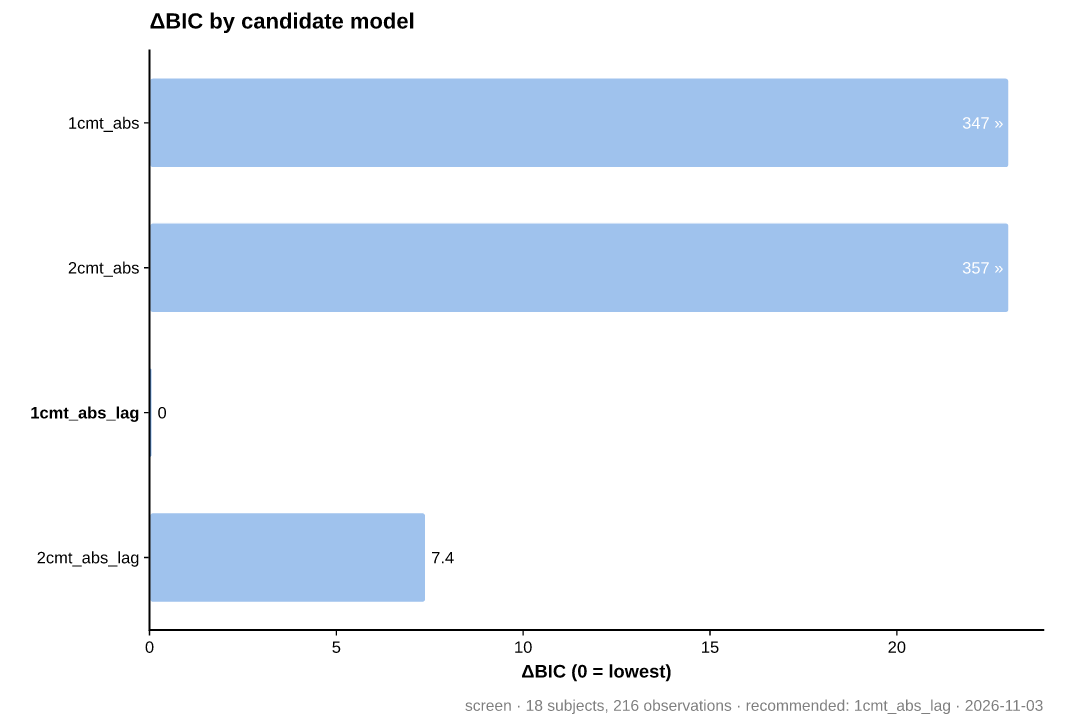
The LRT table reinforces the structural story: adding lag is highly significant, while adding a second compartment within the lag family gives ΔOFV 3.36 for two degrees of freedom, p 0.187. This is a useful example of asking whether the early shape demands timing rather than disposition complexity.
The winner still has a condition number around 4.5 million and ETA shrinkage near 69%. It is therefore a strong lag signal with fragile uncertainty/random-effect structure. Follow-up should review timing, parameter correlations, alternative error/random-effect structures, and sensitivity to starts.
The example also illustrates why “more compartments” is not a substitute for the correct input process. Without lag, the two-compartment model scarcely improves fit. Once lag is present, the second compartment remains unsupported. Candidate design should therefore separate input-shape and disposition questions whenever possible.
Common mistakes
Do not promote the nonconverged two-compartment lag model because its OFV is lower, or interpret high shrinkage as precise individual lag estimates. Nominal sampling times must match actual times.
Checklist
- Verify early dose/sample timing.
- Compare lag and compartment LRT edges separately.
- Apply convergence before ranking.
- Report condition number and shrinkage.
- Diagnose the winner before downstream use.
Further reading
Open the txtlag summary, then revisit lag candidates and warning flags.