Chapter 39 — Errors, warnings, and troubleshooting
What you will learn
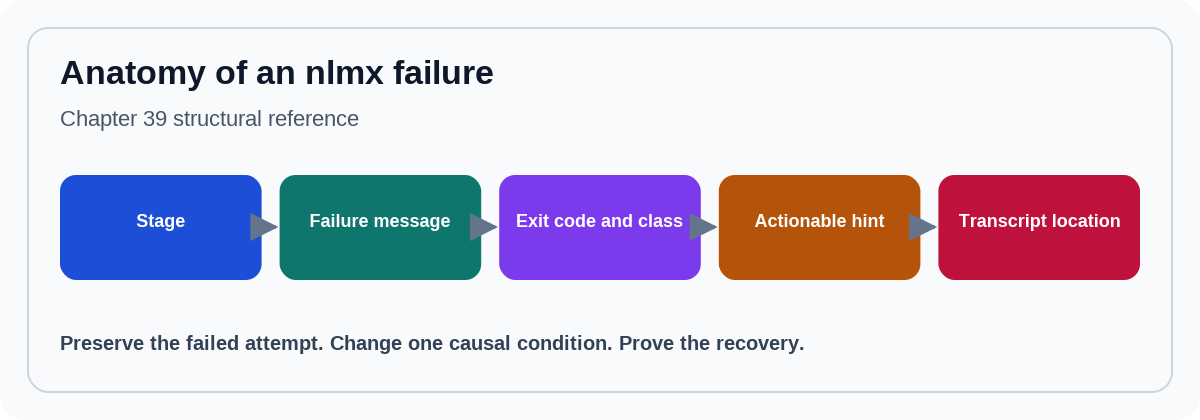
- Read the stage, message, exit class, hint, and transcript as one diagnostic record.
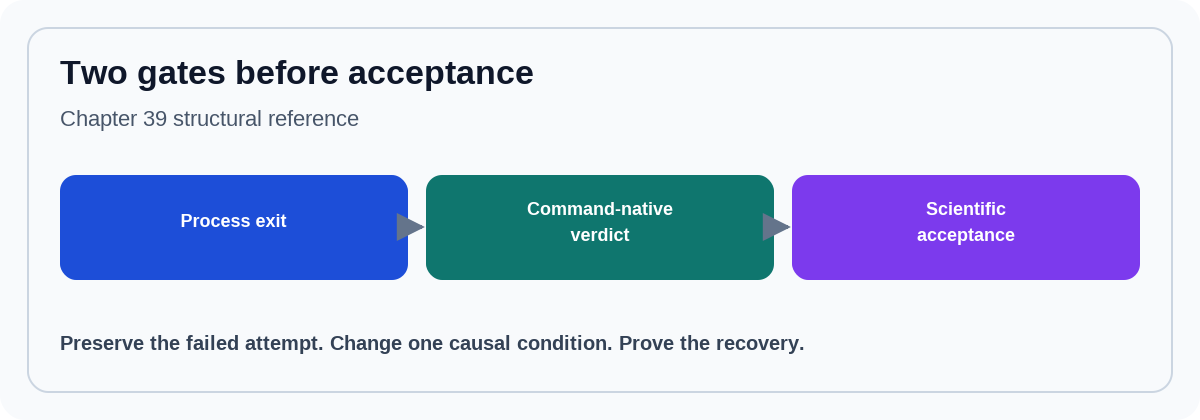
- Distinguish process success, command-native acceptance, and scientific acceptance.
- Diagnose every stable exit class from 2 through 12 without destroying evidence.
- Recover files, settings, data, model artifacts, fits, covariate workflows, reports, and assistant sessions.
- Submit a minimal, sanitized, reproducible problem report.
Prerequisites: Chapter 4 concepts, Chapter 36 command reference, Chapter 37 settings reference, and Chapter 38 output reference.
This novice-oriented chapter is the operational troubleshooting guide for nlmx 4.16.2. It covers all process exit classes, early failures without logs, warnings and zero-exit semantic failures, partial outputs, safe recovery, and escalation. The central rule is simple: preserve first, diagnose second, change one causal condition, then prove the recovery.
Start here
- If a command just failed, use the first five minutes.
- If you have the code, jump to the complete error reference.
- If the process returned 0 but the result worries you, read warnings and native verdicts.
- If nlmx reports an internal bug, follow exit code 12 and reporting a problem.
Chapter structure
Pages 39.1–39.3 establish the diagnostic method. Pages 39.4–39.14 cover each exit class and page 39.15 covers failures after an upgrade. Pages 39.16–39.22 provide workflow-specific playbooks. Pages 39.23–39.24 answer common questions and define a reproducible problem bundle. The searchable JSON inventory contains normalized signatures and implementation source-site evidence with hashes.
This chapter contains 24 numbered pages, this overview, and the complete error reference: 26 Markdown pages total. Continue with 39.1 Reading an nlmx error.