F.7 Maxson, report, determinism and reproducibility
What you will learn
- Find a short, checked answer to 15 common questions about assistant, reports and reproducibility.
- Follow the link after each answer to the page that explains it and shows the evidence.
- Recognise the mistakes that these questions come from, so that you do not make them.
Prerequisites: Chapter 34 and Chapter 36A are helpful.
The assistant and its guardrails, publishing a report, and what nlmx does and does not promise about repeatable results.
Commands named on this page: ask, report.
How to read an answer. Each answer restates what the book says, in a few sentences, and ends with Read more: the page that explains it, with its evidence. The answers are short on purpose. When a decision depends on one, open the linked page.
The 15 questions on this page
- What is Maxson, and what can it do?
- Can the assistant run any command or write anywhere?
- Does Maxson need an internet connection or a remote server?
- How do I see what it would do without running anything?
- How do I audit a Maxson session?
- Does the assistant's judgement get validated by these guardrails?
- How do I turn a Markdown file into Word, PDF and HTML with
report? - Why does my report have no figure when it was built from standard input?
- How do I write an equation in a report?
- Is exit code 0 from
reportenough to release it? - What exactly does nlmx promise about reproducibility?
- Two runs with different thread counts have different checksum lines. Is something wrong?
- Does changing the seed change everything?
- What should I keep so that I can rerun an analysis later?
- Should I expect the same simulated rows from nlmx and from NONMEM with the same seed?
Answers
F.7.1 What is Maxson, and what can it do?
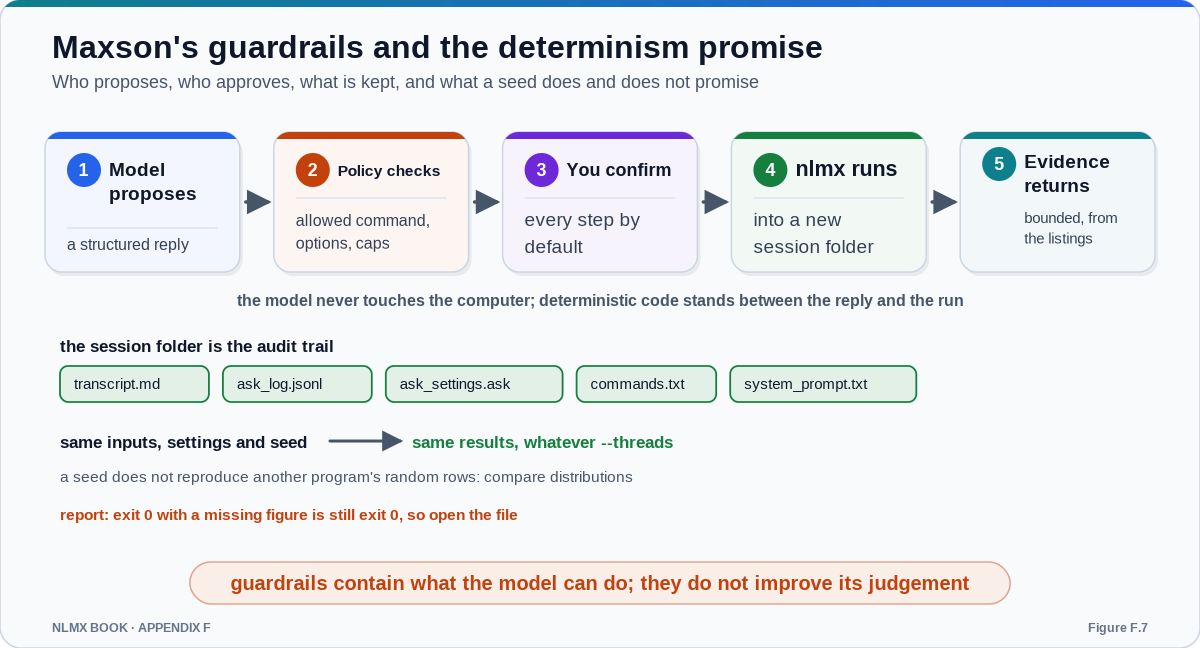
Maxson is the conversational layer of nlmx ask. A language model proposes structured actions; deterministic nlmx code checks them against the settings in force, asks for confirmation, runs only approved nlmx commands and returns bounded evidence. The model never touches the computer directly. Four claims stay separate: the model proposes, the policy approves, the command succeeds or fails, and a qualified person accepts the science.
Read more: 34.1 The Maxson trust model; 34.2 Architecture and trust boundaries.
F.7.2 Can the assistant run any command or write anywhere?
No. A command must be on the allowed list, a forbidden option such as --overwrite is refused, numeric ceilings (replicates, samples, subproblems) are enforced, and the assistant may not start itself. It reads the start folder and the session folder (plus folders you add), writes each command's output into a new subfolder of the session, and does not overwrite your dataset or control stream.
Read more: 34.5 Allowed commands, self-invocation, and the no-shell boundary; 34.6 Option parsing, forbidden flags, and numeric caps; 34.7 Read boundaries, session-only writes, and resolved paths; 41.37 Case 9: the assistant, and what its guardrails do with nine different replies.
F.7.3 Does Maxson need an internet connection or a remote server?
No. The default model runs inside nlmx on your computer and does not need network access. The alternative is a model server: by default the policy accepts only a localhost address over plain HTTP, and allowing a remote server is an explicit widening of the data boundary that needs its own review. For regulated or reproducible work, pin and record the model identity and the server configuration.
Read more: 34.8 Embedded, server, and mock backends; 35.3 Running with a local model server; 41.37 Case 9: the assistant, and what its guardrails do with nine different replies.
F.7.4 How do I see what it would do without running anything?
Use guide mode ([assistant] mode = "guide", or /guide in a conversation), which runs nothing and shows the command to type, or --plan-only, which checks the plan, writes the settings files it needs and records the planned command without running it. A plan is a record that a person can review and run later.
Read more: 35.9 Auto mode, guide mode, plan-only, and slash commands; 41.37 Case 9: the assistant, and what its guardrails do with nine different replies.
F.7.5 How do I audit a Maxson session?
Each session folder holds transcript.md, the event log ask_log.jsonl, the settings in force ask_settings.ask, commands.txt (the commands that were run, which you can rerun without the assistant) and the instructions the model was given, next to the output folders and saved settings files. The event log shows who proposed each step, who allowed it and what happened.
Read more: 34.14 Transcript, JSONL events, commands, and settings history; 34.13 Session-folder structure and evidence ownership; 41.37 Case 9: the assistant, and what its guardrails do with nine different replies.
F.7.6 Does the assistant's judgement get validated by these guardrails?
No. The guardrails are deterministic checks on a request: they can say that a command is allowed, not that it is the right one for your question. In Chapter 41 the sessions use a scripted model, so they show what nlmx does with a reply, whatever the reply is, and nothing about a real model's choices. Review the scientific content of an assistant-run analysis as for any other, and do not treat a QC verdict as approval.
Read more: 34.17 What Maxson cannot establish; 41.37 Case 9: the assistant, and what its guardrails do with nine different replies.
F.7.7 How do I turn a Markdown file into Word, PDF and HTML with report?
nlmx report analysis.md publishes the Markdown into retained Markdown, Word and PDF by default, with optional HTML. Put the choices (title, page size, margins, table of contents, page numbers, style sheet) in a .report file and run nlmx report -c demo.report. The output goes to <input folder>/<stem>_report unless you name one. Archive the Markdown and the settings file with the report.
Read more: 36A.2 Quick start and the three input modes; 36A.20 Complete report settings reference and precedence; 41.38 Case 9: one Markdown file, three ways in, and what "done" means.
F.7.8 Why does my report have no figure when it was built from standard input?
In standard-input and --markdown mode, relative image paths are resolved from the folder where the process started, not from the place the text came from, so the image is not found. The command prints a warning and still exits with code 0. In file mode they resolve from the Markdown file's folder. Read the warnings, and open the finished file.
Read more: 36A.11 Images, paths, copying, and missing-file warnings; 41.38 Case 9: one Markdown file, three ways in, and what "done" means.
F.7.9 How do I write an equation in a report?
In LaTeX inside $ … $. The report command typesets it as a native equation in Word and the PDF and as MathML in the web page. Check the rendering of every format that leaves the team.
Read more: 36A.10 Pharmacometric equations in four formats; 41.38 Case 9: one Markdown file, three ways in, and what "done" means.
F.7.10 Is exit code 0 from report enough to release it?
No. Exit 0 and an existing file are not release criteria. Read the warnings of the run, open every format that will be sent and look at every page, test what a reader will do (search, follow a link), compare the figures and tables with the results they came from, and record what was not verified. The command checks none of the numbers you typed.
Read more: 36A.22 Visual QA, accessibility, troubleshooting, and exit codes; 41.38 Case 9: one Markdown file, three ways in, and what "done" means.
F.7.11 What exactly does nlmx promise about reproducibility?
For the same version of the program, the same inputs, the same settings and the same seed, a command gives the same results, and the results do not depend on --threads. The thread count is therefore a choice about speed only. It is done with a separate random stream for every piece of work, derived from the seed and a label that names the work, so the order of the computation cannot matter.
Read more: 4.3 Determinism and the seed; 9.1 The reproducibility contract; 9.12 Thread-count determinism.
F.7.12 Two runs with different thread counts have different checksum lines. Is something wrong?
Only the expected files differ: the settings-used file (it records the thread count), the HTML report and the summary JSON. The scientific tables are identical. Compare the tables, not the logs, whose commands, thread messages, elapsed times and file names differ by design.
Read more: 4.3 Determinism and the seed; 9.12 Thread-count determinism.
F.7.13 Does changing the seed change everything?
It changes everything that is random, and nothing else. The default seed differs between commands, because each command's default was chosen for its own stream, and the console and the settings echo state it. Streams do not depend on their neighbours, which is why the thread count cannot matter.
Read more: 4.3 Determinism and the seed; 9.2 Seed, label and stream derivation.
F.7.14 What should I keep so that I can rerun an analysis later?
The source settings file and its digest, the settings-used file (the effective configuration), the exact command and working directory, the input manifest with the SHA-256 digest of each input and its role, the executable's identity, the log, and the output checksums. A settings file alone answers only part of the question.
Read more: 7.15 Settings-used files and rerun records; 7.10 Input manifests and SHA-256; 36.4 Logging, audit evidence, and reproducible reruns.
F.7.15 Should I expect the same simulated rows from nlmx and from NONMEM with the same seed?
No. A seed does not identify a universal random sequence: the generator family, stream derivation, ordering and algorithm consumption all matter. Validate the distributions and the downstream operating characteristics instead (means, variances, correlations, quantiles, coverage, power, type-I error and Monte Carlo error).
Read more: 40.6 Random numbers, seeds, threads, and stochastic equivalence; 9.16 Floating-point and platform differences.
Review checklist
- Do you know which of the assistant's limits nlmx enforces and which depend on the model?
- Do you read the warnings of a report run and open every format?
- Do you compare tables, not logs, when you test determinism?
- Do you archive the recipe of every result?
Navigation
See the previous page, the next page, the overview, and the complete FAQ reference.