Defaults, configuration, CLI, and precedence
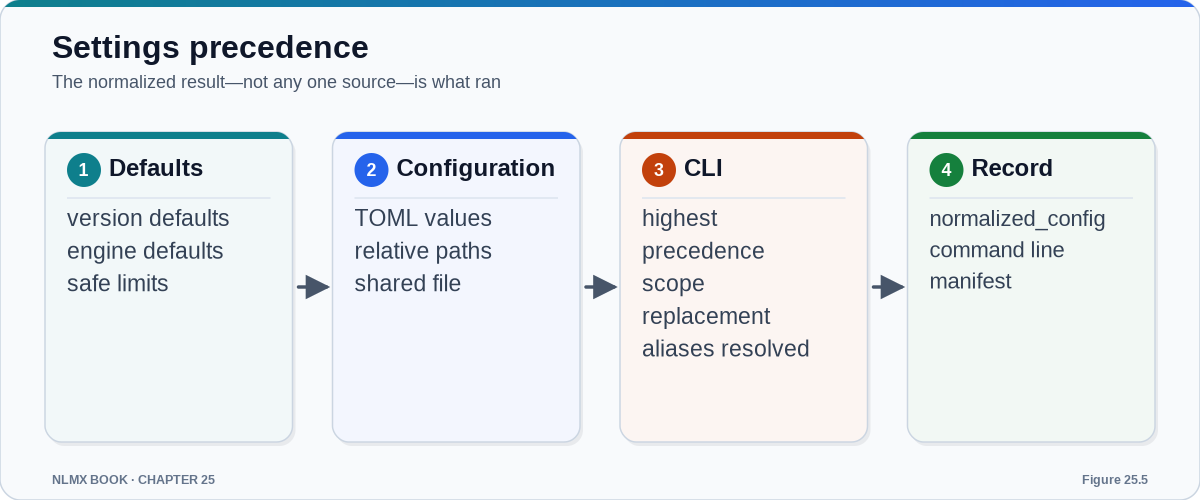
The resolved analysis is layered: compiled defaults, values from the .covar file, then command-line overrides. CLI scope supplied by --covariates replaces the configured scope rather than appending silently. --method, form/type/reference flags, thresholds, resampling controls, seeds, and output switches similarly override their configuration counterparts.
Aliases are normalized: for example --p-forward maps to forward alpha and --p-backward to retention alpha; older form names are translated to current names. Tokens using hyphens or underscores are normalized where documented. Never infer the run from the source configuration alone after adding CLI overrides.
The audit trio is the exact command line, original configuration, and normalized_config.covar. Review the log for override messages. If two aliases conflict, nlmx should reject rather than guess; avoid redundant declarations in any case. For sensitivity analyses, copy or label the changed command and use a fresh output directory so the primary run remains immutable.
Common mistakes
- Changing the scientific question after seeing the result while presenting it as the original run.
- Reading one engine's summary without checking its prerequisites, failures, normalized settings, and fitted endpoint.
- Treating a generated draft, comparison label, or completed checkpoint as a substitute for model diagnostics and reference-software confirmation.
Page checklist
- The exact command, version, inputs, resolved settings, and output directory are identifiable.
- Engine-specific evidence is interpreted on its own scale before cross-method comparison.
- Recovery state, final refit, diagnostics, and remaining confirmation work are explicit.