Post hoc exposure source
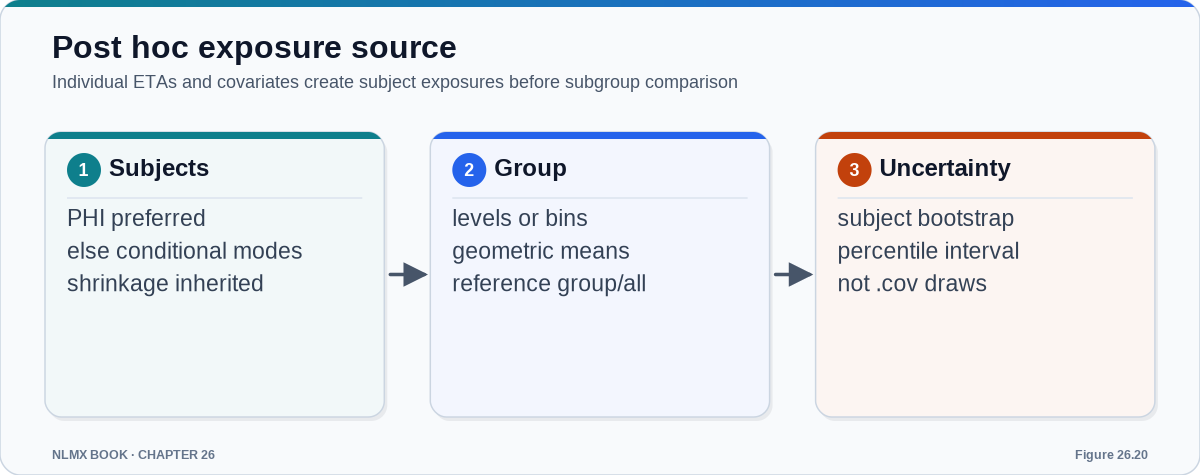
Post hoc mode uses each subject's covariates and individual ETAs from --phi or the fitted stem's PHI; if unavailable, conditional modes are estimated at final parameters. The model simulates each individual's steady-state exposure. Subjects are grouped by the displayed covariate and subgroup geometric means are compared.
Continuous covariates use percentile bins, categorical covariates use levels, and row labels show ranges and n. Intervals come from seeded subject bootstrap replicates controlled by --samples and --ci. The variability row shows individual exposure spread relative to geometric mean.
This analysis can be performed on a base model with explicit --forest-covariates, revealing empirical post hoc subgroup differences even when covariates are absent from model code. Such differences remain descriptive and shrinkage-sensitive, not fitted causal effects.
Common mistakes
- Treating a forest ratio or reference-band class as covariate-selection evidence, causality, or an automatic dosing recommendation.
- Omitting the reference subject, uncertainty source, regimen, subgroup denominator, data support, or fitted-model diagnostics.
- Confusing parameter-uncertainty intervals, BSV ranges, and subject-bootstrap intervals because they share one graphic.
Page checklist
- The numerator, denominator, fitted model, covariate settings, and units are explicit.
- The interval source and clinical meaning are distinguished from BSV and selection uncertainty.
- Tables, resolved settings, commands, diagnostics, limitations, and confirmation evidence are retained.