40.12 Covariate model-building comparison
What you will learn
- Distinguish SCM, score, and posterior-stability questions
- Align equations, thresholds, refits, and failure policy
- Confirm selected relationships in a full model
Prerequisites: Chapter 39 troubleshooting, Chapter 36 command reference, and Chapter 38 output reference.
This page is scoped to nlmx 4.16.2 and an external-documentation snapshot of 2026-11-10. Product names describe different system boundaries; a blank or “outside role” is not a quality ranking. Treat every migration as a new implementation until model semantics, analysis population, objective definition, numerical behavior, outputs, and decisions have been independently reconciled.
PsN SCM implements forward selection and backward elimination by generating and fitting candidate NONMEM models. nlmx method=scm performs its own full refits; it can refit all candidates per step or score-rank and refit a configured top subset. Its frozen engine uses efficient score evidence at the base solution, while the posterior engine uses stability selection on posterior random effects. These are different inferential questions.
Monolix offers classic SCM plus COSSAC and SAMBA-family strategies. COSSAC uses conditional-distribution correlation tests to prioritize relationships, then likelihood/BICc decisions; it is not equivalent to nlmx posterior stability selection. PopED is outside covariate model selection.
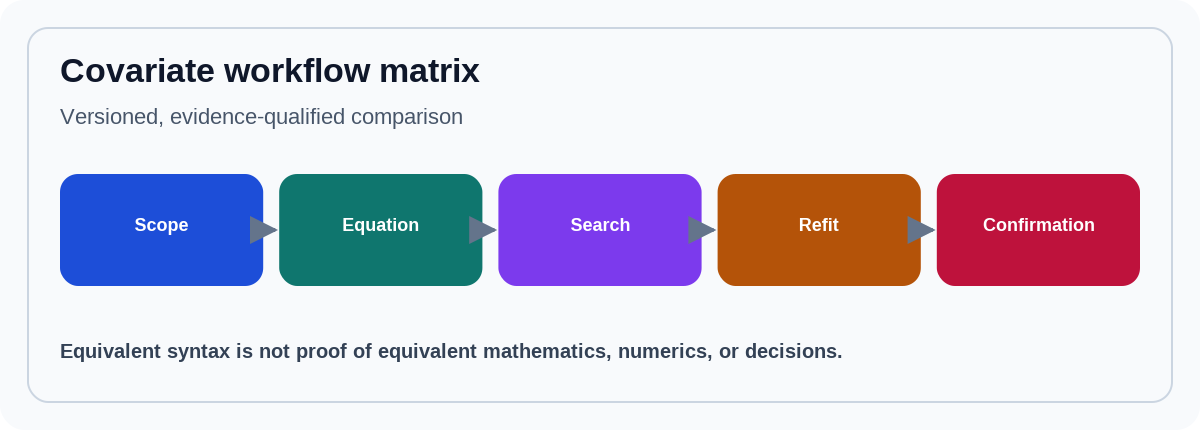
For comparison align candidate scope, continuous/categorical types, reference/centering, missingness, equation forms/states, locked-in/out relationships, forward/backward thresholds, multiplicity, model-failure rules, parameter initialization, estimation/likelihood method, and whether all candidates or a shortlist are refitted.
Compare the complete path: candidate models, OFVs/criteria, failures/retries, chosen relationship each step, backward removals, final refit, and final full-model confirmation. Selection agreement can occur for different reasons; disagreement can occur near thresholds without either implementation being defective.
Path-level comparison table
For every search step store current model, eligible relationships, equation/state, screening score if any, candidate refit status, criterion/ΔOFV/p-value, chosen addition/removal, threshold, and retry/failure disposition. Then compare paths. Two workflows may reach the same final model after different failed candidates or tests; conversely, one near-threshold step can cause divergent downstream models. Final-model agreement alone is therefore weak validation.
Primary source note: Classic PsN SCM behavior comes from the official SCM implementation/help and SCM user guide; Monolix SCM/COSSAC/SAMBA behavior comes from automatic covariate model building.
Review checklist
- Are the exact product versions, task boundaries, inputs, methods, and settings named?
- Were semantics and frozen-parameter results aligned before optimized outputs?
- Is the comparison using a method-appropriate deterministic or stochastic tolerance?
- Are unsupported or analogous features described without implying equivalence?
- Can every claim be reproduced from retained primary evidence?
Navigation
See the previous page, next page, and complete comparison reference.