14.13 AUC to infinity and the extrapolated fraction
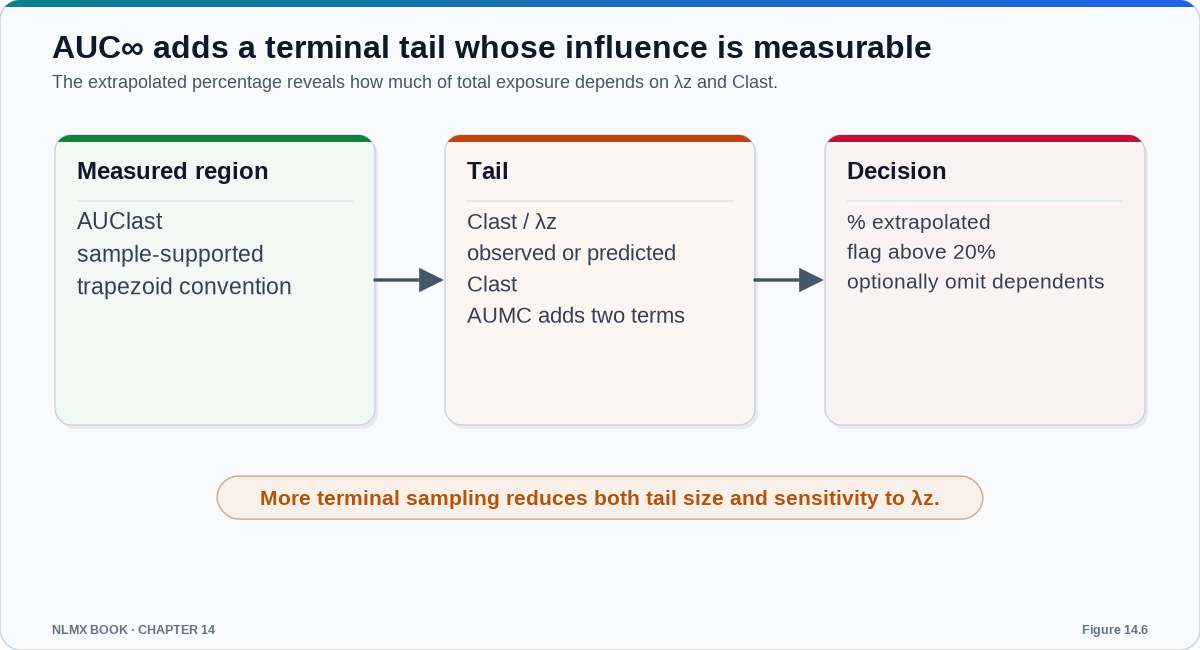
Observed sampling ends at Tlast, but single-dose exposure is often summarized to infinite time. NCA estimates the unobserved tail by assuming the selected terminal log-linear decline continues beyond the last measurable concentration.
AUCinf,obs  = AUClast + Clast / lambda_z
AUCinf,pred = AUClast + Clast,pred / lambda_z
Clast is the observed last positive concentration. Clast,pred is the concentration predicted at the same time by the terminal regression. The two estimates can differ when the last observation lies away from the fitted line. Neither is intrinsically always preferable; the required convention should be stated before comparison with another program.
The extrapolated percentage is
100 × (AUCinf − AUClast) / AUCinf
It reports how much of the total estimate depends on an unobserved mathematical continuation. The default maximum in nlmx is 20%. Exceeding it creates a diagnostic, or can cause dependent infinite-time parameters to be omitted when strict enforcement is configured. A small percentage supports exposure coverage, but does not by itself validate lambda_z; a biased slope can still generate a deceptively modest tail.
What the tail assumption means
The formula assumes a single exponential governs the future decline, no additional input occurs, and the last positive observation belongs to the selected terminal behavior. These assumptions can fail with prolonged absorption, enterohepatic recirculation, multiple peaks, assay truncation, or an inadequately long design. For later dose intervals, extrapolation to infinity is generally not the desired summary because another dose interrupts the hypothetical tail. nlmx flags such use; at steady state, AUC over tau is usually the relevant measure.
Report AUClast alongside AUCinf so readers can distinguish directly supported exposure from extrapolation. Also report lambda_z method, the terminal window, adjusted R², span, and extrapolated percentage. AUCinf without those dependencies is difficult to audit.
Common mistakes
- Dividing the tail by the elimination rate constant from a structural model instead of the NCA lambda_z.
- Calling AUCinf “observed total exposure.”
- Comparing observed-Clast output with predicted-Clast reference output.
- Ignoring a large extrapolated fraction because AUCinf looks plausible.
Checklist
- Identify the observed or predicted Clast convention.
- Reproduce the tail area and percentage.
- Confirm the profile is suitable for extrapolation to infinity.
- Review the configured maximum and enforcement behavior.
- Present AUClast and terminal diagnostics with AUCinf.
Further reading
See terminal half-life, route-specific parameters, and the worked example.