20.38 Retry 1: autoinit mapping into the submitted model
Retry 1 normally starts from estimates obtained by nlmx’s autoinit analysis of the dataset. Autoinit uses dosing, sampling, concentration, and subject information to estimate plausible typical PK values, random-effect variances, and residual-error starts. The retry layer then maps those estimates into the submitted control stream rather than replacing the model with a generated template.
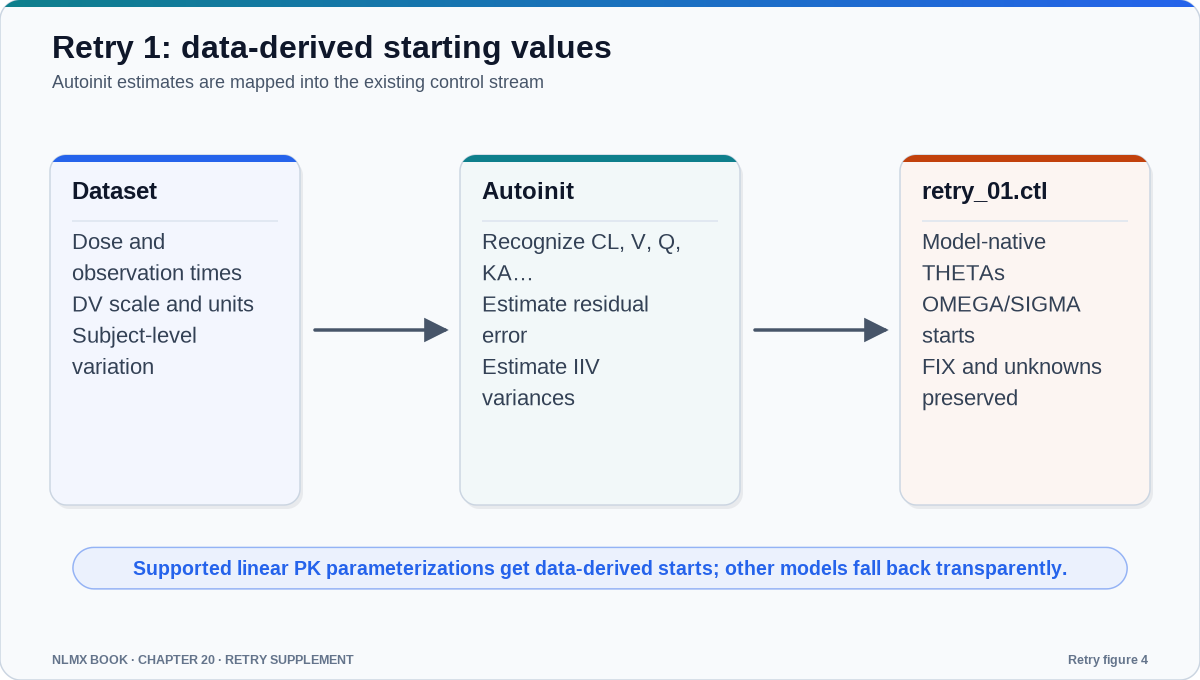
Mapping is based on recognizable $PK relationships and parameter comments. Examples include CL = THETA(1)*EXP(ETA(1)), TVCL = THETA(1), V2 = EXP(MU_2 + ETA(2)), and KA = EXP(THETA(3)). Comments such as “typical clearance” or “proportional error” provide additional meaning. A scale statement such as S2 = V2/1000 helps connect the dose and concentration units.
Autoinit can describe common linear one-, two-, and three-compartment structures implemented with ADVAN1–4, ADVAN11, or ADVAN12 under supported TRANS2/TRANS4 parameterizations. It may map CL, central and peripheral volumes, Q, KA, lag time, bioavailability, IIV variances, and proportional/additive residual errors when recognizable. Parameters it cannot identify retain their submitted values. FIX elements are never changed.
The generated retry_01.ctl contains a header stating that it is an nlmx retry, which attempt it represents, how its starts were produced, the original control stream, and the seed. Its $DATA path is rewritten relative to the retry-control location so the attempt remains executable from its evidence folder.
If autoinit does not support the model—such as a general $PRED, $DES, TRANS1, an unsupported ADVAN, or data that cannot be interpreted with the applicable column mapping—nlmx reports why and uses a bounded random change for retry 1 instead. This fallback is explicit in the transcript and starting_values field; never assume that every retry_01 row is autoinit-based.
Review the mapped start
Compare the submitted and generated THETA, OMEGA, and SIGMA blocks. Ask whether the inferred units and parameter roles are correct. A numerical recovery based on a unit mismatch is not a scientific recovery. Preserve both control streams so reviewers can see exactly what changed.
Get-Content output/retries/retry_01.ctl
Import-Csv output/retries/retries.csv
Common mistakes
- Assuming autoinit recognizes every parameterization.
- Ignoring model scaling and dose/concentration units.
- Believing all parameters are replaced.
- Editing
retry_01.ctlafter the fact without recording the edit as a new run.
Checklist
- Read the transcript’s list of changed parameters.
- Inspect the retry control-stream header.
- Verify scaling, units, parameter roles, bounds, and FIX status.
- Confirm whether autoinit or random fallback was used.
Further reading
See the project’s docs/AUTOINIT.md, Chapter 16 autoinit documentation, and parameter bounds.