16.32 Worked example: intravenous–oral crossover data
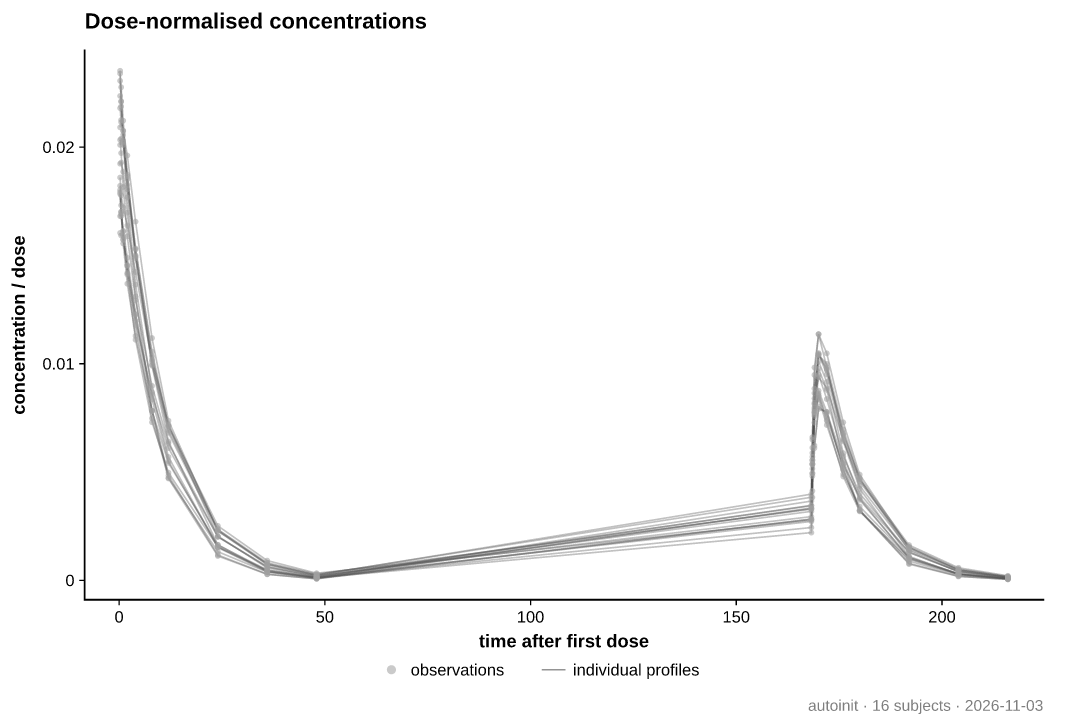
An oral-only dataset identifies apparent clearance and volume, CL/F and V/F, because absolute bioavailability is unknown. A subject who has both intravenous and oral exposure can provide information about F1. This fixture contains 16 subjects, each with intravenous and oral profiles. The generating model uses CL = 5, V = 50, KA = 1.2, and absolute oral bioavailability F1 = 0.6.
Files:
Bioavailability calculation
autoinit estimates F1 as a within-subject ratio of dose-normalised oral AUC to intravenous AUC. The result is 0.597, close to the generating value 0.6. That NCA-derived value is then used by NLS and ML for oral doses. The recommended structural values are CL = 4.991, V = 49.459, and KA = 1.281. Because intravenous information is present, CL and V are labelled without /F in their notes.
This result depends on pairing the correct subject's routes and on the dose, time, and concentration scales being consistent. A period effect, sequence effect, carryover, formulation difference, dose-dependent kinetics, or unrecorded infusion duration can invalidate a simple AUC ratio. autoinit does not estimate a formal crossover statistical model or prove bioequivalence.
Structural caution
The output also contains V1, Q, and V2 from curve stripping of five profiles. Those rows show that a subset met the internal biexponential screen; they do not automatically make a two-compartment model preferable. Here, the data were generated from a one-compartment model, so this is a useful example of why a screening signal must be checked against plots, subject coverage, scientific plausibility, and a later model comparison.
Before copying init_blocks.txt, decide whether the intended model estimates F1, fixes it, or applies relative bioavailability to a specific depot. Confirm that the compartment carrying F1 is the oral depot and that intravenous doses enter the central compartment.
Common mistakes
- Calculating F1 from unpaired subjects or unmatched periods.
- Calling an AUC-ratio start a complete crossover analysis.
- Using CL/F and V/F labels after intravenous data identify the absolute scale.
- Accepting a five-profile curve-stripping signal without structural review.
- Applying F1 to the intravenous compartment.
Checklist
- Confirm every intended subject has correctly labelled IV and oral doses.
- Verify dose-normalised AUCs use compatible units.
- Inspect the F1 source and the number of contributing subjects.
- Review the limited two-compartment signal rather than accepting it automatically.
- Map route-specific dose records to the correct target-model compartments.
Further reading
See route detection, F1 and apparent parameters, curve stripping, and validation limits.