22.12 Continuous power equation
The power model is the default for continuous covariates:
P = TVP × (X / reference)^theta
It is dimensionless, equals one at the reference, stays positive for positive X, and often reflects allometric or elasticity relationships. Theta = 1 gives direct proportionality; theta = 0 gives no effect; negative theta gives an inverse relationship.
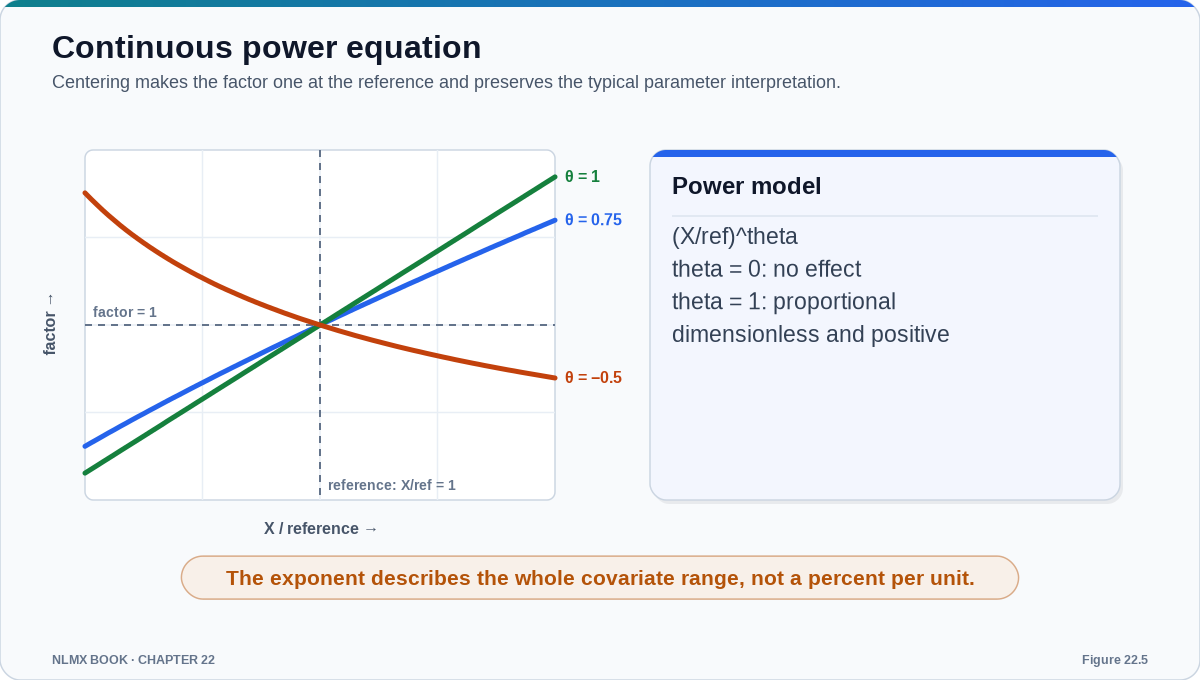
Interpret the exponent through ratios. With theta = 0.75, moving from 70 to 100 kg changes the factor by (100/70)^0.75, not by 0.75 × 30. Report effects across the observed or clinically intended range.
Power equations require positive X because logarithms are used in computation and MU coding. nlmx does not assign a power form to continuous covariates with nonpositive values. Resolve units, zero meaning, and transformation rather than adding an arbitrary constant without scientific justification.
Power and log-linear terminology can be confusing: the equation is linear in log(X/reference) on the log-parameter scale. The draft control stream preserves MU referencing by adding theta × log(X/reference) to MU for exponentially distributed parameters.
Allometric exponents may be prespecified or estimated depending on purpose. A theoretically fixed effect should be encoded as required structure rather than subjected to a broad selection exercise.
Interpreting the exponent at useful values
Do not report a power exponent without translating it. If the WT exponent on CL is 0.75 and the reference is 70 kg, the expected CL ratio at 35 kg is (35/70)^0.75, about 0.59, and at 140 kg it is about 1.68. These ratios describe the typical parameter before ETA, not an individual's measured clearance. Evaluate the equation at prespecified percentiles and clinically important boundaries, propagate coefficient uncertainty, and show the observed covariate distribution. Extrapolation is especially consequential because power curves continue beyond the data. A familiar allometric exponent can be fixed or estimated, but the decision must be distinguished from evidence produced by selection.
Common mistakes
- Reading theta as percent change per unit.
- Applying the power model to zero or negative X.
- Adding offsets solely to make logarithms work.
- Estimating a mechanistically fixed exponent without rationale.
- Extrapolating far beyond the observed range.
Checklist
- Confirm X is positive and units are meaningful.
- State reference and exponent interpretation.
- Calculate ratios at clinical values.
- Decide whether theta is selected, estimated, or prespecified.
- Review extrapolation and MU coding.
Further reading
See exponential and linear forms, positivity, and clinical interpretation.