Reading candidate results
candidate_results.csv is a row-oriented evidence table. Use stable relationship keys to join it with equation definitions and the selection trace. Review parameter, covariate, form, df, score evidence, refit ΔOFV/p, status, selection step, coefficient, and diagnostic fields together rather than sorting one p-value column in isolation.
Statuses distinguish retained, rejected, excluded, forced, uncertain, and failed meanings. A row can contain both fast frozen evidence and refit evidence; identify which engine made the decision. The refit comparison is conditional on the active model at that step. Empty or unavailable values should remain missing, not converted to zero.
Before reporting, check uniqueness at the intended relationship/form level, exact category references, units, and consistency with the final draft. Retain full machine precision in the archive and round only presentation copies. Protect subject identifiers in any detailed derivative tables.
Common mistakes
- Treating a stepwise p-value as clinical importance or causal proof.
- Reading a candidate comparison without its active model, convergence state, degrees of freedom, and exact threshold.
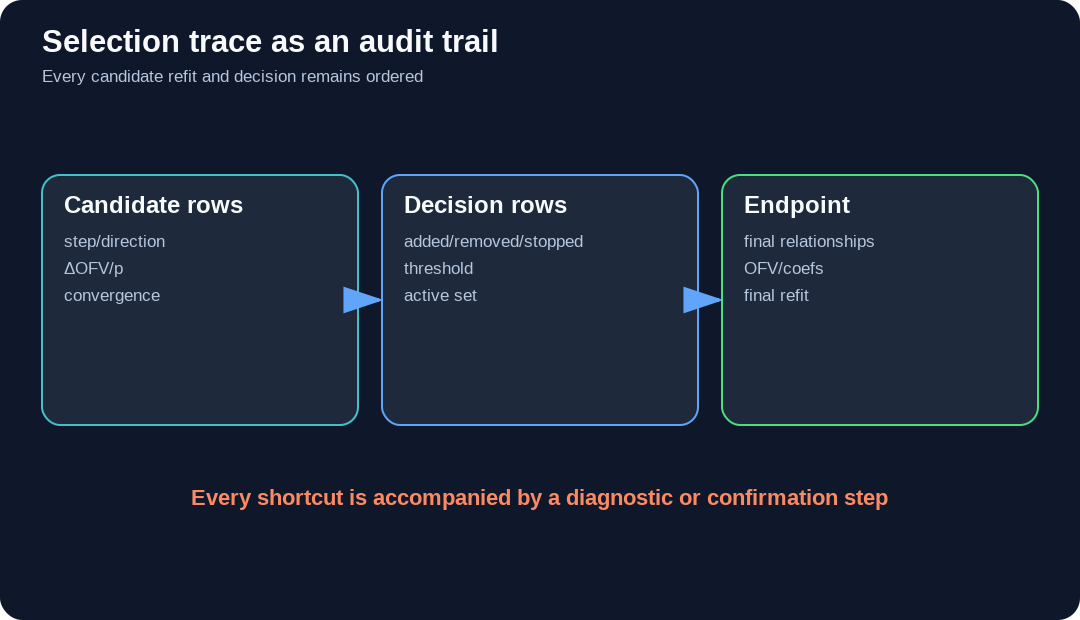
- Reporting only the terminal relationship list while discarding failed models, path decisions, configuration, and provenance.
Page checklist
- The scientific question, model identities, and comparison direction are explicit.
- Numerical validity is reviewed before interpreting statistical evidence.
- The result is linked to the complete trace and final joint-model diagnostics.