29.8 Creating a project from an existing dataset
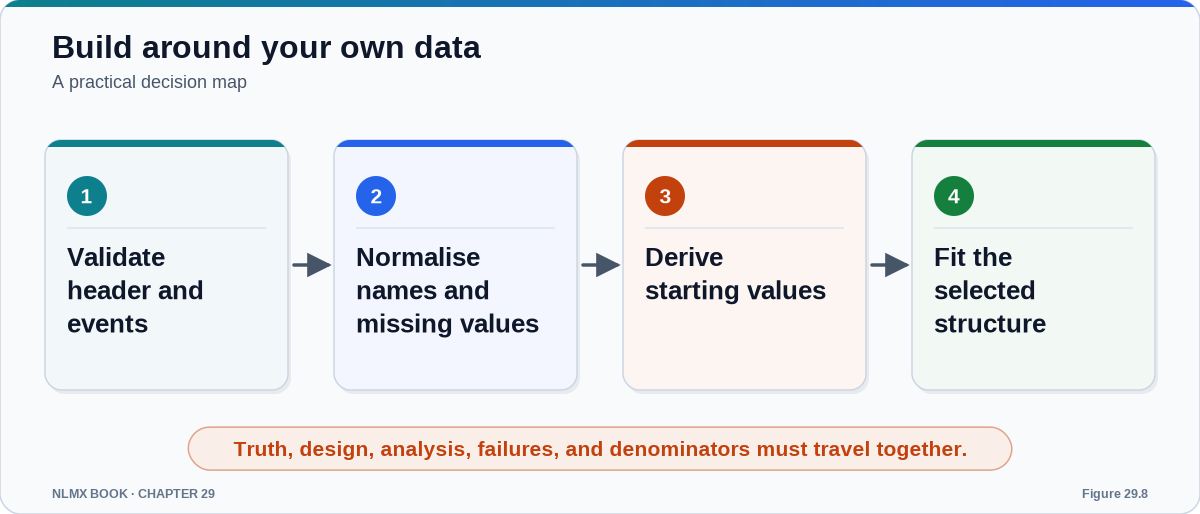
With --data, nlmx requires a header and ID, TIME, AMT, and DV; it infers dose/observation records when EVID is absent and accepts common NONMEM event columns. Names are uppercased and sanitised, duplicates made unique, model-variable collisions renamed, missing values written as ., text covariates DROPped, text IDs numbered with a key, and DATE-like columns removed. The original file is never changed.
Why this matters
The choice on this page changes either the generated truth, the information available to the fit, the analysis decision rule, or the denominator of an operating characteristic. A novice should be able to point to the corresponding setting and output column. A reviewer should be able to trace every aggregate back to a generated project, completed engine run, and relationship-level row.
Detailed behavior
- Starting CL, V, and KA are estimated from subject AUC, terminal slopes, and peak times when possible; explicit
--typicalvalues override them. - Structure checks validate CMT and RATE consistency before fitting.
- Effects without numeric values can be fitted from existing covariates; continuous columns must be positive and complete, while categorical coding must be appropriate.
- Synthetic-only CLI design flags are refused with
--data; comparable settings tables are ignored with a warning.
Keep four layers separate: design truth defines what was generated; realised data contain finite random variation; fitted artifacts estimate the model from those data; and analysis decisions classify relationships under a method and threshold. Mixing these layers is the most common source of incorrect recovery claims.
Example command or settings fragment
nlmx generate --data pk.csv -o project --structure 1cmt-oral --effects 'CL~WT,V~WT' --approximation foce-i
Begin with an inexpensive smoke run, inspect every generated artifact and warning, and only then increase subjects, scenarios, engines, or replicates. Use a new output directory for each analytical run. In a regulated or validation setting, preserve both the command as issued and the resolved settings or generated configuration because defaults and precedence are versioned behavior.
Interpretation and quality control
Read the README and normalised header mapping before trusting the control stream. Units, endpoint semantics, occasions, BLQ likelihood, multiple DVs, and complex model logic remain the analyst's responsibility.
At minimum, verify subject/record counts, truth coefficients and forms, fit convergence, covariance status, relationship scope, classifications, completed denominators, and checksums. Read the row-level result before trusting a scenario metric. A graph is a compact diagnostic view; numerical tables remain authoritative.
Common mistakes
- Assuming nlmx knows dataset units
- Fitting a structure inconsistent with CMT/RATE
- Calling run102 relationships true because they were requested
Also avoid describing a failed or skipped cell as a zero rate. Missing, undefined, failed, rejected, and uncertain are different states and must remain distinguishable.
Evidence to retain
- nlmx version, command, configuration, seed behavior, threads, and runtime environment;
- generated truth/control stream, data, group/design definition, base and optional covariate fits;
- engine settings, relationship scope, row-level results, summaries, metrics, report, failures, and completed denominators;
- checksums, scripts used to regenerate figures, tolerances, acceptance rules, and scoped interpretation.
Navigation
See the previous page, next page, and complete command and settings index.