23.2 What is frozen—and what still changes
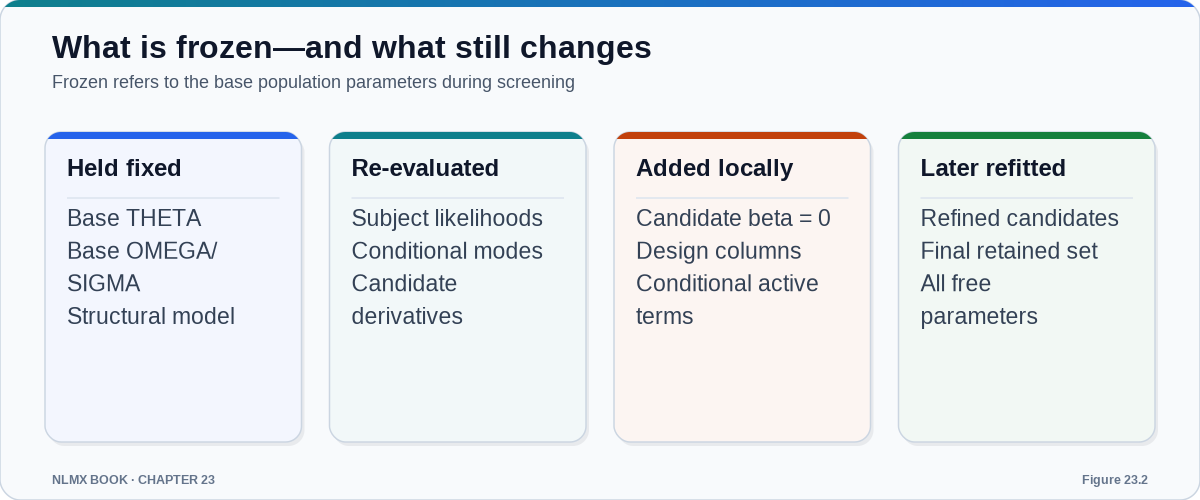
“Frozen” refers primarily to the completed base population parameters during the screening calculation. THETAs, OMEGAs, SIGMAs, the structural model, residual model, and parameter map define the null point. A candidate coefficient is appended at zero. The engine evaluates how the likelihood changes with that new coefficient and adjusts its evidence for directions shared with the frozen nuisance parameters.
Several computations still occur. Subject likelihoods are evaluated under the requested approximation. Conditional ETA modes are found and warm-started from the base modes. Candidate and nuisance derivatives are computed. In conditional selection, coefficients of already active covariate columns form part of the active set, so the question changes after each forward addition or backward removal. Parameter-uncertainty draws can perturb the base point, and refinement or final refitting deliberately releases parameters for optimization.
For a parameter with an exponential ETA, a conventional multiplicative covariate effect corresponds naturally to a shift on the log/ETA scale. A parameter without an ETA can also be screened by inserting its factor after the last assignment. For additive or proportional ETA parameterizations, the implementation shifts the ETA rather than pretending the model is log-normal. These distinctions affect the derivative and must be verified in the generated equation and draft model.
The word “frozen” should never be used to imply that data, subject modes, candidate design columns, or active conditional terms are ignored.
Common mistakes
- Assuming individual ETAs never move during likelihood evaluation.
- Assuming active covariate coefficients remain zero during conditional steps.
- Confusing frozen screening with
MAXEVAL=0evaluation of an already coded effect. - Forgetting that the final joint refit is no longer frozen.
- Applying a log-normal interpretation to an additive ETA without checking code.
Checklist
- Identify frozen nuisance labels in the report.
- Confirm the likelihood approximation and ETA form.
- Inspect how parameters without ETAs receive effects.
- Distinguish screening, refinement, and final-refit stages.
- Preserve the base artifacts used as the null point.
Further reading
Next read the computational advantage and likelihood reconstruction.