F.5 Covariates, posterior stability, resume and forest plots
What you will learn
- Find a short, checked answer to 14 common questions about covariates and forest plots.
- Follow the link after each answer to the page that explains it and shows the evidence.
- Recognise the mistakes that these questions come from, so that you do not make them.
Prerequisites: Chapter 22 is helpful.
Which covariate engine to run, what each one claims, how to resume a long run, and how to read a forest plot without over-reading it.
Commands named on this page: fit, cov, posterior, resume, inspect, validate, forest, simulate-study.
How to read an answer. Each answer restates what the book says, in a few sentences, and ends with Read more: the page that explains it, with its evidence. The answers are short on purpose. When a decision depends on one, open the linked page.
The 14 questions on this page
- What do
covand its relatives need as input? - Which
--methodshould I use? - Does
bothinclude the stepwise method? - Why can the frozen engine drop a relationship that SCM keeps?
- How does the stepwise engine decide?
- What does a selection probability from the posterior engine mean?
- What is the joint final refit, and can I skip it?
- The two engines disagree. Which do I believe?
- What is the difference between
inspectandvalidate? - How do I resume an interrupted covariate run?
- How are missing covariates handled in
cov? - What is the reference subject of a
forestplot? - What does the interval of a
forestplot represent? - Can I use a
forestplot to justify a dose change?
Answers
F.5.1 What do cov and its relatives need as input?
A control stream, a run family from a completed fit (the .ext, .cov and .phi files that share its stem), the dataset, and a .covar settings file that declares the scope. The .covar settings family is shared by posterior, inspect, validate, resume, fit and simulate-study, but the commands do not all use every key, so check the command's own help. A model fitted in NONMEM can go straight in, as long as the family is complete and consistent.
Read more: 4.1 Projects, run families and stems; 22.7 Input artifacts and run-family discovery; 1.2 What is inside: the command map.
F.5.2 Which --method should I use?
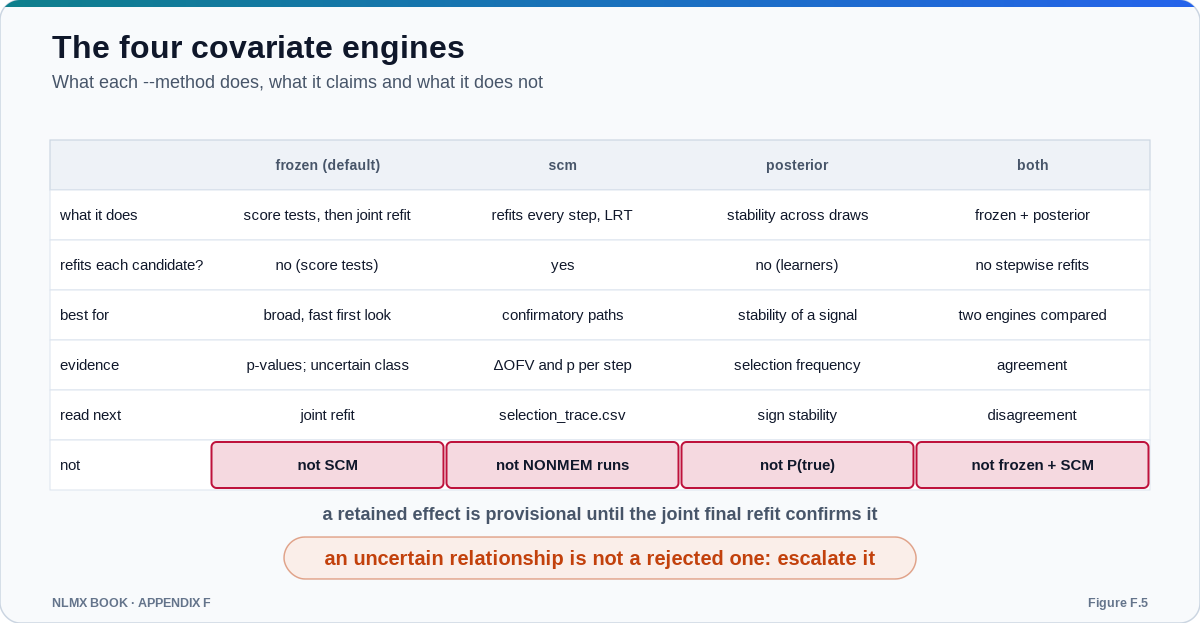
frozen is the default high-speed method (efficient score tests around the base solution, then a joint refit). scm refits candidate models and tests every forward and backward step by likelihood ratio, closer to PsN's stepwise procedure and more expensive. posterior builds stability evidence from posterior information and resampling. both runs frozen and posterior. Match the engine to the claim you need to make.
Read more: 22.23 Method selection map.
F.5.3 Does both include the stepwise method?
No. both is the frozen engine plus the posterior engine. Run scm separately when you need refit-based stepwise evidence, and do not call frozen results SCM because they have forward and backward steps.
Read more: 22.23 Method selection map; 22.27 Both mode and joint final refit.
F.5.4 Why can the frozen engine drop a relationship that SCM keeps?
Frozen selection uses one-step score approximations around the base solution, which are most credible for small effects and a well-fitted base. In the Chapter 22 teaching run, frozen selection retained V–WT but classified the true CL–WT and CL–EGFR signals as uncertain under its strict backward threshold, and SCM refits retained all three. An uncertain relationship is not a rejected one: escalate it.
Read more: 22.24 Frozen score selection; 22.25 Stepwise covariate modelling (SCM).
F.5.5 How does the stepwise engine decide?
Forward selection starts from the base model, refits candidates, adds the one with the smallest p-value below the forward alpha and repeats; backward elimination removes the term with the largest p-value at or above the retention alpha. By default it refits the top three score-ranked candidates per step (--scm-candidates-per-step 3; 0 refits all). It uses nlmx's own likelihood and no NONMEM executable, so the objective differences can differ from PsN's. Read selection_trace.csv, the whole path, not only the endpoint.
Read more: 22.25 Stepwise covariate modelling (SCM); Stepwise covariate selection with cov.
F.5.6 What does a selection probability from the posterior engine mean?
How often a learner selected the relationship under the configured perturbation (posterior draws, subject resampling and learners). It is not a Bayesian posterior probability that the effect is true. It depends on the posterior source, the resampling design, the learner and the threshold, and sign stability is a separate question. Repeat with other seeds when a decision depends on it.
Read more: 22.26 Posterior stability selection; The posterior-stability engine.
F.5.7 What is the joint final refit, and can I skip it?
All methods normally refit the retained effects together, re-estimating the base parameters, which turns provisional coefficients into a coherent model with a final objective. --no-final-refit saves time but leaves provisional values. A retained effect that collapses or reverses in the joint model needs an explanation.
Read more: 22.27 Both mode and joint final refit.
F.5.8 The two engines disagree. Which do I believe?
Neither automatically. Disagreement is informative: it can reflect shrinkage, correlated features, resampling instability or a local approximation. Do not take the union or the intersection by default. Build explicit candidate final models and compare them under the same fitting and diagnostic workflow, then document the decision.
Read more: 22.27 Both mode and joint final refit; 41.23 Case 5: three engines side by side, cheap checks first, and a run that survived an interruption.
F.5.9 What is the difference between inspect and validate?
inspect resolves the artifacts and prints the detected covariate types, levels, references, equations and every candidate relationship; it fits nothing. validate runs the validation pipeline and reports incompatible artifacts, missing covariates, invalid equations and unsupported ranges without completing the selection. Run them before an expensive refit.
Read more: 22.9 Inspect, validate, schema, and resume.
F.5.10 How do I resume an interrupted covariate run?
nlmx resume --run-dir OUTPUT continues supported checkpointed work, and refit caches avoid repeating estimations. The checkpoint stands for the exact computational identity, so resume refuses (exit code 11) after a change of settings, input or random-number derivation, even a tiny one. Start a new run instead. An interrupted run that resumes should equal the uninterrupted one, and Chapter 41 shows the check.
Read more: 22.9 Inspect, validate, schema, and resume; 39.13 Exit code 11: checkpoint or resume incompatibility; 41.23 Case 5: three engines side by side, cheap checks first, and a run that survived an interruption.
F.5.11 How are missing covariates handled in cov?
Before either engine runs, by one policy for both: error (the default), drop_subject or median. Declare sentinel codes such as -99 in missing_codes. Record-level values for screening are completed by last observation carried forward with a baseline backfill; this does not change what $PK reads directly, so write the intended values on the rows if the model uses a time-varying covariate.
Read more: 6.10 Missing-covariate policies and carry-forward.
F.5.12 What is the reference subject of a forest plot?
A covariate vector, not necessarily a real subject: by default the median of the first value for continuous covariates and the most frequent baseline level for categorical ones, evaluated with ETA = 0. [reference] in a .forest file sets explicit values. Changing the reference changes the reported ratios, not the fitted model, so state it in the report.
Read more: 26.5 The reference subject and denominator.
F.5.13 What does the interval of a forest plot represent?
Parameter uncertainty (a 90 % interval by default) around the typical-subject ratio, from covariance-based draws or a bootstrap or SIR parameter file. It is not a prediction interval for future subjects and not the between-subject range, and overlap with 1 is not a formal covariate-selection test. Post hoc exposure intervals come from a subject bootstrap and include the variability of the subgroup.
Read more: 26.13 Point estimate, draw median, and confidence interval; 26.10 Covariance-based parameter uncertainty.
F.5.14 Can I use a forest plot to justify a dose change?
Not by itself. A ratio or a reference-band class is not selection evidence, not causal proof and not an automatic dosing recommendation. Report the reference subject, the uncertainty source, the regimen, the subgroup denominator, the data support and the diagnostics of the fitted model, and flag an extrapolated scenario.
Read more: 26.5 The reference subject and denominator; 22.34 Clinical interpretation and forest plots; 41.24 Case 5: a forest plot, rebuilt by hand.
Review checklist
- Do you match the engine to the claim?
- Do you read the whole selection path, and the joint refit?
- Do you state the reference subject and the uncertainty source of a forest plot?
- Do you start a new run rather than resume after any change?
Navigation
See the previous page, the next page, the overview, and the complete FAQ reference.