inspect: the readable preflight
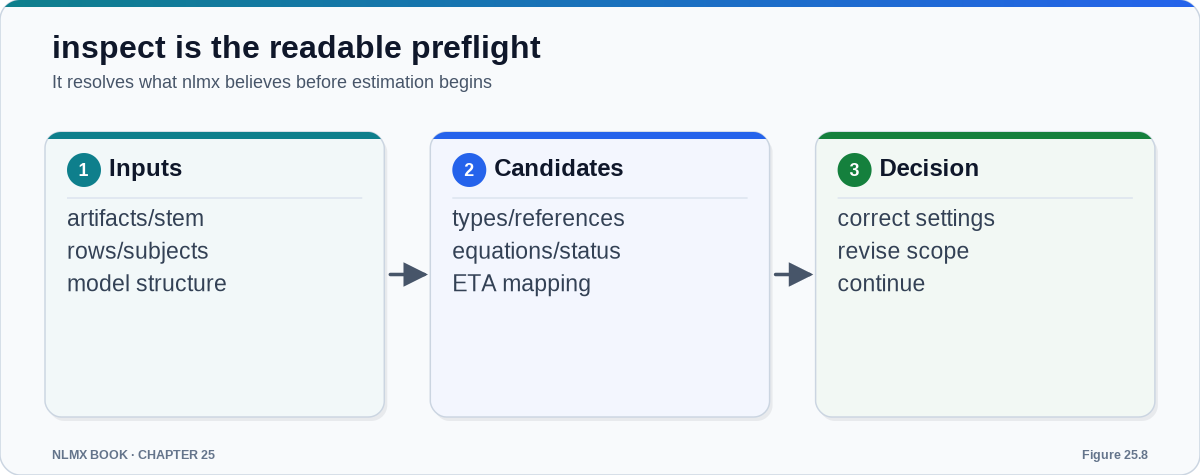
nlmx inspect loads configuration and inputs, parses the control stream and dataset, reconciles artifacts, detects parameter/ETA mappings, infers covariate types and references, constructs candidate equations, and prints the resolved scope. It is the fastest way to catch a wrong stem, mislabeled categorical variable, unexpected reference, missing ETA, or accidental candidate explosion.
Use the same configuration and CLI overrides intended for execution. Read the run stem, control stream, dataset rows/subjects, model/approximation, residual error, base parameters, random effects, covariance/PHI sources, and every candidate key. With multiple forms, confirm the order and comparison rule. With statuses, verify that forced and excluded relationships are labeled correctly.
inspect is read-only analysis preparation; it does not establish numerical stationarity or run selection. Save its console output with the chapter's command, especially when review occurs before a long remote run. Any unexpected inference should be corrected explicitly rather than accepted because the program “found something.”
Common mistakes
- Changing the scientific question after seeing the result while presenting it as the original run.
- Reading one engine's summary without checking its prerequisites, failures, normalized settings, and fitted endpoint.
- Treating a generated draft, comparison label, or completed checkpoint as a substitute for model diagnostics and reference-software confirmation.
Page checklist
- The exact command, version, inputs, resolved settings, and output directory are identifiable.
- Engine-specific evidence is interpreted on its own scale before cross-method comparison.
- Recovery state, final refit, diagnostics, and remaining confirmation work are explicit.