22.36 Complete covariate-analysis checklist and reporting template
Base and objective
- State scientific purpose, intended population, prediction/dosing use, and clinical contrasts.
- Qualify base model convergence, covariance, boundaries, shrinkage, diagnostics, and artifacts.
- Pin nlmx version, command, data/control hashes, method, and seed.
Scope and data
- List every parameter–covariate pair and rationale/status.
- Verify types, units, levels, references, ranges, time variation, and missing codes.
- Prespecify equations, form order, missingness policy, mandatory terms, competitors, and support rules.
- Archive
inspect/validateoutput and normalized configuration.
Method
- Frozen: information, selection mode, adjustment, calibration, thresholds, uncertainty, draws, refinement.
- SCM: direction, candidates per step, p-forward/p-backward, form comparison, refit convergence.
- Posterior: source, draws, resampling, learners, thresholds, sign stability, variance consistency, seed.
- Both: define how agreement/disagreement will be resolved.
Results and confirmation
- Distinguish univariate, conditional, step-specific, stability, and final-refit estimates.
- Review every selection step, uncertainty classification, failed refit, and cache identity.
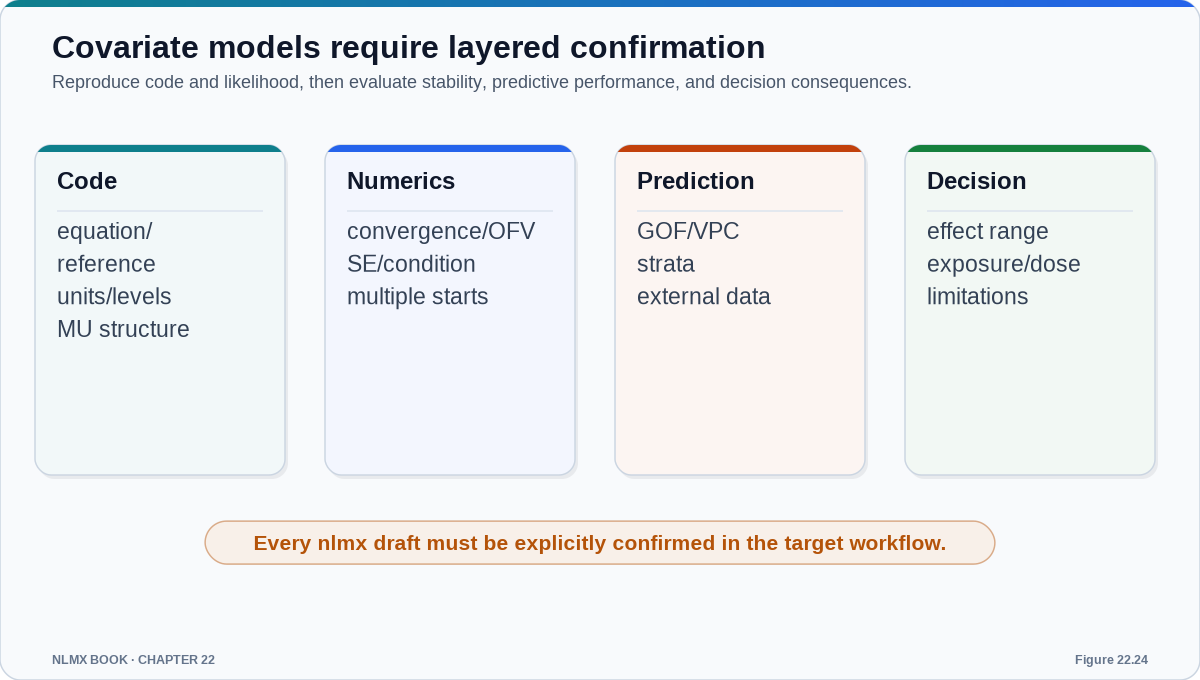
- Refit the retained set and examine OFV, estimates, uncertainty, boundaries, diagnostics, VPC, and sensitivity.
- Translate effects to parameter ratios, exposure/response, dose implications, and observed support.
- Confirm
draft_model.ctlin the target workflow and preserve cross-software tolerances.
Suggested report statement
Covariate relationships were prespecified from biological plausibility and analysis purpose. The resolved scope comprised [N] relationships and [N] equation forms. Selection used [method/settings], with [missingness, multiplicity, uncertainty] rules. The joint final refit retained [effects], produced [OFV/diagnostic summary], and yielded clinically relevant ratios of [results] over [range]. Sensitivity and validation analyses showed [findings]. The model is considered [adequate/limited] for [use], with limitations [details].
Common mistakes
- Reporting only the final retained list.
- Omitting scope, forms, thresholds, or failed steps.
- Presenting screening coefficients as final estimates.
- Ignoring clinical effect and extrapolation.
- Calling the generated draft validated.
Checklist
- Complete every applicable item above.
- Attach machine-readable evidence and exact commands.
- Separate prespecified from exploratory work.
- Obtain independent review for decision-critical models.
- Preserve final decisions, limitations, and confirmation status.
Further reading
Return to the Chapter 22 overview, use the complete command index, and proceed to Chapter 23 frozen-engine theory or Chapter 23A SCM.