39.18 Troubleshooting data from raw file to analysis population
What you will learn
- Inspect the parser's view before the model's view
- Build population and event reconciliations
- Separate data defects from model incompatibility
Prerequisites: Chapter 36 exit-code reference, Chapter 38 output completion, and the Chapter 39 overview.
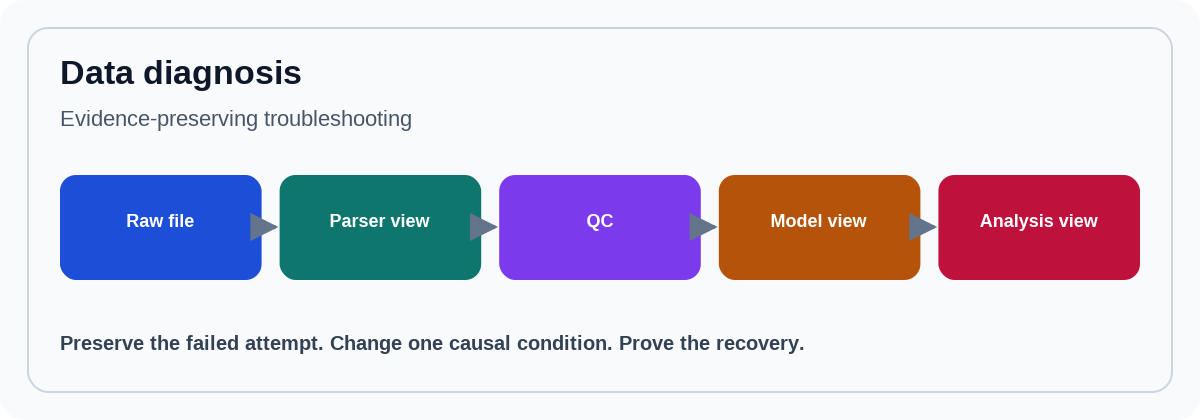
This page describes nlmx 4.16.2. Troubleshooting must preserve the failed attempt: keep its exact command, working directory, log, resolved settings, input/model identities, partial outputs, and process exit code. Correct one causal condition at a time and compare the new evidence with the failed run. Never convert a nonzero exit into success in a wrapper, and never interpret exit 0 as scientific acceptance without the command-native verdict.
Use five views: raw file, parsed table, QC interpretation, model-event stream, and final analysis population. At each boundary record rows, subjects, observations, doses, exclusions, missing/BLQ counts, and key ranges. The first boundary where counts or meanings diverge identifies the responsible layer.
Verify delimiter, quoting, BOM/UTF-8, header, skipped lines, repeated NONMEM headers, Fortran D exponents, and missing tokens. Confirm $INPUT aliases/DROP and $DATA IGNORE/ACCEPT. Then audit ID/TIME order, EVID/MDV, AMT/RATE/CMT, ADDL/II/SS, resets/occasions, DVID, BLQ and units. Plot sentinel subject timelines.
Next trace mutate/filter/distinct/head/select or command-specific exclusions in their documented order. Reconcile baseline versus time-varying covariates and one-row-per-subject assumptions. For every correction, retain source ticket/reason, before/after hashes, row-level audit where permitted, and QC approval.
When only a model fails on otherwise valid data, inspect domain assumptions: positive concentrations for log transforms, nonzero denominators, compartment mapping, and dose units. Do not label the data “bad” merely because one model cannot represent them.
Page checklist
- Did you retain the exact exit code, stage, message, hint, log, and partial output?
- Did you identify one causal layer before changing anything?
- Is the recovery a new, traceable attempt with the same intended estimand?
- Did you check command-native and scientific acceptance after process completion?
Navigation
See the previous page, next page, and complete error reference.