11.3 PASS, WARN, FAIL, COMMENT, N/A and verdicts
Every catalogue check ends with one status. Learn these five words before reading the report.
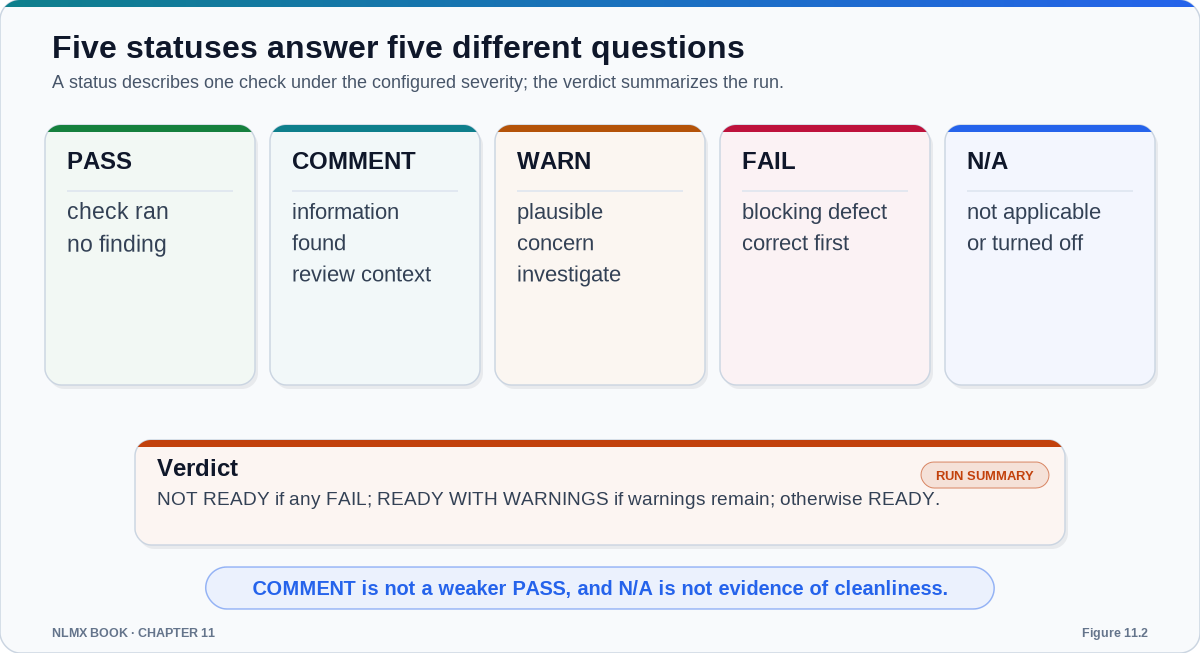
Figure 11.4. Statuses describe individual checks. The run verdict is derived from the worst remaining status.
The five statuses
| Status | Meaning | Beginner action |
|---|---|---|
| PASS | The check ran and found no issue | Confirm it checked the expected scope |
| COMMENT | Informational result, such as used compartments | Read and compare with protocol/model |
| WARN | A suspicious or context-dependent condition | Investigate and document disposition |
| FAIL | A blocking consistency/readiness problem | Correct before analysis |
| N/A | Check did not apply or was turned off | Confirm the reason is legitimate |
PASS is not universal approval. A PASS can have a CHECKED count of zero if the check had no relevant records only when implementation reports it that way; inspect the comment and applicability. N/A is even more explicit: no positive claim was made.
Severity produces status
Catalogue definitions have default severities: error, warning or comment. A finding under an error-severity check makes that check FAIL; under warning it makes WARN; informational checks produce COMMENT. A reviewed [severity] override can change the outcome, and off makes the check N/A. Changing severity changes governance, not the underlying fact.
Some individual hits can carry a check-specific level. Always use the emitted finding level and checklist status rather than reconstructing them from memory.
Verdicts
The overall verdict is NOT READY when any check fails, READY WITH WARNINGS when there are warnings but no failures, and READY when neither remains. Comments do not prevent READY. The verdict is visible in text, JSON and HTML output.
Common mistakes
- Treating COMMENT as a problem that must be removed.
- Treating N/A as equivalent to PASS.
- Downgrading severity only to obtain READY.
- Reading the verdict without checking how many checks were N/A.
Checklist
- Read status, issue count, checked count, comment and action together.
- Review every N/A reason.
- Document every severity override before running QC.
- Resolve failures before warnings.
Further reading
See threshold and severity settings, checklist and findings tables and pipeline exit behavior.