40.21 Workarounds, alternate tools, and honest limits
What you will learn
- Distinguish workaround from implementation
- Assess impact on estimand and evidence
- Write a defensible limitation statement
Prerequisites: Chapter 39 troubleshooting, Chapter 36 command reference, and Chapter 38 output reference.
This page is scoped to nlmx 4.16.2 and an external-documentation snapshot of 2026-11-10. Product names describe different system boundaries; a blank or “outside role” is not a quality ranking. Treat every migration as a new implementation until model semantics, analysis population, objective definition, numerical behavior, outputs, and decisions have been independently reconciled.
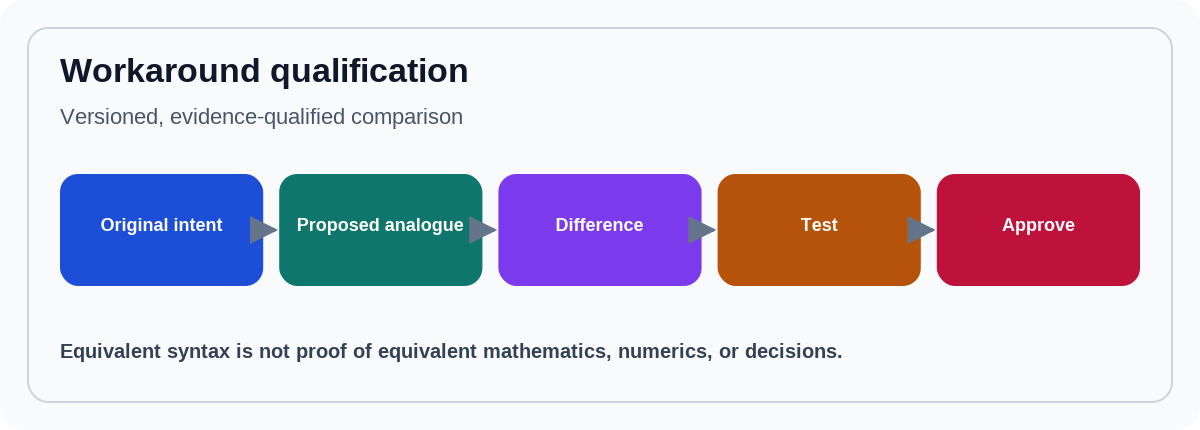
A workaround is acceptable only when it answers the same intended question or the changed question is explicitly approved. Replacing Bayesian estimation with Laplace, full TMDD with Michaelis–Menten, sparse NCA with ordinary individual NCA, or optimal design with a sample-size grid changes the method.
Use a workaround record: original capability/intent; why nlmx cannot execute it; proposed engine/translation; mathematical and population differences; new assumptions; validation fixtures/tolerances; operational handoff; reviewer; and residual limitation. Prefer the tool designed for the task—NONMEM for unsupported NM-TRAN/methods, PsN for an unmatched NONMEM workflow, PopED for optimal-design search, or Monolix for a qualified Mlxtran/SAEM workflow.
Hybrid use is often strongest. nlmx can QC/inspect data/model, another engine can execute an unsupported method, and nlmx can consume compatible tables for selected downstream tasks. Keep producer metadata and do not relabel external outputs as nlmx-native.
Write limits plainly: “nlmx 4.16.2 did not estimate this $MIX model; NONMEM X produced the fit; nlmx was used only for Y after adapter Z was validated.” This is more credible than a broad equivalence claim.
Decision rule for alternate tools
Choose the alternate tool that natively represents the missing mathematical task, then minimize handoffs. Validate inputs at the boundary and archive the adapter. For example, retain a $MIX fit in NONMEM rather than flattening classes; use PopED for optimizing sample times rather than manually screening a few grids; use a qualified sparse-NCA implementation rather than forcing individual NCA. The goal is not to keep every step inside nlmx—it is to preserve scientific intent and evidence.
Review checklist
- Are the exact product versions, task boundaries, inputs, methods, and settings named?
- Were semantics and frozen-parameter results aligned before optimized outputs?
- Is the comparison using a method-appropriate deterministic or stochastic tolerance?
- Are unsupported or analogous features described without implying equivalence?
- Can every claim be reproduced from retained primary evidence?
Navigation
See the previous page, next page, and complete comparison reference.