35.15 Every [limits] setting, CLI option, and precedence rule
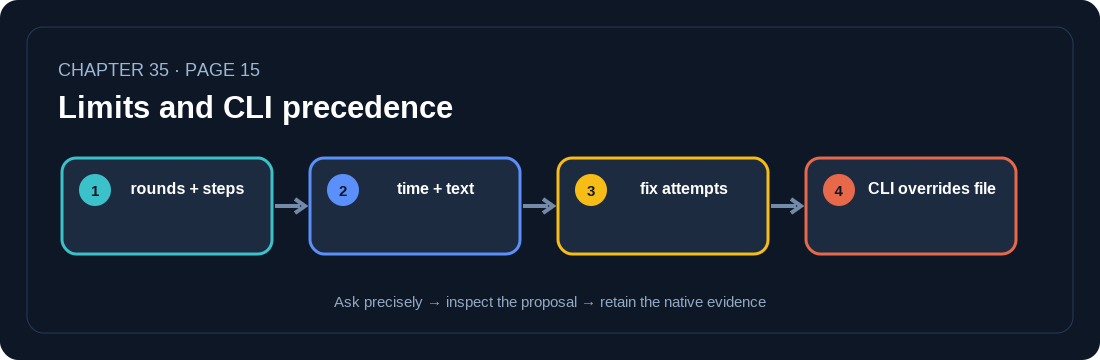
max_rounds=12, max_steps=15, step_timeout_minutes=120, total_minutes=480, result_chars=3500, fix_attempts=2, and manual_chars=3000. These bound loops, runtime, model-facing output, corrections and manual context.
How to use it
Ask-specific CLI: request words; -c; -o; --llm-backend; --llm-model; --llm-gpu-layers; --llm-url; --llm-name; --llm-script; --threads; --yes; --plan-only; --print-config. Logging options include suppression, custom log, color, verbose/quiet and license/help. Command line overrides the file.
Practical interpretation
Shared parser help displays options for other commands; approximation, replicates, exposure, samples, filters and similar are not settings of ask itself. They may appear only inside proposed child commands. --run-dir, overwrite and keep-subject-ids are not ordinary Maxson controls.
Limits, precedence, and completion states
The limit fields protect different resources. Rounds bound model exchanges; steps bound proposed command executions; step timeout bounds one child; total time bounds the request; result characters bound text returned to the model; fix attempts bound corrections; and manual characters bound automatic documentation context. Increasing one does not remove the others. A small result_chars may hide a warning from the model even though the full native output remains on disk.
Command-line backend/model/thread controls override .ask values for that invocation. The resolved session configuration is therefore the record to review. Distinguish outer initialization errors from request outcomes: codes 2–5 describe invocation/configuration/backend failures, while a fully initialized session can finish with outer zero after a declined, refused, failed, questioned, or partially successful request. For automation, assert explicit end-state events, expected step count, child exit codes, and required artifacts.
A safe novice workflow
- Start with the narrowest backend, policy, files and command set that can answer the request.
- Name exact inputs and decisions; use guide or plan-only before granting execution.
- Inspect the normalized command and complete settings file, not only Maxson’s explanation.
- Read request end state, native command result, warnings, outputs and checksums.
- Preserve the session and record the qualified person’s interpretation and disposition.
Review and pitfalls
Choose text limits large enough to retain warnings and small enough for context. Capture exit codes: usage 2, I/O/server 3, config 4, embedded-unavailable 5; child refusals/failures can still leave outer exit 0.
- A session exit code of zero does not prove that every proposal ran or succeeded.
- Model fluency, structured JSON, and policy approval do not establish scientific validity.
- Settings and commands are reproducibility inputs; they still require versioned software and frozen data.
What to retain
Retain .ask, backend/model identity, system prompt, request, raw/normalized replies, transcript, JSONL events, settings versions, commands, child logs/outputs, checksums, exceptions, and reviewer conclusions.
Navigation
See the previous page, next page, and complete ask command and settings index.