Refit convergence, boundaries, and failures
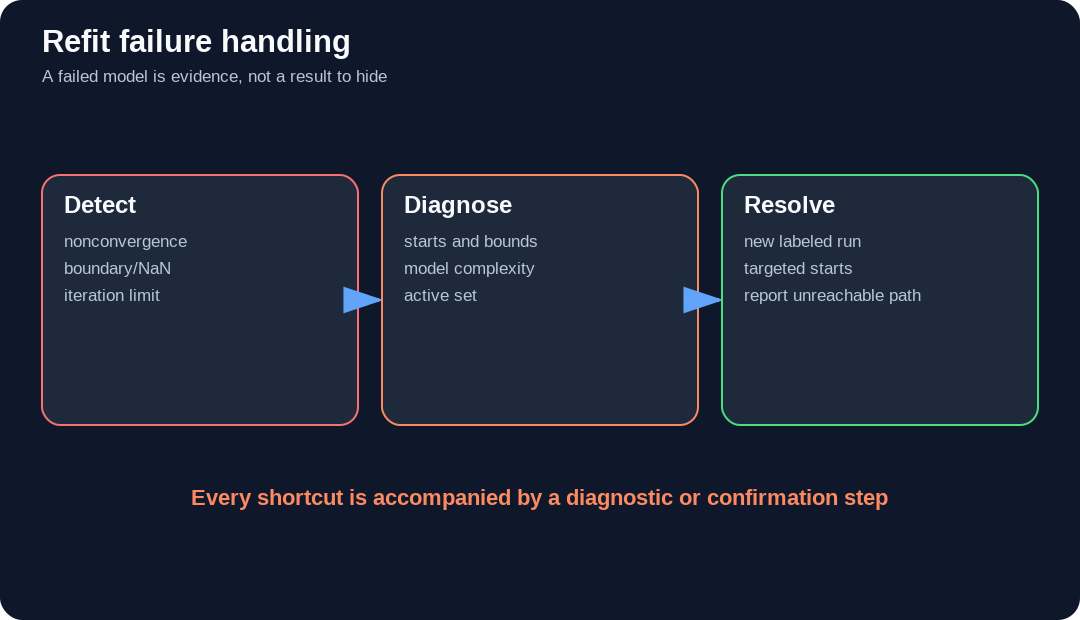
A candidate refit can fail through nonconvergence, invalid likelihood evaluation, a singular information problem, boundary behavior, or exhausting the inner iteration limit. A failure is not equivalent to p=1, and it is not evidence for inclusion. It marks a model comparison that could not be completed under the recorded numerical conditions.
Diagnose model identity first: data, equation coding, reference, active set, approximation, starts, scaling, bounds, and iteration history. Then run targeted, labeled sensitivities. If the result changes only after altering numerical settings, report both the original failure and the justified recovery. Never erase the failed row from the audit trail.
Backward-only deserves special caution because nlmx may proceed from a failed full fit's last iterate. This recovery can identify a simpler estimable model, but the early p-values require qualification. Final selection must be confirmed by a clean joint refit with appropriate diagnostics.
Common mistakes
- Treating a stepwise p-value as clinical importance or causal proof.
- Reading a candidate comparison without its active model, convergence state, degrees of freedom, and exact threshold.
- Reporting only the terminal relationship list while discarding failed models, path decisions, configuration, and provenance.
Page checklist
- The scientific question, model identities, and comparison direction are explicit.
- Numerical validity is reviewed before interpreting statistical evidence.
- The result is linked to the complete trace and final joint-model diagnostics.