23.10 Efficient information and the Schur complement
The full local information matrix can be partitioned into candidate and nuisance blocks. Efficient information is
I* = Iββ − Iβψ Iψψ⁻¹ Iψβ.
The second term is the candidate information explainable by nuisance directions. The result is a Schur complement: information unique to the candidate after nuisance adjustment.
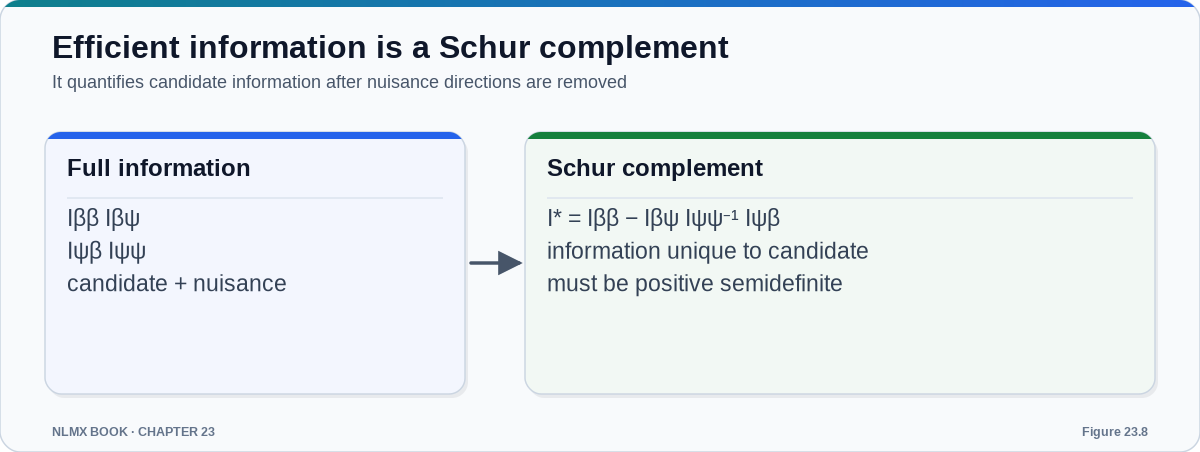
For a well-posed test, I* should be positive semidefinite. Its eigenvalues describe identifiable directions, and its effective rank determines score-test degrees of freedom. A near-zero eigenvalue means a candidate column or combination is poorly distinguished. A negative eigenvalue can arise from incompatible information blocks, noisy finite differences, observed-Hessian behavior, collinearity, or a flawed model map. nlmx does not convert a clearly negative matrix into a persuasive p-value; it reports a numerical failure with diagnostic guidance.
The engine records candidate information, cross-information, efficient information, adjustment fraction, eigenvalues, rank, inverse method, and ridge when detailed matrix output is requested. These are especially important when categories are sparse, spline columns overlap, or several active effects share a covariate.
Candidate-only information uses Iββ without subtracting the nuisance projection. It can remain positive when I* fails, but that does not make it an equivalent replacement.
A geometric interpretation
Imagine the candidate derivative as a direction in a space whose other axes are changes in the base parameters. If part of the candidate direction can be reproduced by changing CL, OMEGA, or another active effect, that part is not unique candidate information. The Schur complement keeps the portion that cannot be explained by those nuisance axes. A large adjustment fraction therefore indicates strong overlap, not automatically a software defect. The question is whether the remaining matrix is positive, sufficiently ranked, and stable. If it is not, a likelihood refit can optimize the coupled directions directly instead of relying on the local projection.
Common mistakes
- Assuming nominal coefficient count always equals effective rank.
- Treating a negative efficient eigenvalue as a minor warning.
- Switching to candidate-only solely to obtain a p-value.
- Ignoring the adjustment fraction.
- Comparing matrices constructed from incompatible likelihood scales.
Checklist
- Review minimum/maximum eigenvalues and effective rank.
- Inspect large nuisance-adjustment fractions.
- Preserve matrix outputs for difficult cases.
- Test finite-difference and information-source sensitivity.
- Escalate failed or rank-deficient candidates to refits.
Further reading
Continue with score statistic and rank stabilization.