30.3 Null and alternative hypotheses
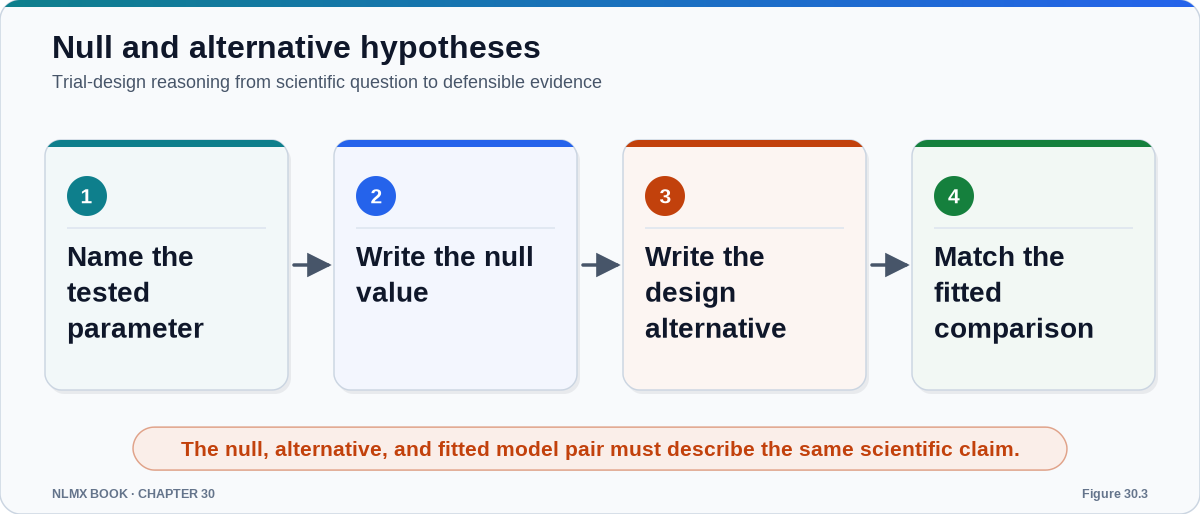
A hypothesis converts a scientific claim into a testable parameter restriction. The null H0 is the value or model treated as insufficient evidence; the alternative H1 is the value or model used to design the study. In covariate modelling, H0 often fixes an effect to zero, but nonzero nulls, equivalence margins, or multi-parameter hypotheses require different restrictions and critical values.
Concepts to keep separate
- Write the parameter and scale explicitly: CL~WT exponent, proportional factor, log effect, or a named THETA are not automatically the same object.
- A simple test has one degree of freedom. A joint test of k independent restrictions generally uses k degrees of freedom and a vector noncentrality.
- The alternative is a design assumption, not a promise about the future dataset. Sensitivity scenarios should include smaller and larger meaningful effects.
- The reduced model must impose the exact null. Fixing an effect at zero when the declared null is 0.3 tests the wrong question.
Terminology matters because a single scenario can contain several denominators and several sources of randomness. Truth is the parameter vector used to generate a replicate. Estimate is the value recovered from that replicate. Design is the planned arrangement of subjects, arms, doses, and observations. Method is the approximation or simulation–estimation procedure used to predict performance. A credible report labels all four.
Mathematical or operational walkthrough
For a power-model relationship CL_i = CL_typ × \(WT_i/70\)^beta, H0: beta=0 means no weight scaling. H1: beta=0.75 is an allometric-like design value. It is not equivalent to a binary 75% change, and its clinical consequence depends on the realised WT distribution.
For novices, read every expression from the inside out: identify the scientific effect, identify the null value, put both on the same parameter scale, identify the variance or information that belongs to the actual design, and only then calculate a test statistic or sample size. Units and parameterisation should cancel in a way that leaves a dimensionless statistic.
How this maps to nlmx
Inspect reference medians and covariate distributions because an exponent can be weakly informed when values cluster near the reference. A hypothesis is about both its coefficient and the design that generates coefficient leverage.
Chapter 30 explains the statistical and implementation concepts. Chapter 31 gives the complete nlmx power command, every CLI and settings control, precedence, output schema, and production workflow. This separation is deliberate: choosing an option correctly requires understanding which estimand and assumption it changes.
Quality-control checklist
- Does the model implement the written parameterisation?
- Does the reduced fit fix the same null value?
- Is the degree of freedom correct?
- Are effect scenarios clinically and statistically justified?
The graph is explanatory; the CSV, JSON, resolved settings, model inputs, and replicate rows are the authoritative evidence. When a plotted point looks surprising, diagnose the underlying rows before changing the design.
Common mistakes
- Writing H1 only as ‘an effect exists’
- Confusing an exponent with a percentage change
- Changing the null after inspecting simulation results
Also avoid copying a sample size from a nearby project. Power is conditional on the model, tested effect, covariate distribution, schedule, residual and random variability, attrition, test, estimator, and success criteria. Similar-looking studies can have very different information.
Evidence to retain
- scientific question, estimand, hypothesis, alpha, target, and criteria;
- model/data/design inputs, parameter source and uncertainty distribution;
- software version, method, approximation, seed, threads, command, and resolved settings;
- scenario grid, row-level results, failures, denominators, intervals, diagnostics, and checksums;
- scripts that calculate derived tables and figures, plus the interpretation and limitations.
Navigation
See the previous page, next page, and formula and decision index.