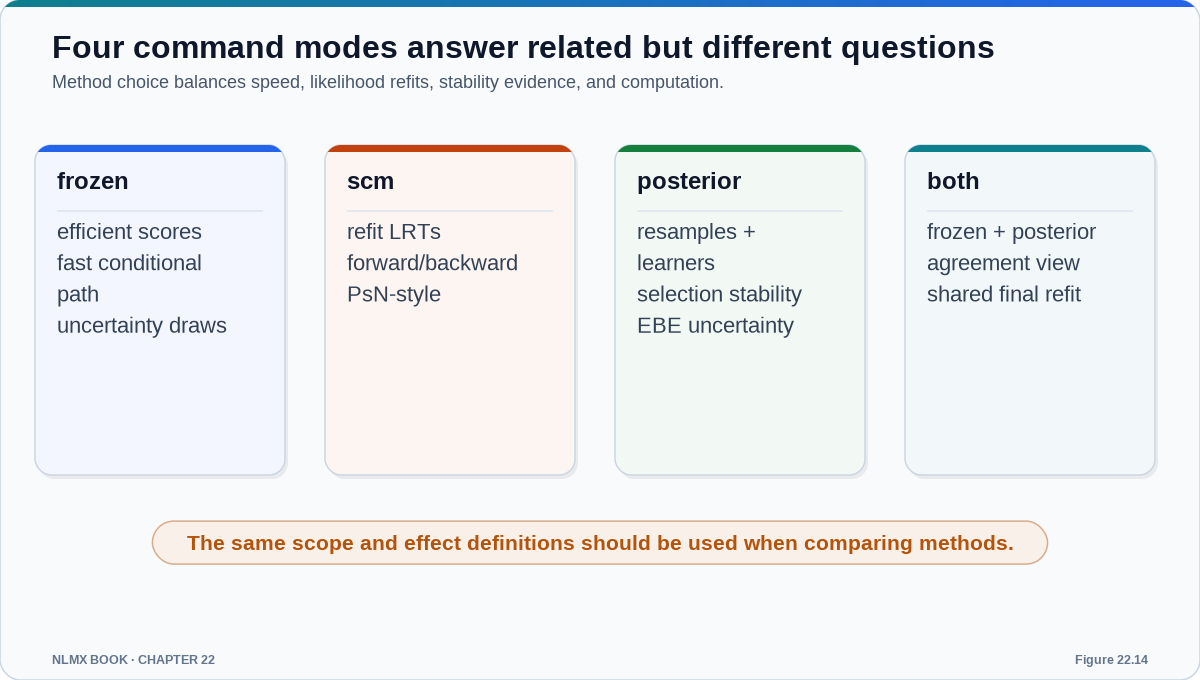
Complete cov command and method index
This index lists the options applicable to nlmx cov in version 4.8.0. The shared CLI may display options belonging to unrelated commands; those are not included.
Invocation, inputs, and scope
nlmx cov -c nlmx.covar
nlmx cov --ctl run101.ctl --covariates "CL=WT,EGFR,SEX;V=WT,SEX"
nlmx cov --model-dir fit/run101 --run-stem run101 --method scm
| Purpose | Options |
|---|---|
| Method | `--method frozen |
| Scope | repeatable --covariates PARAM=COV1,COV2 or semicolon-separated pairs |
| Input discovery | --model-dir, --run-stem, --recursive, --files, --ctl |
| Artifact overrides | --ext, --cov, --cor, --data, --lst, --phi, --table |
| Core | -c/--config, -o/--output, --run-dir, --overwrite, --dry-run, --no-checkpoint |
Covariate declarations and equations
| Purpose | Options/default |
|---|---|
| Continuous forms | --continuous-forms; default power |
| Categorical forms | --categorical-forms; default proportional |
| All standard forms | --all-equations |
| Per-covariate forms | repeatable --covariate-forms COV=FORMS |
| Type override | repeatable `--covariate-type COV=continuous |
| Reference override | repeatable `--covariate-reference COV=value |
| Missing values | `--missing-covariates error |
| Form comparison | `--compare-forms auto |
| Final model | --no-final-refit skips the default joint refit |
Configuration also supports missing_codes, per-covariate missing policies, binary/ordinal form lists, positivity/range/time-varying declarations, categorical levels/minimum counts, and relationship status test, always_include, or always_exclude.
Frozen and SCM controls
--approximation, --refine, --calibration none|permutation|parametric-bootstrap, --calibration-replicates, --information efficient|candidate-only, --information-estimator opg|observed, --nuisance-information observed|from-cov, --selection univariate|hierarchical-conditional|all-joint|refit-scm, --adjust none|bonferroni|holm|bh|by|westfall-young, --alpha, --retention-alpha, --scm-direction forward|backward|both, --scm-candidates-per-step, --max-candidates, --uncertainty, --no-uncertainty, --draws, --fd-rel, --write-subject-scores, and --write-matrices.
--p-forward and --p-backward are accepted aliases for --alpha and --retention-alpha. --selection refit-scm with the frozen method invokes the refit-SCM search; --method scm is the clearer command.
Posterior controls
--posterior-source require-phi|prefer-phi|reconstruct, --allow-point-ebe 0|1, --response posterior-draws|posterior-mean, --draw-method normal|antithetic-normal|sobol-normal, --resampling complementary-pairs|subsample|bootstrap|repeated-kfold, --replicates, --subject-fraction, --draws-per-resample, --base-param-draws, --cv-folds, --threshold, --uncertain-lower, --sign-threshold, --learners, --primary, --max-features, --variance-consistency penalized-matching|moment-correction|none, --write-subject-level, --write-posterior-draws, and --write-replicate-selections.
Supported learner names include adaptive-elastic-net, group-elastic-net, weighted-gls, gam, boosting, and multivariate.
Shared execution and companion commands
| Option | Meaning for a covariate run |
|---|---|
--seed |
Fixes the master random seed used by uncertainty draws, calibration, posterior draws, and resampling. Record it even when a selected method is mostly deterministic. |
--threads N |
Sets worker parallelism. The documented contract is that changing the thread count does not change results. |
--ridge-max VALUE |
Sets the largest permitted matrix-stabilizing ridge. Exceeding the limit is a numerical failure, not a silent repair. |
--strict |
Promotes every warning to an error. This is useful in qualification pipelines after warnings have been understood. |
--run-dir DIRECTORY |
Identifies an existing covariate run directory for resume-oriented workflows. The stored input identity and settings must remain compatible. |
| `--suppress-console 0 | 1` |
--log-file FILE |
Selects the transcript path instead of the generated log_<id>.txt name. |
-v/--verbose |
Increases terminal detail; repeat it to move from informational to debug and trace output. |
-q/--quiet |
Prints only errors on the terminal without reducing the content of the run log. |
--no-color |
Disables ANSI terminal color, useful for captured logs and automated systems. |
--keep-subject-ids |
Prevents subject-ID hashing in subject-level outputs. Use only when privacy and data-handling rules permit it. |
--license |
Prints license, dependency, and contact information, then stops without running the analysis. |
-h/--help |
Prints the executable's command help and stops. Capture this output with the executable version for a frozen interface record. |
| `--format txt | toml |
--no-checkpoint disables posterior replicate checkpoints and therefore reduces recovery options for a long posterior run. --overwrite permits a non-empty output directory; it should be used only when the intended destination has been positively identified. --dry-run executes the validation pipeline without the selection analysis.
Use nlmx inspect to print the resolved scope, nlmx validate to run validation, nlmx resume to continue checkpointed/refit work, nlmx schema for the annotated configuration reference, and nlmx forest to communicate retained effects and exposure consequences. The covariate-specific index above contains all 82 options shown in the version 4.8.0 nlmx cov --help covariate/shared section; options displayed later in the shared help for unrelated commands are intentionally excluded.