41.2 The decision log
What you will learn
- Record an analysis decision as a row: question, evidence, decision, reversibility.
- Distinguish decisions that can be undone from those that cannot.
- Use the log to separate what the data decided from what the analyst decided.
- Keep a log a reviewer can audit against the output folder.
Prerequisites: 41.1 How the case studies are built.
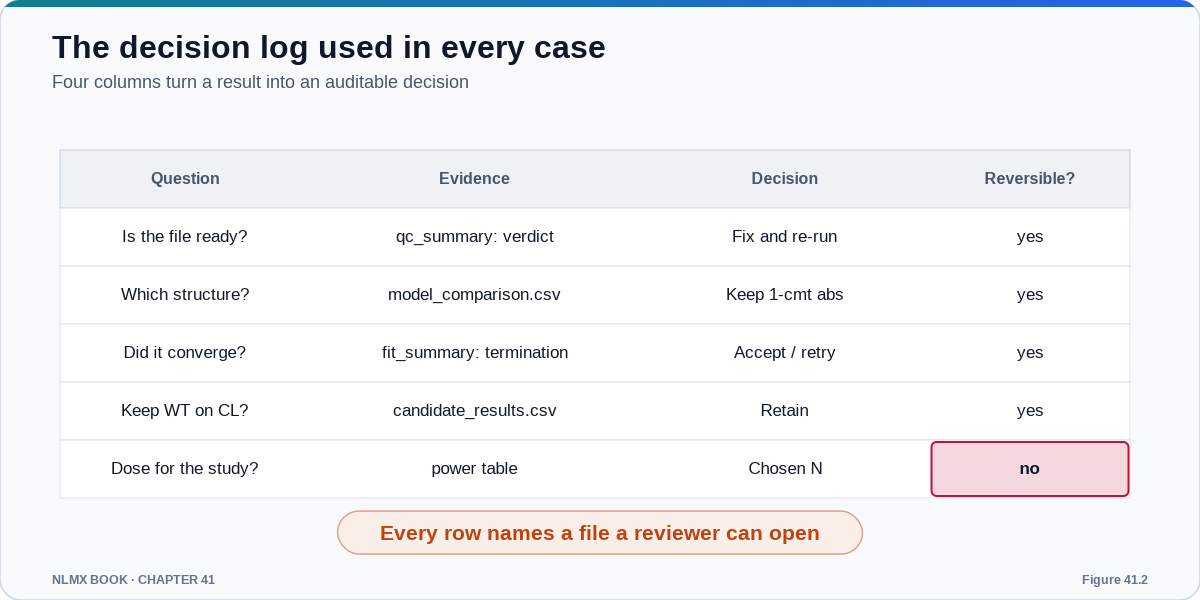
An analysis is a chain of small decisions, and most of the harm in a bad analysis comes from decisions nobody wrote down: a profile dropped because it "looked odd", a structure kept because it was the one already in the template. The decision log is the smallest record that prevents this. It has four columns.
| Column | Question it answers | Example |
|---|---|---|
| Question | What was I trying to settle? | Is the file ready? |
| Evidence | Which file and which value did I look at? | qc_summary.txt, Verdict line |
| Decision | What did I do, in one sentence? | Fixed the four errors at source and re-ran |
| Reversible? | Could I undo this later at low cost? | Yes: the original file is kept |
Reversible and irreversible decisions
Most analysis decisions are reversible because nlmx never changes an input and refuses to overwrite a result without an explicit instruction (Chapter 38.1). A decision is irreversible when it commits something outside the analysis:
- a dose chosen for a study that will be run;
- a sample size fixed in a protocol;
- a model locked in an analysis plan;
- a number quoted in a submission.
Those rows get a second signature in a regulated setting, and in every setting they are the rows to re-read before moving on. The figure marks the dose decision in red: after the power table is used to choose a design, the analysis can be repeated but the study cannot.
A log for the cases
The log below is the one you will fill in as you read the chapter. The first row is completed by Case 1; the others are prompts.
| # | Question | Evidence | Decision | Reversible? |
|---|---|---|---|---|
| 1 | Is the file ready? | qc_summary.txt: verdict and counts |
Case 1 | yes |
| 2 | What are the exposure parameters? | nca_results.csv |
Case 2 | yes |
| 3 | Where does the fit start? | initial_estimates.csv |
Case 3 | yes |
| 4 | Which structure? | model_comparison.csv |
Case 3 | yes |
| 5 | Did the fit converge? | fit_summary.txt: termination |
Case 4 | yes |
| 6 | Which covariates stay? | candidate_results.csv |
Case 5 | yes |
| 7 | Is the model adequate? | VPC tables | Case 6 | yes |
| 8 | Which design? | power table | Case 7 | no |
| 9 | Is response related to exposure? | ER model table | Case 8 | yes |
Writing the "decision" cell well
Three habits make the cell useful months later.
- Say what you did, not what you concluded. "Retained WT on CL" is a decision; "WT is important" is an opinion.
- Say what would have changed it. "Would drop WT if ΔOFV fell below the threshold, or if the posterior check disagreed." A decision with no stated reversal condition is a decision nobody can review.
- Keep the evidence cell a file name. A reviewer who cannot find the file cannot check the row.
The log and the audit trail
The program's own audit trail (transcript, checksum list, input manifest; page 42.13) records what ran. The decision log records why you ran the next thing. The two are complementary, and neither can stand in for the other: a perfect transcript of the wrong question is still a wrong analysis.
Review checklist
- Does every row of your log name a file?
- Is each irreversible row marked and double-checked?
- Can a colleague reproduce each decision from the evidence cell alone?
Navigation
See the previous page, the next page and the complete case-study reference.