A.13 Comparing models: information criteria, weights and the likelihood-ratio test
What you will learn
- Compute AIC, AICc and the three BIC variants of nlmx, and the Akaike-type weights that turn differences into proportions.
- Use the likelihood-ratio test for nested models, with its critical values, and know when its reference distribution is only approximate.
- Compare three candidate structures with all of these at once, and see why they can disagree.
Prerequisites: A.5, A.6 and A.12.
What a criterion does
A model with more parameters always fits the data at least as well (a smaller OFV). A criterion balances the fit against a penalty for the number of estimated parameters \(k\), so that an extra parameter must earn its place. All of them have the form
and are comparable only across models fitted to the same observations with the same likelihood definition (page A.6).
The criteria
| Criterion | Formula (OFV scale) | Penalty per parameter |
|---|---|---|
| AIC | \(\mathrm{OFV}+2k\) | 2 |
BIC, obs (the NONMEM/PsN convention) |
\(\mathrm{OFV}+k\ln N_{\text{obs}}\) | \(\ln N_{\text{obs}}\) |
BIC, subjects (the Monolix convention) |
\(\mathrm{OFV}+k\ln N\) | \(\ln N\) |
| BICc (the default of the screening command) | \(\mathrm{OFV}+k_R\ln N+(k-k_R)\ln N_{\text{obs}}\) | \(\ln N\) for parameters tied to random effects, \(\ln N_{\text{obs}}\) for the others |
Here \(N_{\text{obs}}\) is the number of observations, \(N\) the number of subjects, and \(k_R\) counts the parameters tied to the random effects: the OMEGA elements and the THETAs that carry an ETA. The BICc rests on the idea that a parameter describing a population distribution is informed by the number of subjects, while a fixed effect measured on every observation is informed by the observations (Delattre, Lavielle and Poursat, 2014).
For the exposure–response analyses the criteria are defined on the log-likelihood \(\ell\), with \(k_p\) estimated parameters (including the residual variance for a continuous endpoint) and \(n\) subjects:
with the penalty \(k_p\ln(\text{number of events})\) for a Cox model. The AICc correction is infinite for \(n\le k_p+1\) and matters for small samples: for \(n=40\) and \(k_p=4\) it adds \(2\cdot4\cdot5/35=1.14\).
Differences and weights
With a chosen criterion, define for each candidate \(m\)
The weights are non-negative and sum to one; they describe the relative support for each model within the set that was fitted. The program describes a runner-up with \(\Delta<2\) as practically indistinguishable, \(2\le\Delta<10\) as having positive evidence against it and \(\Delta\ge10\) strong evidence. These are conventions, not tests, and a weight says nothing about a model that was not in the set.
The likelihood-ratio test
For nested models (the reduced one is the full one with parameters fixed at null values),
under the null hypothesis that the extra parameters are not needed. Critical values at \(\alpha=0.05\): 3.84 (\(d=1\)), 5.99 (2), 7.81 (3), 9.49 (4) (page A.5).
When the reference is only approximate. The \(\chi^2_d\) distribution rests on the regularity conditions of page A.12. A test that sets a variance to its boundary value (zero) violates them: under the null the statistic is distributed, for one variance, as an equal mixture of a point mass at 0 and a \(\chi^2_1\), whose 5 % critical value is \(2.71\) rather than \(3.84\). Using \(\chi^2_1\) is then conservative (it rejects less often than its nominal level). Tests that add a fixed effect, or that compare non-nested models, are different again: non-nested models can be compared with a criterion but not with this test.
A worked illustration
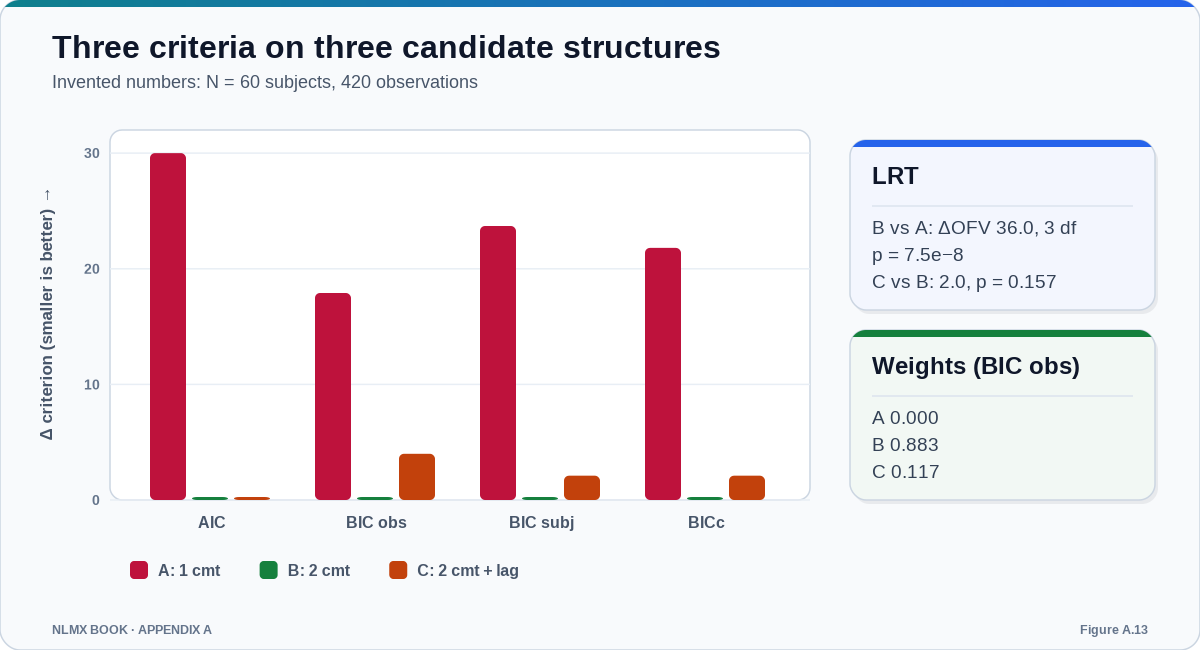
Three candidate structures for the same data — an invented set of numbers to show the arithmetic, with \(N=60\) subjects and \(N_{\text{obs}}=420\) observations (\(\ln60=4.094\), \(\ln420=6.040\)).
| Model | OFV | \(k\) | \(k_R\) | AIC | BIC obs |
BIC subjects |
BICc |
|---|---|---|---|---|---|---|---|
| A: one compartment | 1250.0 | 8 | 5 | 1266.0 | 1298.3 | 1282.8 | 1288.6 |
| B: two compartments | 1214.0 | 11 | 7 | 1236.0 | 1280.4 | 1259.0 | 1266.8 |
| C: two compartments, lag time | 1212.0 | 12 | 8 | 1236.0 | 1284.5 | 1261.1 | 1268.9 |
| Criterion | \(\Delta_A\) | \(\Delta_B\) | \(\Delta_C\) | weights \(w_A,\ w_B,\ w_C\) |
|---|---|---|---|---|
| AIC | 30.0 | 0.0 | 0.0 | 0.000, 0.500, 0.500 |
BIC obs |
17.9 | 0.0 | 4.0 | 0.000, 0.883, 0.117 |
BIC subjects |
23.7 | 0.0 | 2.1 | 0.000, 0.740, 0.260 |
| BICc | 21.8 | 0.0 | 2.1 | 0.000, 0.740, 0.260 |
And the likelihood-ratio tests of the nested pairs: B against A, \(\Delta\mathrm{OFV}=36.0\) on \(d=3\) degrees of freedom, \(p=7.5\times10^{-8}\); C against B, \(\Delta\mathrm{OFV}=2.0\) on \(d=1\), \(p=0.157\).
What the numbers say, and what they do not.
- All criteria reject A. The second compartment lowers the OFV by 36 units for three more parameters, and every penalty is paid several times over.
- The lag time (C against B) is not supported by the test (\(p=0.157\)) and is penalised by every BIC; AIC calls it a tie, because the OFV gain (2.0) exactly equals its penalty (2 per parameter, twice).
- The BIC variants agree on the order and differ on the margin (\(\Delta_C\) of 4.0 against 2.1): the choice of \(N\) or \(N_{\text{obs}}\) in the penalty matters for borderline terms. A conclusion that depends on which BIC is used is a conclusion that is not firm.
- The criteria say nothing about whether any of them is adequate: that is for diagnostics, predictive checks and the precision of the estimates (Chapter 21; Chapter 41, page 41.11).
Common mistakes
- Comparing OFV or any criterion between data sets, different observation sets, or different likelihood definitions.
- Using the likelihood-ratio test for non-nested models.
- Reading a weight as a probability that the model is true: it is relative support within the fitted set.
- Selecting by a criterion alone when the winner has an imprecise or ill-conditioned parameter.
Review checklist
- Can you compute AIC and the three BIC variants for a model from its OFV, \(k\), \(N\) and \(N_{\text{obs}}\)?
- Can you turn a set of criterion values into weights?
- Do you know the critical values of the likelihood-ratio test, and when its reference distribution is only approximate?
- Can you say why two criteria can disagree about a borderline term?
Navigation
See the previous page, the next page and the mathematical reference.