23.7 The candidate score vector
Let β denote the coefficient or coefficient block of a candidate relationship. At the null model, β = 0. The score is the first derivative of log likelihood:
Uβ = ∂ℓ(β, ψ)/∂β |β=0, ψ=ψ̂
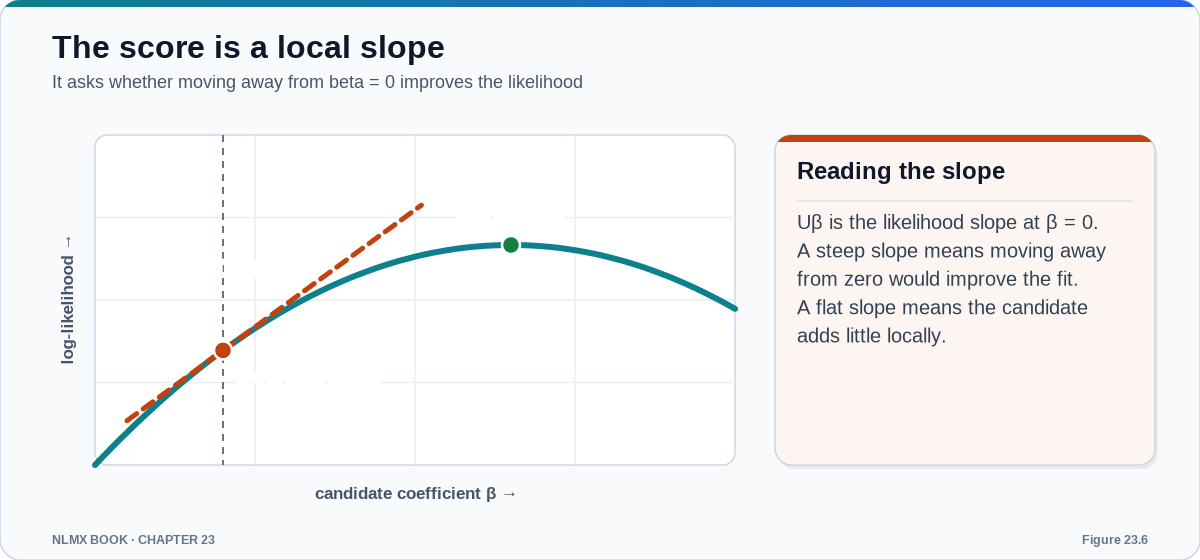
where ψ contains base nuisance parameters and any active covariate coefficients. Intuitively, the score is the local uphill direction: a positive component favors movement in one direction, a negative component favors the other, and a value near zero indicates little local slope.
A score alone is scale-dependent. A value of 10 can be weak when information is enormous or strong when information is small. It must be standardized by efficient information. A multi-level categorical relationship yields several score components and must be evaluated as a block rather than by selecting the most favorable level after inspection.
nlmx computes derivatives numerically within its likelihood reconstruction. It stores the raw score and the nuisance-corrected efficient score. The two differ when the candidate direction overlaps base-parameter directions or the base solution has residual nuisance score. Conditional selection recomputes the score after active effects are added, so a candidate's conditional result can differ substantially from its univariate result.
The score is local. Large true effects can create curvature that makes the first derivative and one-step coefficient an imperfect description of the refitted optimum.
Common mistakes
- Comparing raw scores from differently scaled equations.
- Reading score sign without checking equation coding and reference.
- Testing category columns separately and cherry-picking a level.
- Assuming the univariate score remains valid after another effect enters.
- Treating a near-zero slope as proof of global model equivalence.
Checklist
- Identify candidate dimension and coding.
- Confirm coefficient zero represents the intended null.
- Use efficient information for the statistic.
- Distinguish raw, univariate efficient, and conditional scores.
- Refit large or decision-critical effects.
Further reading
Next read nuisance parameters and efficient score.