24.11 Standardization, zero variance, and redundancy clusters
Continuous columns are standardized so learner penalties operate on comparable scales. Robust scaling reduces sensitivity to extreme values. A zero-variance column contains no selection information and is dropped when screening is enabled.
Highly correlated columns targeting the same ETA are connected when absolute correlation reaches the configured threshold, default 0.85. Connected features form a redundancy cluster. EGFR and creatinine clearance are a classic pharmacometric example: resamples may alternate between proxies even though renal function is consistently important.
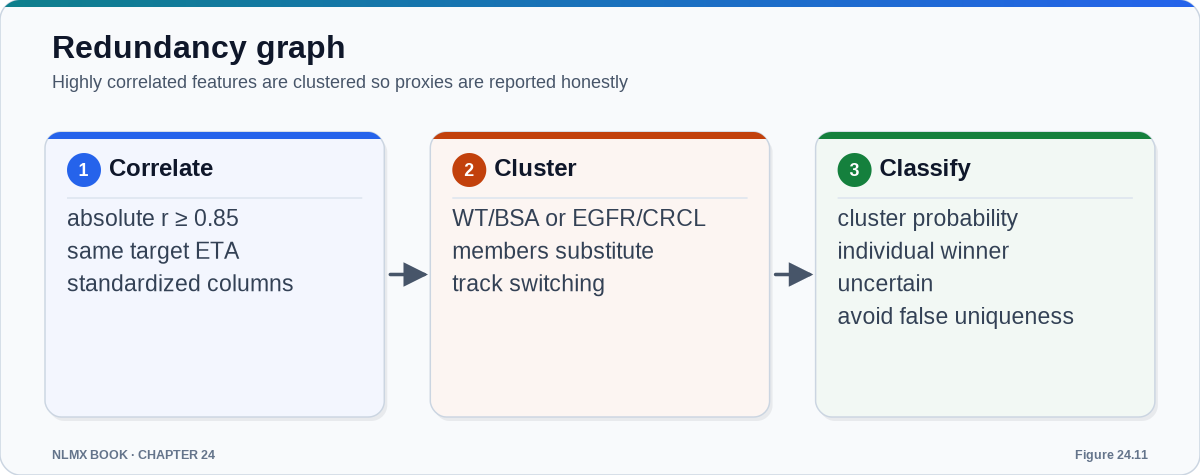
Cluster probability can be high while no individual member reaches the retention threshold. nlmx then reports ambiguity rather than claiming a unique winner. cluster_switching.csv records substitutions. Scientific choice should consider mechanism, assay quality, missingness, transportability, and clinical usability—not only a small probability difference.
Common mistakes
- Treating standardized coefficients as raw clinical effects.
- Ignoring a dropped zero-variance feature.
- Declaring one proxy uniquely causal because it wins slightly more often.
- Building clusters across unrelated target ETAs.
- Changing the correlation threshold after seeing preferred winners.
Checklist
- Record scaling and cluster threshold.
- Inspect correlation and subject support.
- Review cluster and member probabilities together.
- Report switching and proxy ambiguity.
- Adjudicate proxies with scientific criteria and refits.
Further reading
See cluster switching and feature construction.