24.16 Base-parameter uncertainty and probability swing
When posterior_sampling.include_base_parameter_uncertainty = true, nlmx draws base parameters from .cov and repeats stability units across those perturbations. --base-param-draws controls the number. This layer asks whether selection probability depends strongly on uncertain base population parameters.
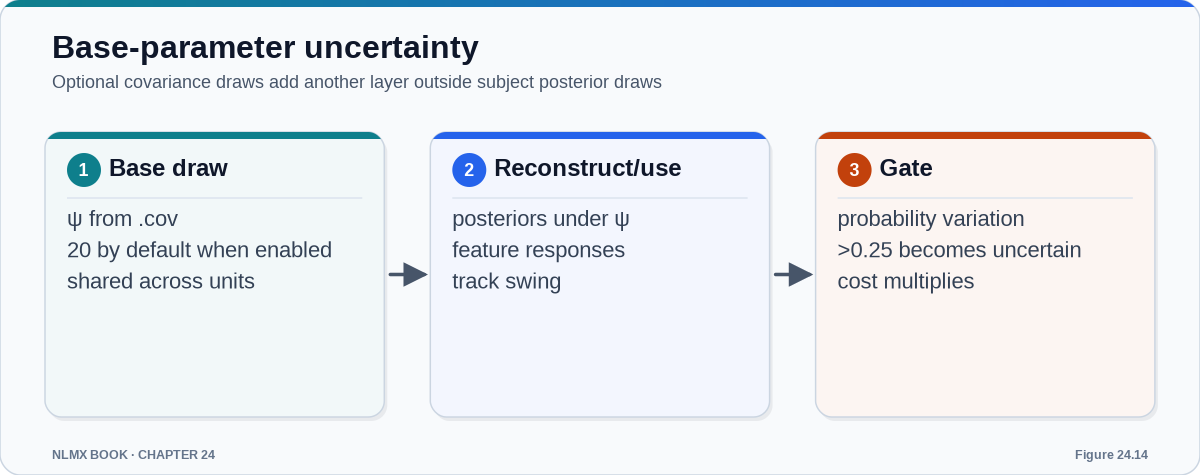
The classification gate considers probability swing across base draws; a swing larger than 0.25 can make an otherwise stable relationship uncertain. Cost can multiply substantially, so use enough draws to distinguish real sensitivity from Monte Carlo noise. The covariance must be qualified, aligned, and admissible.
This is distinct from drawing subject ETAs: base draws move population parameters shared by subjects, while posterior draws represent subject-specific uncertainty conditional on a base.
Common mistakes
- Confusing base draws with posterior ETA draws.
- Enabling base uncertainty with an incompatible
.cov. - Using too few base draws to estimate probability swing.
- Ignoring increased checkpoint/storage/runtime requirements.
- Treating a stable probability as a final coefficient CI.
Checklist
- Verify covariance identity and conditioning.
- Record base draw count and seed.
- Review probability by draw and maximum swing.
- Budget multiplied learner fits.
- Escalate sensitive relationships to likelihood analysis.
Further reading
Compare Chapter 23's frozen uncertainty propagation and continue to resampling.