17.1 Why structural screening matters
A structural model describes the main paths by which drug enters, distributes through, and leaves the body. If this foundation is wrong, later covariate searches can explain structural misspecification with spurious relationships. A one-compartment model may turn a genuine distribution phase into residual error; an omitted absorption delay may inflate variability in KA; linear clearance may fail across a dose range when elimination saturates.
Screening makes a finite comparison reproducible. nlmx screen prepares one analysis dataset, constructs named candidates, fits each under shared assumptions, records failures, applies the same eligibility rules, and ranks only the candidates that remain. This is faster and less error-prone than copying control streams by hand, but the scientific problem still belongs to the analyst.
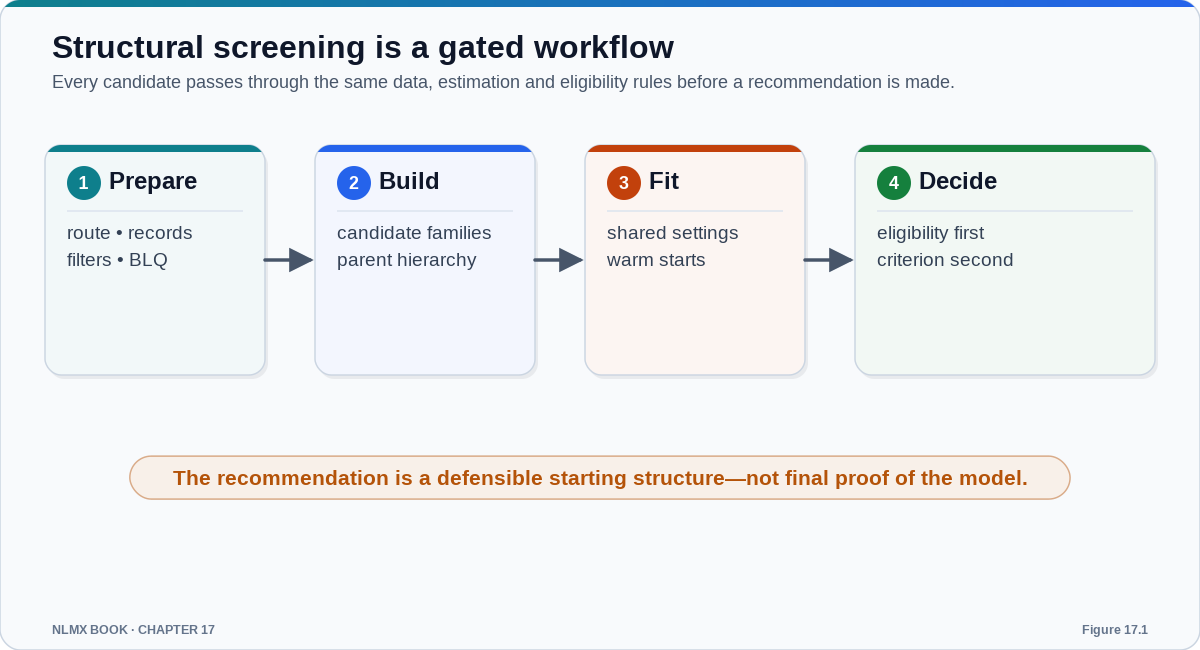
The essential discipline is to separate four questions. Is the candidate scientifically plausible? Was it fit to comparable data and likelihood assumptions? Is its numerical result reliable enough to compare? Among the reliable candidates, which predeclared criterion supports the best balance of fit and complexity? A low OFV answers only part of the third and fourth questions.
The screen recommendation is therefore a base-model proposal. Continue by reviewing parameter plausibility, uncertainty, goodness-of-fit plots, individual predictions, residual patterns, shrinkage, and sensitivity to reasonable settings. A complex model can win because it follows noise; a simple model can win because the design lacks early or late samples. Neither outcome proves biology.
Common mistakes
Do not treat every generated model as equally meaningful, change the criterion after seeing results, compare candidates fitted to different observation sets, or report the recommended name without its warning flags. Avoid an enormous “try everything” set: multiplicity and numerical failures make the result harder, not easier, to defend.
Checklist
- State the scientific uncertainty that the candidate set addresses.
- Freeze data, likelihood, error model, and selection rule before fitting.
- Inspect eligibility before criterion values.
- Carry the full evidence bundle into review.
- Treat the winner as a hypothesis for diagnostic confirmation.
Further reading
Continue to your first run, comparison criteria, and validation boundaries.