23.23 Selection modes and the question each answers
--selection changes the inferential question, not just the output layout.
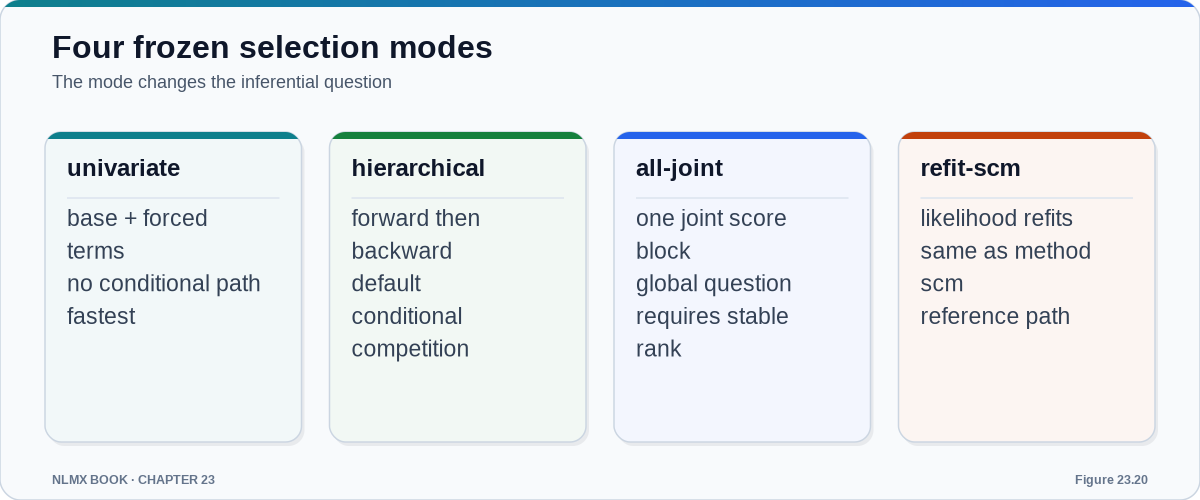
univariateevaluates each relationship against the base plus always-included effects. It is fast and useful for screening summaries, but it does not resolve correlated candidates.hierarchical-conditionalis the default. It performs conditional forward inclusion followed by backward retention using score evidence.all-jointforms one joint score block for the testable candidates. It answers whether the candidate family contains signal as a whole and requires stable joint rank; it is not a term-by-term final model.refit-scmperforms the refit-based stepwise search also exposed more clearly as--method scm. It is much more expensive and is treated in Chapter 23A.
The primary mode should be specified before seeing results. Univariate results remain useful diagnostics under a conditional primary analysis, but they should not override the conditional path. All-joint significance does not identify which relationship to retain. Refit-SCM p-values are likelihood-ratio evidence and should not be labeled score tests.
Common mistakes
- Choosing a mode according to which one retains more terms.
- Calling univariate screening conditional selection.
- Interpreting an all-joint p-value as evidence for every candidate.
- Mixing score and likelihood-ratio p-values in one unlabeled column.
- Assuming
refit-scmhas frozen-engine speed.
Checklist
- State the primary selection mode and scientific question.
- Preserve univariate evidence as supporting diagnostics.
- Review joint rank for
all-joint. - Label refit-SCM evidence distinctly.
- Use separate outputs for mode sensitivity analyses.
Further reading
Continue with forward inclusion, backward retention, and Chapter 23A.