39.9 Exit code 7: data validation failure
What you will learn
- Trace parsing, roles, events, filters, and analysis population
- Distinguish source correction from declared handling
- Quantify every exclusion or transformation
Prerequisites: Chapter 36 exit-code reference, Chapter 38 output completion, and the Chapter 39 overview.
This page describes nlmx 4.16.2. Troubleshooting must preserve the failed attempt: keep its exact command, working directory, log, resolved settings, input/model identities, partial outputs, and process exit code. Correct one causal condition at a time and compare the new evidence with the failed run. Never convert a nonzero exit into success in a wrapper, and never interpret exit 0 as scientific acceptance without the command-native verdict.
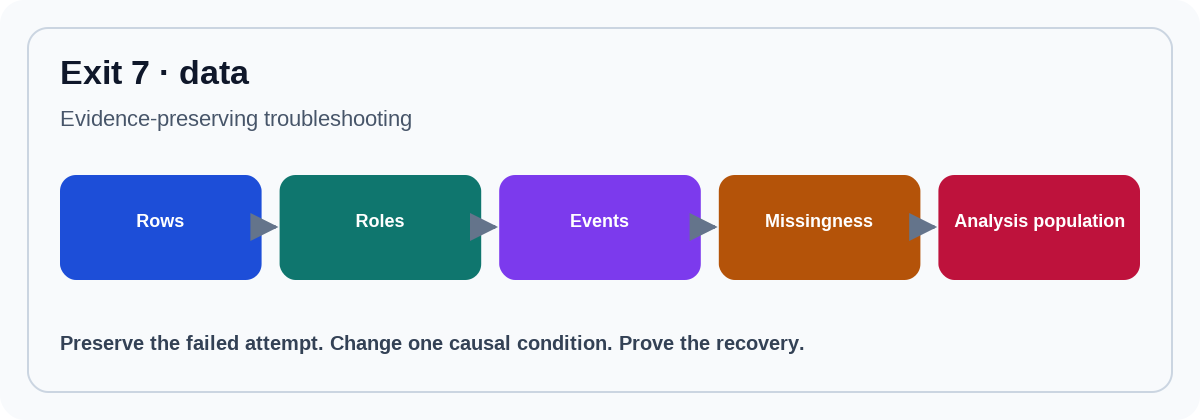
Exit 7 means input content cannot support the requested interpretation. Start at the raw bytes and move forward: delimiter/header/encoding, $INPUT aliases and DROP, numeric/missing tokens, required roles, subject blocks/order, event semantics, filters/mutations, covariate policy, then command-specific eligibility.
A “missing column” may be a wrong delimiter or skipped header rather than an absent variable. “No observations” may result from MDV/EVID mapping, IGNORE/ACCEPT text-versus-numeric comparison, DVID/CMT selection, or filters. Invalid doses can involve AMT, RATE, ADDL, II, SS, reset records, or compartment meaning. Repeated rows can be valid longitudinal data but invalid one-row-per-subject E-R input.
Never change values directly in a derived run folder to make the error disappear. Correct verified source errors upstream with traceability. For legitimate missingness, BLQ, or population restrictions, use a prespecified option/settings policy and retain the mutated/excluded-row evidence. Quantify original rows/subjects, retained observations, each exclusion reason, and analysis population.
Run qc-data and command-specific validation before expensive estimation. Visually inspect sentinel subjects and event timelines, including first/last subject, multiple dosing, infusion, steady state, resets, BLQ, and missing covariates. A successful parser does not prove pharmacometric correctness; compare units, ranges, and dose/concentration timing with the data specification.
Page checklist
- Did you retain the exact exit code, stage, message, hint, log, and partial output?
- Did you identify one causal layer before changing anything?
- Is the recovery a new, traceable attempt with the same intended estimand?
- Did you check command-native and scientific acceptance after process completion?
Navigation
See the previous page, next page, and complete error reference.