Shared scope, equations, statuses, and competition groups
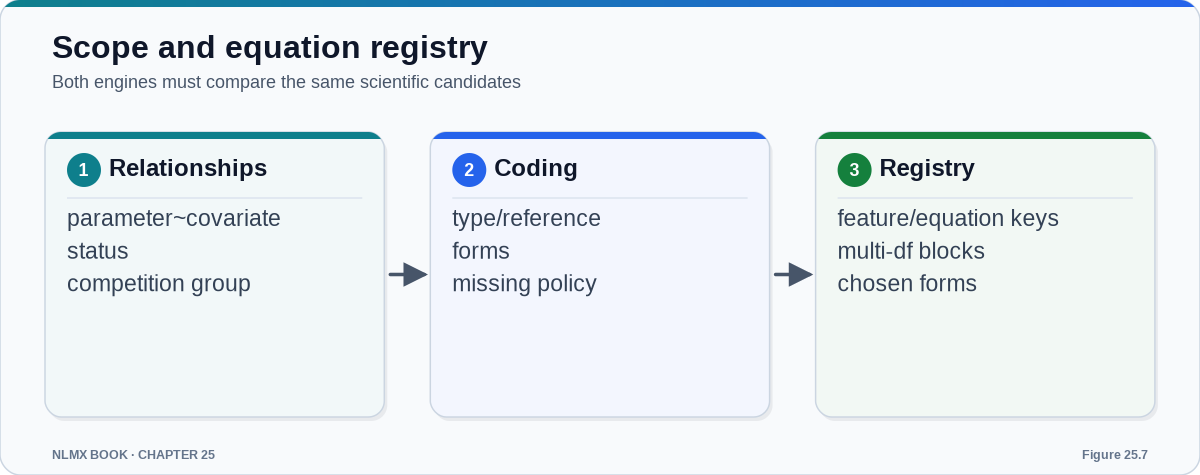
A fair cross-engine comparison begins with identical parameter–covariate relationships, types, references, forms, and missing-value rules. Declare scope with [covariates] or repeatable --covariates. Control forms using --continuous-forms, --categorical-forms, --all-equations, and per-covariate overrides; control coding with type/reference and missing-policy options.
Detailed [[relationships]] entries can mark test, always_include, or always_exclude. These statuses change starting models and classifications and must not be conflated with data-driven retention/rejection. [[competition_groups]] tell the posterior workflow that correlated relationships may substitute for one another; they do not merge the frozen statistics or prove exchangeability.
Posterior selection is limited to parameters with target ETAs, while frozen/SCM can test some parameters without ETAs. Therefore both can legitimately contain “frozen only” relationships. Preserve the feature/equation registry and explain any engine-specific eligibility before interpreting missing comparison cells.
Common mistakes
- Changing the scientific question after seeing the result while presenting it as the original run.
- Reading one engine's summary without checking its prerequisites, failures, normalized settings, and fitted endpoint.
- Treating a generated draft, comparison label, or completed checkpoint as a substitute for model diagnostics and reference-software confirmation.
Page checklist
- The exact command, version, inputs, resolved settings, and output directory are identifiable.
- Engine-specific evidence is interpreted on its own scale before cross-method comparison.
- Recovery state, final refit, diagnostics, and remaining confirmation work are explicit.