36A.4 Reading and citing nlmx result files
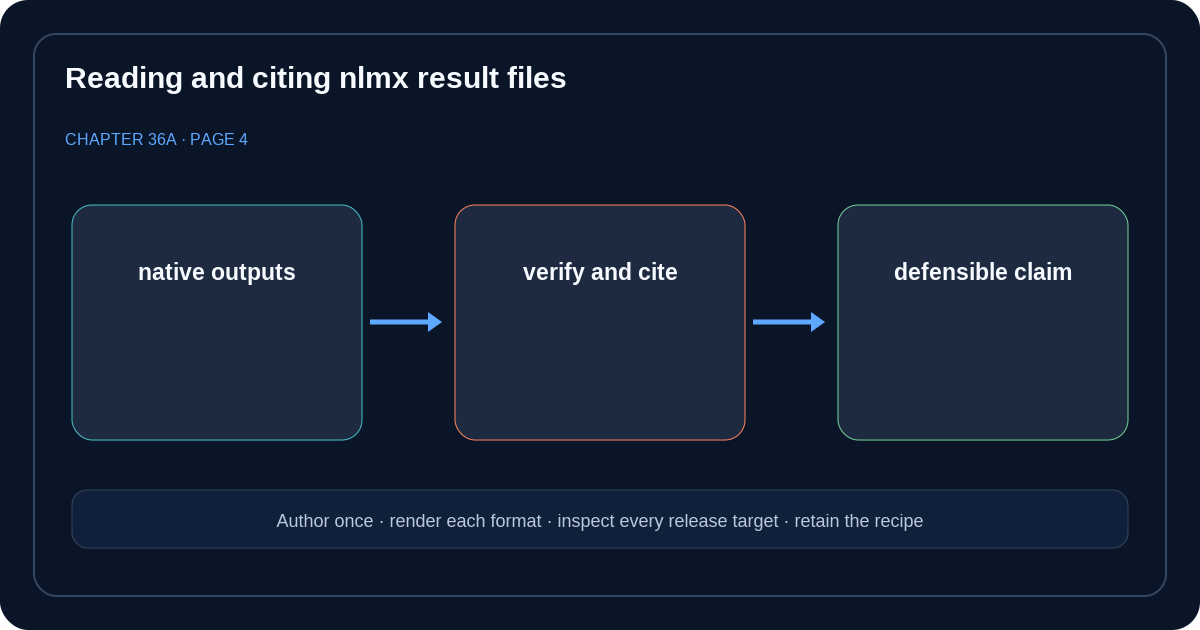
nlmx report publishes one Markdown source into retained Markdown, Word and PDF by default, with optional HTML. The command solves document generation; it does not validate the scientific analysis or approve its interpretation. Treat the source Markdown and .report file as the controlled recipe, and treat every released format as a separate review target.
Read native files, do not reconstruct results
Every reported number should have an authoritative source. Common sources include qc_summary.json, nca_parameters.csv, parameters.csv, fit_summary.json, VPC bins/summary, analysis_results.json, forest/ER/power tables, and simulation summaries. Use the file's units, denominator, population and precision. If a value is calculated from two files, state the formula and sources.
Under each table or figure, add a compact source line naming the file, run, version and reproducible command/settings. For a paragraph, name the source once where the claim appears. A reader should be able to move from sentence to native row without asking the author.
Check more than the copied cell: verify subject/record counts, exclusions, reference group, endpoint, method, convergence/covariance status, interval level, seed/replicate count, and warnings. A ratio can be numerically correct but attached to the wrong reference. A plot can be the right filename from an obsolete run.
Never redraw nlmx figures merely to imitate their appearance. Use the publication PNG/SVG produced by the analysis command or create a controlled custom plot whose settings are retained. Keep failed runs in the narrative when they affected method or model choice.
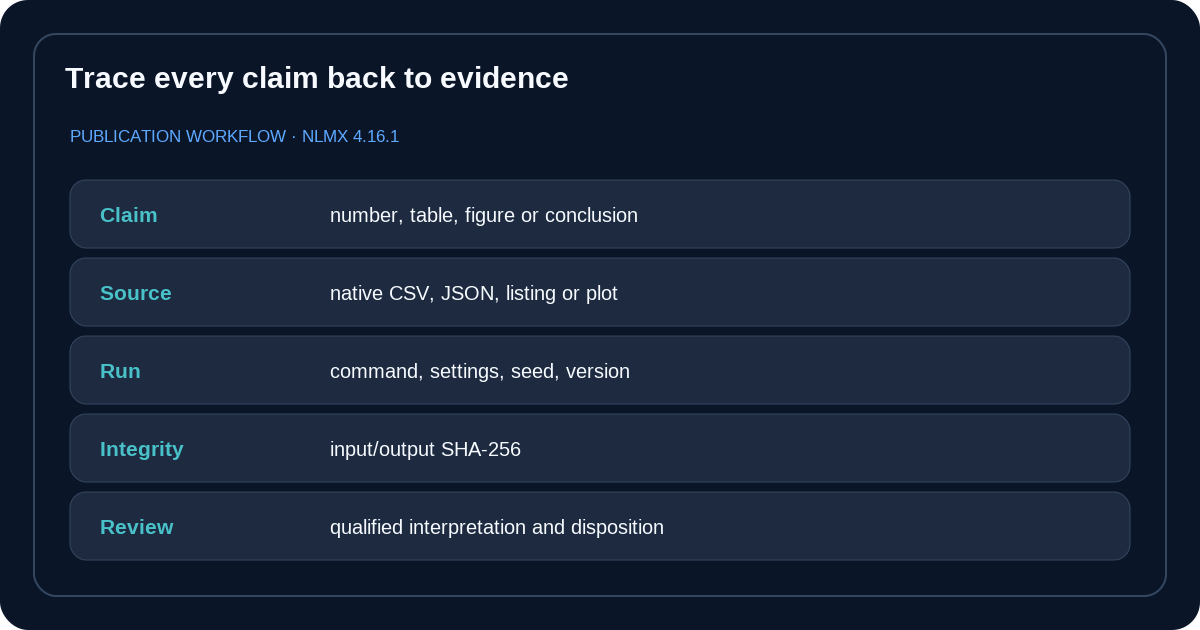
The traceability chain is claim → native file → run settings/command → input hash → reviewer decision. report carries text and images; the author supplies that chain.
A source-ledger check
For every reported value, capture: displayed label, exact native field, input/run, transformation, rounding and destination. Example: “CL 5.20 L/h” may come from parameters.csv, but the ledger must also identify run stem, row label, estimate column and whether CL/F or CL was fitted. For a figure, record plot path and settings file. For a decision, record criterion and result that triggered it. Sample three entries after document generation and compare the rendered text to the ledger. If a value cannot be traced without interpretation, add enough context or remove it.
Practical review questions
- Does the released content answer the stated question without exceeding the evidence?
- Can every number, table, figure and decision be traced to a retained native file and run?
- Were all generated targets—not merely the source—inspected after the latest change?
- Are warnings, failed runs, limitations and unverified steps visible rather than silently omitted?
- Could another qualified analyst rebuild the same document from the retained recipe?
Navigation
See the previous page, next page, and complete report reference.