27.17 Equal-count and equal-width binning
Equal-count bins aim for similar observation counts and therefore similar empirical precision, while equal-width bins preserve equal spans on the x axis but may be sparse in lightly sampled regions. --bins N selects count bins; add --bin-method width --bins N for equal width.
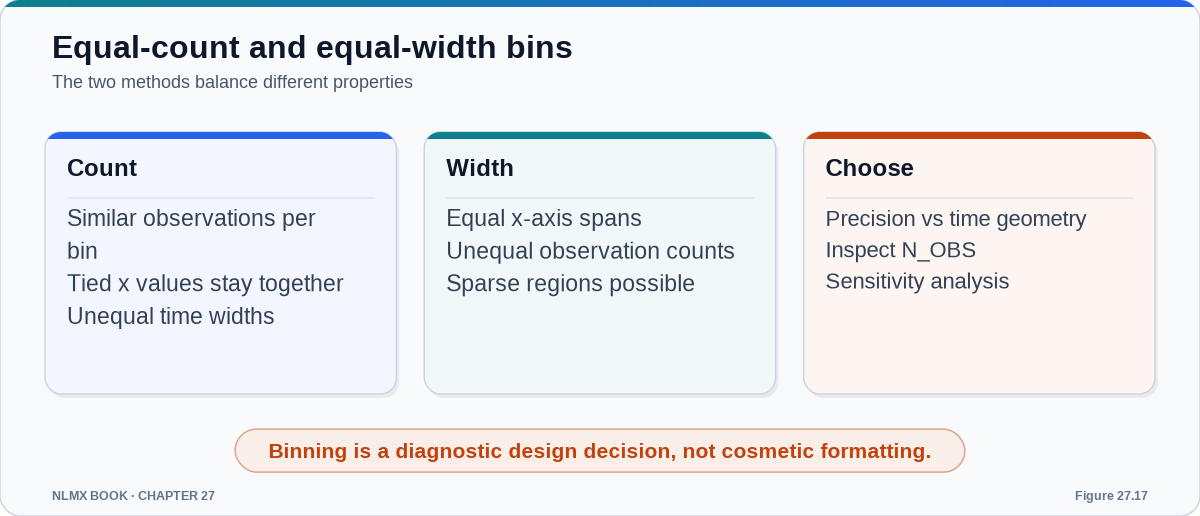
Novice translation
This topic changes three practical decisions in a predictive-check review. First, count binning never splits tied x values, so realised counts may differ from the target. Second, width boundaries are arithmetic positions; an observation on a cut enters the upper bin. Third, both methods are subject to min_obs merging, which can reduce the requested number of bins. Keep those decisions separate: one defines what is simulated or summarised, another controls how evidence is displayed, and the last controls what conclusion the evidence can support. A reviewer should be able to reproduce each decision from the resolved settings and numerical tables, not infer it from the appearance of the figure.
What to understand
- Count binning never splits tied x values, so realised counts may differ from the target.
- Width boundaries are arithmetic positions; an observation on a cut enters the upper bin.
- Both methods are subject to
min_obsmerging, which can reduce the requested number of bins.
Practical interpretation
Run a binning sensitivity when conclusions depend on one boundary or when sampling density changes sharply over time.
Evidence to retain
For equal-count and equal-width binning, retain the issued command, vpc_settings.vpc, the source model/data/result identifiers, seed and replicate count, the relevant CSV/JSON fields, warnings and notes, and the exact figure used for interpretation. Record any sensitivity run that changed the conclusion. If an option was selected after seeing the data, label that analysis exploratory. This evidence separates a reproducible diagnostic decision from a visual impression and lets another pharmacometrician check counts, transformations, exclusions, and uncertainty assumptions.
Common mistakes
- Calling requested N the realised bin count
- Choosing width with empty late intervals
- Changing bins between candidate models
Page checklist
- State method and N
- Inspect realised counts
- Check boundary sensitivity
- Retain identical bins for comparison
Further reading
See previous page, next page, complete VPC command and settings index.