36A.16 Word output and editable review
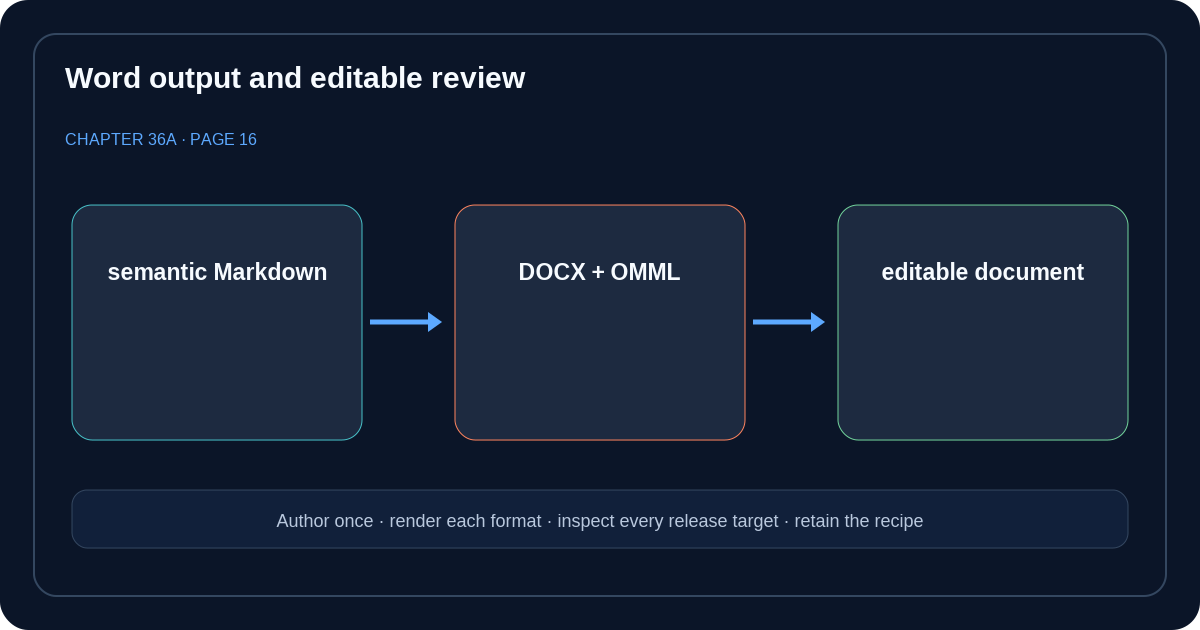
nlmx report publishes one Markdown source into retained Markdown, Word and PDF by default, with optional HTML. The command solves document generation; it does not validate the scientific analysis or approve its interpretation. Treat the source Markdown and .report file as the controlled recipe, and treat every released format as a separate review target.
What Word receives
DOCX contains semantic heading styles/bookmarks, lists, tables, real footnotes, embedded images, hyperlinks, native OMML equations, a TOC field and optional page-number footer. This supports editing and reuse better than pasted images or flattened text.
Word layout depends on the application, installed fonts, field updates and printer metrics. Open the file in the approved viewer, update the TOC field when needed, and inspect every page. Confirm heading navigation, table header/row behavior, equation editability, image anchoring, hyperlinks, footnotes, language and document properties. If reviewers edit DOCX directly, reconcile changes back into Markdown or the next regeneration will erase them.
The executed DOCX package passed structural inspection: document XML, footnotes, one media item, one table, OMML equations, drawing and TOC field were present. The environment lacked the required bundled LibreOffice renderer, so the example is deliberately not claimed as visually verified. This illustrates an important release rule: successful creation and valid OOXML do not replace rendered-page inspection.
Keep DOCX, source Markdown, settings and approval/redline process together. report does not add tracked changes, signatures or approval workflow.
Word acceptance record
Record application/version used to open the DOCX, whether fields were updated, page count, and checks performed. Confirm the document properties and language, then navigate headings/TOC, inspect equations in edit mode, select table headers, check footnotes and open links. If tracked review occurs, designate one controlled DOCX and reconcile accepted edits into Markdown before regeneration. The chapter fixture demonstrates the honest alternative when rendering infrastructure is missing: report structural facts, leave visual verification open, and do not claim Word acceptance from package validity alone.
Practical review questions
- Does the released content answer the stated question without exceeding the evidence?
- Can every number, table, figure and decision be traced to a retained native file and run?
- Were all generated targets—not merely the source—inspected after the latest change?
- Are warnings, failed runs, limitations and unverified steps visible rather than silently omitted?
- Could another qualified analyst rebuild the same document from the retained recipe?
Navigation
See the previous page, next page, and complete report reference.