14.20 BLQ rules and sensitivity analysis
Below-quantification-limit observations are not ordinary zeros. They state that the assay did not provide a reliable numerical concentration below a threshold. How those records are represented changes Tmax, Cmax, trapezoidal area, candidate terminal points, and sometimes whether lambda_z can be estimated at all.
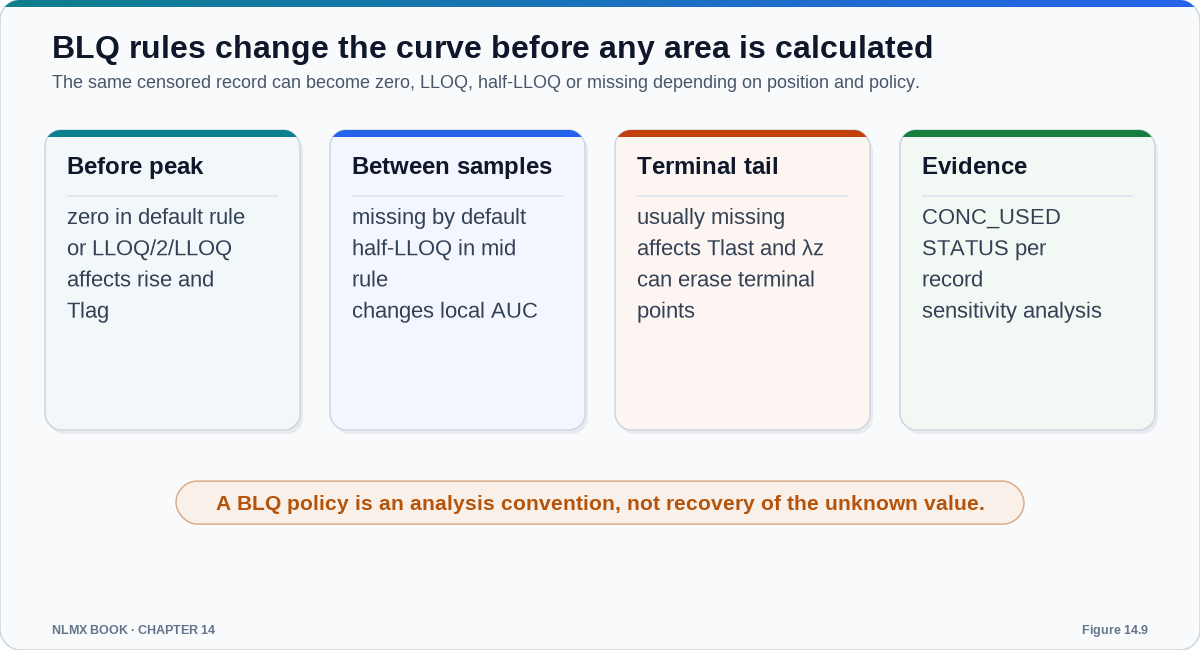
nlmx provides six rules:
| Rule | Conceptual treatment |
|---|---|
zero |
Replace every BLQ value with zero. |
missing |
Exclude every BLQ concentration. |
lloq |
Replace every BLQ value with its LLOQ. |
half-lloq |
Replace every BLQ value with one half of its LLOQ. |
tmax-zero-missing |
Before or at Tmax use zero; after Tmax treat BLQ as missing. This is the default. |
first-zero-mid-half-last-missing |
Use zero for the first BLQ run, half-LLOQ for internal BLQ values, and missing for the terminal BLQ run. |
The exact classification depends on profile order and BLQ status. An assay value recorded as numeric zero but not marked BLQ is a different data condition. Negative concentrations are not valid log-regression inputs and are omitted rather than converted silently.
Why position matters
Predose BLQ values often support a zero baseline. Internal BLQ values between quantifiable observations may represent intermittent assay behavior. Terminal BLQ values should not usually be converted into artificial positive points that flatten or steepen the terminal regression. The default positional rule reflects these different roles, but it is not universally correct for every assay, analyte, or protocol.
Preserve the raw value, BLQ indicator, LLOQ, transformed value, and reason in an audit table. That makes it possible to reproduce the result and distinguish source data from analysis data.
Sensitivity analysis
When BLQ frequency is material, rerun at least one plausible alternative rule and compare Cmax/Tmax, AUClast, lambda_z, AUCinf, and the number of estimable profiles. The objective is not to choose whichever rule produces the cleanest result. It is to show whether scientific conclusions depend on an uncertain convention.
Common mistakes
- Assuming blank, zero, negative, and BLQ all mean the same thing.
- Substituting half-LLOQ without retaining the transformation status.
- Allowing imputed terminal values into lambda_z without review.
- Selecting a rule after seeing treatment differences.
Checklist
- Verify BLQ and LLOQ mappings from the source data.
- State the rule before calculating parameters.
- Inspect transformed values by profile position.
- Run sensitivity analyses when BLQ is influential.
- Preserve raw and analysis representations.
Further reading
Continue with sparse and irregular sampling, terminal regression, and the Chapter 15 input-mapping pages.