23.9 Efficient score and residual base-score correction
With candidate score Uβ, nuisance score Uψ, candidate–nuisance information Iβψ, and nuisance information Iψψ, nlmx forms
U* = Uβ − Iβψ Iψψ⁻¹ Uψ.
At an exact optimum under the same likelihood, Uψ = 0 and the efficient score equals the raw candidate score. In practice, final estimates may come from another approximation, may be rounded in the EXT file, or may be mapped imperfectly. The residual nuisance score correction prevents that mismatch from being attributed to the candidate.
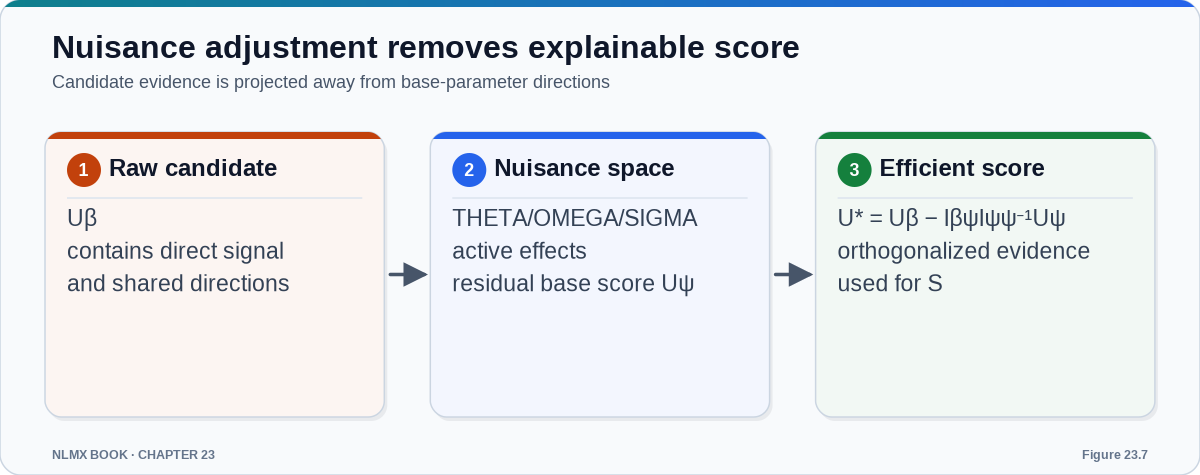
This correction is an important implementation detail. A generic derivation often assumes stationarity and silently drops Uψ. nlmx instead computes the nuisance score, reports a stationarity statistic, and corrects the candidate score. The adjustment cannot cure a wrong parameter map or unsupported model feature; it only provides the appropriate local projection when the information is usable.
Inspect the largest standardized nuisance-score components. A small total with one unexpectedly large component can identify a label, variance, or scaling problem. If stationarity is poor, resolve the base discrepancy before interpreting candidate evidence, even though the formula technically produces a corrected statistic.
How to read the correction in practice
Begin with the base stationarity result. When it is essentially zero, the residual-score correction contributes little and the test resembles the classical efficient score derivation. When it is not zero, compare the raw and efficient candidate scores and identify which nuisance components explain the difference. A large correction concentrated in one OMEGA or THETA direction is more informative than the total alone. Then verify that the nuisance direction has the intended label and scale. If repairing the map changes Uψ, discard the old candidate results and recompute the complete family because every efficient score used the earlier nuisance block.
Common mistakes
- Assuming imported estimates are exactly stationary in nlmx.
- Dropping
Uψfrom an explanation of the implemented test. - Using the correction as justification to ignore a large stationarity warning.
- Comparing efficient scores across different nuisance parameter maps.
- Confusing score correction with parameter-uncertainty propagation.
Checklist
- Review
Uψthrough the stationarity diagnostic. - Confirm nuisance labels and scaling.
- Preserve the residual-score correction in method reporting.
- Investigate approximation or mapping discrepancies.
- Recompute after correcting the base model.
Further reading
See stationarity and nuisance-information sources.