12.13 THETA bounds, initial values and fixed effects: PAR01-PAR04 and PAR09
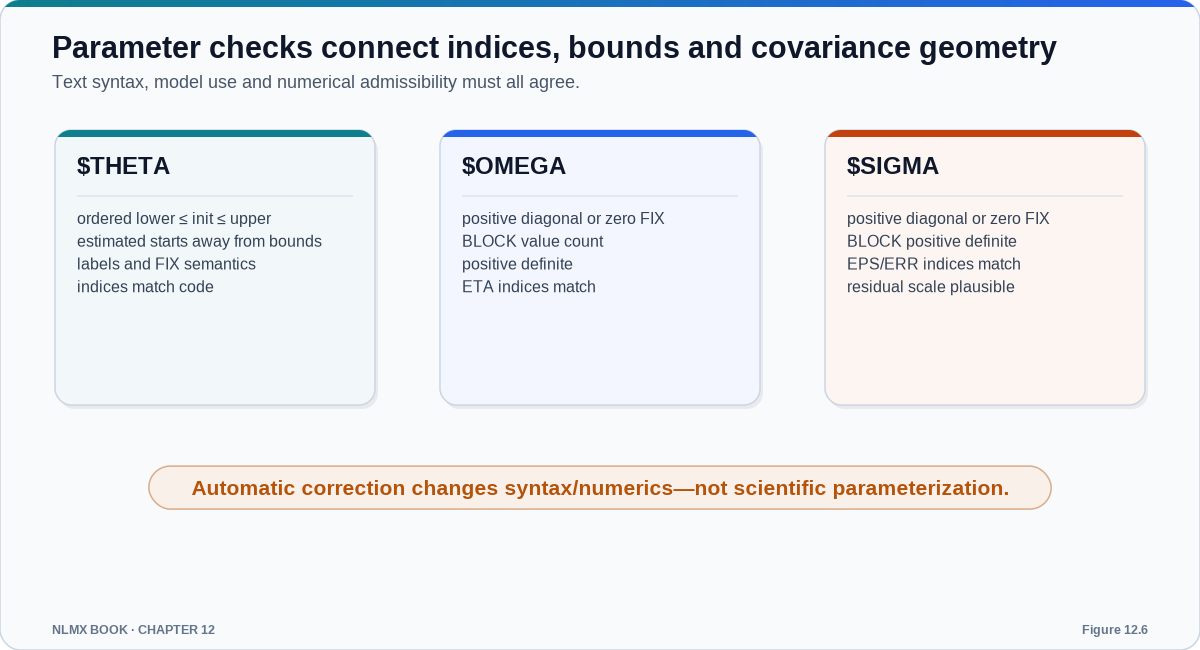
PAR01 parses $THETA, $OMEGA, and $SIGMA. PAR02 verifies ordered THETA bounds and an initial value inside them. PAR03 identifies starts close to a bound, PAR04 identifies estimated THETAs starting at zero, and PAR09 checks whether a fixed THETA carries bounds that will not operate as an estimation constraint.
Read each THETA as a scientific statement
The common three-value form is (lower, initial, upper). In the worked example, (10,5,1) is impossible because the lower bound exceeds the upper bound; the correction orders it as (1, 5, 10). That makes the syntax coherent, but it does not prove that 1, 5, and 10 are suitable for clearance. Units, population, dose route, and model parameterization still govern plausibility.
A start near a boundary may make optimization fragile or indicate that the chosen scale is awkward. Starting an estimated positive parameter at zero can be especially problematic. Consider whether a log-scale parameterization is more natural, but treat reparameterization as a model change requiring review, not a formatting repair.
For a fixed THETA, the effective intent should be unmistakable. Bounds surrounding a fixed value can mislead readers into thinking estimation is constrained within an interval. Prefer a clear fixed value with a useful label and comment.
Corrections and review
The bounds correction can repair recognizable ordering or representation problems. Always inspect qc_nm_changes.csv and the unified diff. A syntactically valid reordered tuple may not reflect the author's intended lower and upper limits.
Common mistakes
- Treating an automatic bound reorder as scientific approval.
- Omitting units and parameter labels.
- Using very broad bounds as a substitute for stable parameterization.
- Fixing a parameter temporarily and forgetting to document or reverse it.
Checklist
- Parse and label every THETA.
- Confirm lower, initial, and upper values in scientific units.
- Investigate starts at or near bounds and zero.
- Make fixed effects visually and semantically clear.
- Refit and compare diagnostics after any parameterization change.
Further reading
See parameter corrections, reading changes, and estimation theory in the roadmap.