36.21 posterior command reference
This chapter is a lookup reference for nlmx 4.16.1. Option tables are generated from the installed release executable. Read an option in the context of the command page: nlmx uses a global parser, but an accepted option can be irrelevant to a command unless its help text names that command or the command's method chapter defines the behavior.
The safe sequence is: identify the installed version, open that command's help, freeze input/settings/output paths, run into a new or empty output directory, inspect both the process status and the command-native verdict, and retain the log/resolved settings/checksums. A command line is reproducible only when its referenced files and software version are also frozen.
Synopsis
nlmx posterior [OPTIONS]
Required context. The fitted base-model artifacts required to ingest or reconstruct subject posterior means and variances.
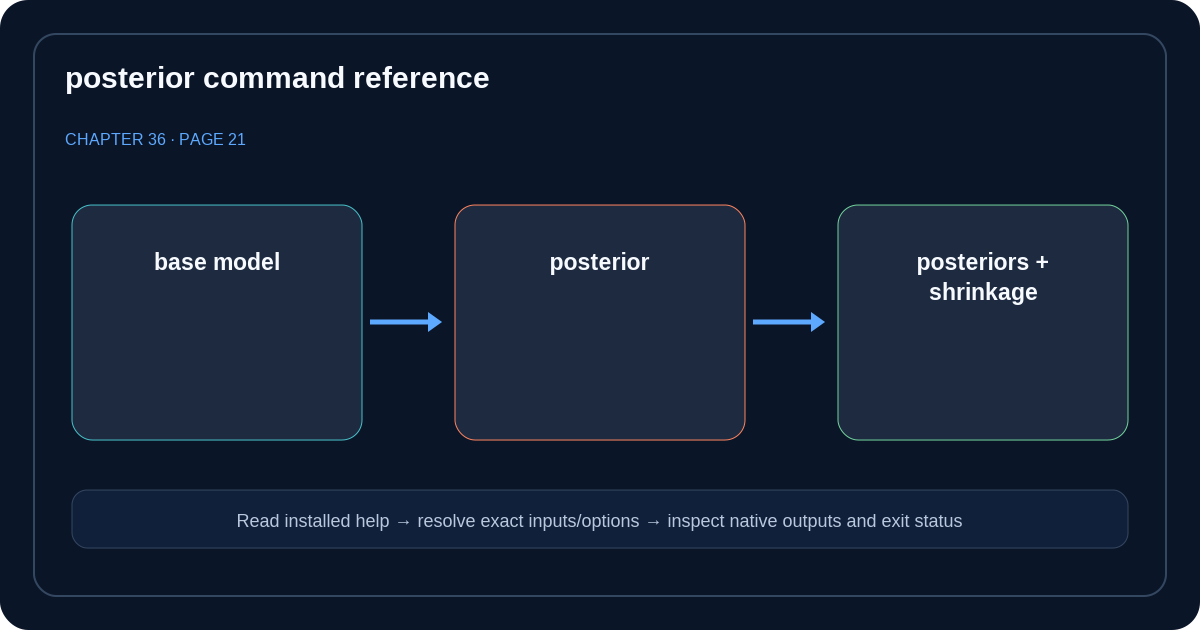
What it does. Runs the posterior reconstruction/ingestion stage only and reports posterior sources, shrinkage, curvature, and moment-consistency diagnostics without selecting covariates.
Principal outputs. Posterior and shrinkage summaries, variance consistency, diagnostics, feature registry, report, normalized configuration, manifest, logs, and checksums.
Practical invocations
nlmx posterior -c study.covar -o posteriornlmx posterior --ctl models/run101.ctl --covariates CL=WT
Start with installed help and, when available, generate the complete settings template before entering study choices. Run into a new or empty output folder. After completion, review the command's native summary/verdict, warnings, logs, resolved settings, and checksum manifest—not only the console's final line.
Complete installed option reference
The following 83 options are parsed directly from nlmx 4.16.1 posterior --help. The unmodified txthelp snapshot and its SHA-256 are preserved in the jsonhelp inventory. Shared descriptions sometimes mention several commands; apply only the clause naming posterior unless its method chapter specifies otherwise.
Options
| Option | Installed description |
|---|---|
-h, --help |
Print help |
Method
| Option | Installed description |
|---|---|
--method <METHOD> |
Selection engine: frozen | scm (stepwise forward/backward on refits) | posterior | both (overrides method in the config) |
--threads <THREADS> |
Worker threads for subject- and replicate-level parallelism (default: all cores). Results do not depend on this value |
Covariates
| Option | Installed description |
|---|---|
--covariates <PARAM=COVS> |
run, inspect, validate: covariates to test on a parameter, PARAM=COV1,COV2 (repeatable, or ';'-separated), e.g. --covariates CL=WT,AGE,SEX --covariates V=WT. Types (continuous, binary, categorical) are detected from the data. Replaces the configuration's scope; with a model (--ctl or --model-dir) no -c file is needed |
--continuous-forms <LIST> |
Equations tried for continuous covariates: power, exponential, linear, standardized_linear, spline (default: power) |
--categorical-forms <LIST> |
Equations tried for binary and categorical covariates: proportional (one θ per level), grouped (one θ for all non-reference levels), ordinal (default: proportional; a binary covariate always has the single proportional equation) |
--all-equations |
Try every standard equation of each covariate type (continuous: power, exponential, linear; categorical: proportional, grouped) and keep the best per pair, instead of the one typical equation (power; proportional) |
--covariate-forms <COV=FORMS> |
Equations for one covariate, COV=FORMS (repeatable), e.g. --covariate-forms WT=power |
--covariate-type <COV=TYPE> |
Covariate type, COV=continuous|binary|categorical|ordinal (repeatable; default: detected) |
--covariate-reference <COV=VALUE> |
Centring value of a continuous covariate (or reference level of a categorical one), COV=VALUE|median|mean (repeatable; default: median, most frequent level) |
--missing-covariates <POLICY> |
Missing covariate values: error (default) | median | drop_subject |
--compare-forms <MODE> |
How the equations of one parameter-covariate pair are compared: auto (default: refit each equation and keep the lowest AIC when there is more than one) | refit | score (score test only: fast, but cannot tell linear from exponential) |
--no-final-refit |
Skip the joint refit of the retained effects (both engines); the final model then uses one-step (frozen) or median two-stage (posterior) coefficients and has no OFV |
Input selection
| Option | Installed description |
|---|---|
--model-dir <MODEL_DIR> |
Directory holding one NONMEM run family, matched on a common stem (e.g. run101.ctl/.ext/.cov); power: the folder with the run's <stem>.ext and <stem>.cov |
--files <MANIFEST.txt> |
Explicit [files] manifest (.txt); paths resolve against the manifest location |
--ctl <CTL> |
Control stream (.ctl/.mod) |
--ctls <PATTERN>... |
fit: run fit once for every control stream matching the patterns (file names, folders, or wildcards * ? and ** such as *.ctl or ./xyz/*.mod), each with all the other options (--retry, --approximation, ...); every run has its own output folder (<name>_fit next to its control stream, or <output>/<name> with --output) and log |
--ext <EXT> |
Final estimates (.ext); sims: the parameter values of --estimates final; power: the final estimates (default: those of the control stream) |
--cov <COV> |
Parameter covariance matrix (.cov); sims: with it every simulation of the study uses a new parameter set (parameter uncertainty); power: needed for --uncertainty |
--cor <COR> |
Parameter correlation matrix (.cor) |
--data <DATA> |
Analysis dataset (overrides $DATA); sims: simulate this dataset instead of generating one |
--lst <LST> |
NONMEM listing (.lst) |
--phi <PHI> |
Individual estimates (.phi) |
--table <TABLE> |
Table file with ID and ETA columns (.tab), used when no .phi is available |
--run-stem <RUN_STEM> |
Disambiguate a directory containing several runs |
--recursive |
Scan --model-dir recursively (still rejects ambiguity) |
Core
| Option | Installed description |
|---|---|
-c, --config <FILE> |
Settings file of the command (TOML syntax), with the command's extension: .covar (cov, posterior, inspect, validate, fit), .qcd, .qcn, .eda, .nca, .init, .screen, .vpc, .forest, .sims, .er, .power, .gen, .ask |
-o, --output <OUTPUT> |
Output directory |
--run-dir <RUN_DIR> |
Existing run directory, for resume |
--overwrite |
Allow writing into a non-empty output directory |
--dry-run |
Run the validation pipeline instead of the full analysis |
--no-checkpoint |
Do not write replicate checkpoints (posterior engine) |
Frozen method
| Option | Installed description |
|---|---|
--approximation <APPROXIMATION> |
Likelihood approximation: auto (from $ESTIMATION, default) | fo | foce | foce-i | laplace; fit and screen also accept saem (SAEM with an importance-sampling objective); screen default foce-i |
--refine <REFINE> |
Re-estimate the N most significant candidates by virtual refitting (0 = off) |
--calibration <CALIBRATION> |
Score-test calibration: none | permutation | parametric-bootstrap |
--calibration-replicates <CALIBRATION_REPLICATES> |
Permutations or bootstrap replicates for --calibration |
--information <INFORMATION> |
Information: efficient | candidate-only |
--information-estimator <INFORMATION_ESTIMATOR> |
Information estimator: opg (default, outer product of per-subject scores) | observed (finite-difference Hessian) |
--nuisance-information <NUISANCE_INFORMATION> |
Nuisance information source: observed | from-cov |
--selection <SELECTION_MODE> |
Selection mode: univariate | hierarchical-conditional | all-joint | refit-scm |
--adjust <ADJUST> |
Multiplicity adjustment: none | bonferroni | holm | bh | by | westfall-young |
--alpha <ALPHA> |
Forward inclusion alpha (stepwise: p-value of the likelihood-ratio test to enter) |
--retention-alpha <RETENTION_ALPHA> |
Backward retention alpha (stepwise: a term whose p-value is above it is removed) |
--scm-direction <DIRECTION> |
Stepwise (--method scm): which stages to run: forward (inclusion only) | backward (elimination from the full model only) | both (forward, then backward; default) |
--scm-candidates-per-step <N> |
Stepwise: candidates refitted at each forward step, best conditional score first; 0 = all of them, as PsN does (default 3) |
--max-candidates <MAX_CANDIDATES> |
Hard cap on evaluated candidates (safety rail) |
--uncertainty |
Enable MVN resampling of the frozen parameters from the .cov |
--no-uncertainty |
Disable .cov uncertainty propagation |
--draws <DRAWS> |
Number of uncertainty draws |
--fd-rel <FD_REL> |
Relative finite-difference step |
--write-subject-scores |
Emit per-subject objective and score contributions (IDs hashed unless --keep-subject-ids) |
--write-matrices |
Emit information / efficient-information matrices per candidate |
Posterior method
| Option | Installed description |
|---|---|
--posterior-source <POSTERIOR_SOURCE> |
Posterior source: require-phi | prefer-phi | reconstruct |
--allow-point-ebe <ALLOW_POINT_EBE> |
Permit point EBEs with no usable curvature (0|1); output is labelled EXPLORATORY |
--response <RESPONSE> |
Response: posterior-draws | posterior-mean er: response (endpoint) column(s), comma separated |
--draw-method <DRAW_METHOD> |
Draw method: normal | antithetic-normal | sobol-normal |
--resampling <RESAMPLING> |
Resampling: complementary-pairs | subsample | bootstrap | repeated-kfold |
--replicates <REPLICATES> |
Number of resampling replicates |
--subject-fraction <SUBJECT_FRACTION> |
Subsample fraction in (0,1] |
--draws-per-resample <DRAWS_PER_RESAMPLE> |
Posterior draws per replicate |
--base-param-draws <BASE_PARAM_DRAWS> |
Base-parameter (.cov) perturbation draws |
--cv-folds <CV_FOLDS> |
Folds for penalty tuning inside each replicate |
--threshold <THRESHOLD> |
Selection-probability threshold for retention |
--uncertain-lower <UNCERTAIN_LOWER> |
Lower edge of the uncertainty band |
--sign-threshold <SIGN_THRESHOLD> |
Required sign stability |
--learners <LEARNERS> |
Learners (comma-separated): adaptive-elastic-net, group-elastic-net, weighted-gls, gam, boosting, multivariate |
--primary <PRIMARY> |
Learner whose selection probability drives retention |
--max-features <MAX_FEATURES> |
Hard cap on generated feature columns (safety rail) |
--variance-consistency <VARIANCE_CONSISTENCY> |
Variance consistency: penalized-matching | moment-correction | none |
--write-subject-level |
Emit per-subject posterior summaries |
--write-posterior-draws |
Emit the generated posterior draws (large) |
--write-replicate-selections |
Emit the per-replicate selection matrix |
Shared numerics
| Option | Installed description |
|---|---|
--seed <SEED> |
Master seed (uncertainty draws, resampling, posterior draws, vpc simulations, autoinit ML) |
--ridge-max <RIDGE_MAX> |
Largest ridge permitted when stabilising a matrix; exceeding it is a failure |
--strict |
Promote every warning to an error |
Logging and output
| Option | Installed description |
|---|---|
--suppress-console <0|1> |
0 (default) prints progress to the terminal; 1 silences it (the log is still written) |
--log-file <LOG_FILE> |
Write the transcript here instead of log_<id>.txt |
--no-color |
Disable ANSI colour |
--license |
Print the license (CC BY-ND 4.0), the third-party components, how long this version may be used and how to contact the author, and stop |
-v, --verbose... |
Increase verbosity (repeatable: info -> debug -> trace) |
-q, --quiet |
Errors only on the terminal (the log file is unaffected) |
--keep-subject-ids |
Do not hash subject identifiers in outputs |
--format <FORMAT> |
Output format for schema: txt | toml | json | json-schema [default: txt] |
Interpretation and common failure
Point EBEs are not full posteriors. Review source categories, convergence, curvature, shrinkage, moment identity, missing subjects, and whether approximation/model artifacts match.
The detailed method and examples are in the relevant book chapter. Common nonzero process classes are documented on 36.35. A process exit of zero still requires command-native scientific and numerical review.
Minimal handoff record
Record the version, exact command and working directory, input/settings hashes, selected options and defaults, output path, process exit, native verdict or convergence state, warnings/exclusions, principal results with uncertainty, checksum verification, and reviewer disposition.
Navigation
See the previous page, next page, and complete command index.