Typical-subject exposure source
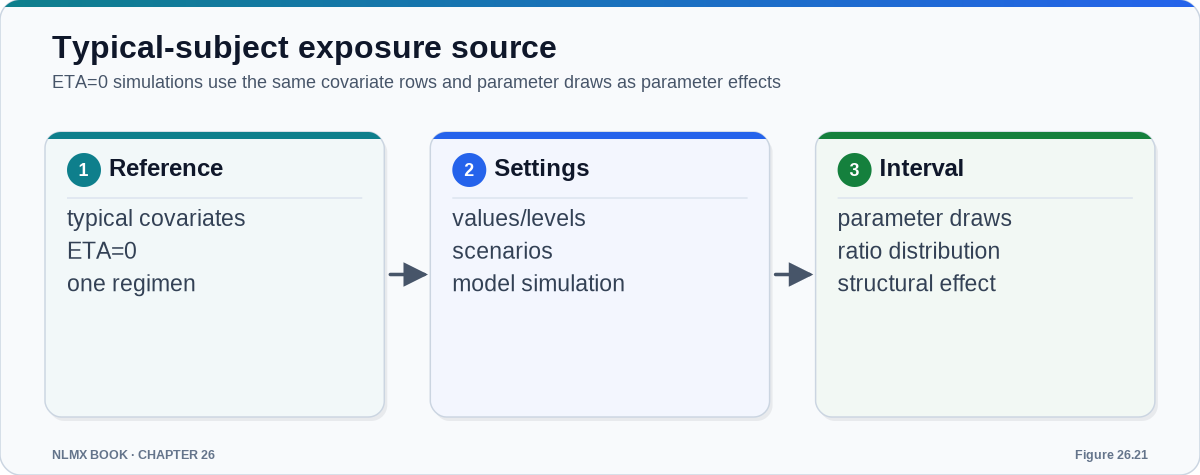
Typical mode sets ETA=0 and simulates the reference subject and each requested value, level, or scenario. It uses the same parameter draws as parameter-effect rows, so intervals express fitted-parameter uncertainty rather than subject bootstrap variability.
This source isolates structural model/covariate effects from the empirical ETA distribution and is suitable for prospective scenario communication. It does not describe the observed exposure distribution or between-subject variability unless separate rows provide context.
The worked low-weight renal-impairment scenario yields typical ratios about 1.69 for Cmax, 2.91 for Ctrough, and 1.99 for AUC at 100 every 24 hours. Different metrics diverge because CL and V jointly change the concentration-time profile.
Common mistakes
- Treating a forest ratio or reference-band class as covariate-selection evidence, causality, or an automatic dosing recommendation.
- Omitting the reference subject, uncertainty source, regimen, subgroup denominator, data support, or fitted-model diagnostics.
- Confusing parameter-uncertainty intervals, BSV ranges, and subject-bootstrap intervals because they share one graphic.
Page checklist
- The numerator, denominator, fitted model, covariate settings, and units are explicit.
- The interval source and clinical meaning are distinguished from BSV and selection uncertainty.
- Tables, resolved settings, commands, diagnostics, limitations, and confirmation evidence are retained.