Complete Chapter 25 command and settings index
This version 4.14.3 index covers every option that belongs to the cov workflow and every callable option of posterior, resume, inspect, validate, and schema. The shared parser can display switches from unrelated commands in global help; those are not part of this workflow.
Command map
| Command | Runs | Stops before |
|---|---|---|
nlmx schema |
Prints the annotated configuration reference as txt, toml, json, or json-schema. |
Input loading and analysis. |
nlmx inspect |
Resolves configuration, inputs, model/data, types, references, ETA mappings, forms, statuses, and candidate scope. | Numerical validation and selection. |
nlmx validate |
Performs inspect plus artifact reconciliation, covariance diagnostics, base-objective/stationarity checks, covariate validation, and posterior feasibility. | Candidate selection and stability schedules. |
nlmx cov |
Runs frozen, scm, posterior, or both, including final joint refit unless disabled. |
Nothing; this is the full selection command. |
nlmx posterior |
Ingests/reconstructs subject posteriors and writes shrinkage/curvature/consistency diagnostics. | Stability selection and final covariate-model selection. |
nlmx resume |
Continues an incomplete compatible posterior checkpoint or frozen/SCM refit cache. | It refuses completed or incompatible state. |
Runnable command patterns
# Create a starting configuration
nlmx schema --format txt > nlmx.covar

# Readable and numerical preflight
nlmx inspect -c nlmx.covar
nlmx validate -c nlmx.covar --method both
nlmx cov -c nlmx.covar --method both --dry-run

# Four selection modes
nlmx cov -c nlmx.covar --method frozen -o out_frozen
nlmx cov -c nlmx.covar --method scm --scm-candidates-per-step 0 -o out_scm
nlmx cov -c nlmx.covar --method posterior -o out_posterior
nlmx cov -c nlmx.covar --method both -o out_both

# Posterior construction only; no stability selection
nlmx posterior -c nlmx.covar -o posterior_stage

# Continue interrupted posterior or refit-cache work
nlmx resume --run-dir out_posterior --threads 8
nlmx resume --run-dir out_both/posterior --threads 8
Method, scope, and equation options
These apply to cov, inspect, validate, and, where preparation requires them, standalone posterior.
| Option | Values/default | Role |
|---|---|---|
--method |
frozen, scm, posterior, both |
Overrides configured method. Standalone posterior reconstructs posteriors regardless of the configured selection method. |
--threads N |
default all cores | Subject/replicate parallelism. Results must not depend on N; resume may change it. |
--covariates PARAM=COVS |
repeatable or semicolon-separated | Replaces configured scope. |
--continuous-forms LIST |
power, exponential, linear, standardized_linear, spline; default power |
Allowed continuous equations. |
--categorical-forms LIST |
proportional, grouped, ordinal; default proportional |
Allowed categorical equations; binary has one proportional model. |
--all-equations |
flag | Tries the standard equation set and chooses one form per relationship. |
--covariate-forms COV=FORMS |
repeatable | Per-covariate form override. |
--covariate-type COV=TYPE |
continuous/binary/categorical/ordinal | Overrides detected type. |
--covariate-reference COV=VALUE |
number, median, mean |
Sets continuous center or categorical reference. |
--missing-covariates POLICY |
error, median, drop_subject |
Missing-covariate handling. |
--compare-forms MODE |
auto, refit, score |
Chooses how competing forms are reduced to one per pair. |
--no-final-refit |
flag | Skips the joint endpoint; frozen uses one-step and posterior median two-stage coefficients and no final OFV. |
Configuration additionally supports detailed [[covariates]] declarations, [[relationships]] status test|always_include|always_exclude, binary/ordinal form lists, missing codes, range/positivity/levels, minimum level size, time-varying policies, and [[competition_groups]].
Input selection and artifact overrides
| Option | Purpose |
|---|---|
--model-dir DIR |
Finds one run family sharing a stem. |
--run-stem STEM |
Resolves a directory containing several runs. |
--recursive |
Searches beneath the model directory but still refuses ambiguity. |
--files MANIFEST.txt |
Uses an explicit role-to-file manifest. |
--ctl FILE |
Control stream override. |
--ext FILE |
Final-estimate override. |
--cov FILE / --cor FILE |
Parameter covariance/correlation overrides. |
--data FILE |
Dataset override instead of $DATA. |
--lst FILE |
Listing override. |
--phi FILE |
Individual-estimate/posterior input. |
--table FILE |
ID/ETA table used when no PHI is available. |
Core execution options
| Option | Purpose and boundary |
|---|---|
-c, --config FILE |
Loads the TOML configuration; relative paths resolve from its directory. |
-o, --output DIR |
Chooses a new output directory. |
--run-dir DIR |
Required recovery target for resume; for both, use its posterior child. |
--overwrite |
Permits a non-empty destination. Avoid on evidence bundles. |
--dry-run |
Runs validation instead of the full analysis. |
--no-checkpoint |
Disables posterior replicate checkpoints and recovery. It does not disable frozen/SCM refit caches. |
Frozen and SCM options
| Option | Values/default | Role |
|---|---|---|
--approximation |
auto, fo, foce, foce-i, laplace |
Likelihood approximation; auto follows $ESTIMATION where supported. |
--refine N |
default 0 |
Likelihood-refits N most significant frozen candidates. |
--calibration |
none, permutation, parametric-bootstrap |
Score-test calibration mode. |
--calibration-replicates N |
method-specific count | Permutation/bootstrap replicate count. |
--information |
efficient, candidate-only |
Nuisance-adjusted or diagnostic unadjusted information. |
--information-estimator |
opg (default), observed |
Information construction. |
--nuisance-information |
observed, from-cov |
Nuisance block source. |
--selection |
univariate, hierarchical-conditional, all-joint, refit-scm |
Frozen/SCM selection mode. --method scm is the clear SCM expression. |
--adjust |
none, bonferroni, holm, bh, by, westfall-young |
Multiplicity adjustment for appropriate frozen evidence. |
--alpha / --p-forward |
default 0.05 |
Forward-entry threshold. |
--retention-alpha / --p-backward |
default 0.01 |
Backward-retention threshold. |
--scm-direction |
forward, backward, both; default both |
SCM stages. |
--scm-candidates-per-step N |
default 3; 0 = all |
Score-ranked forward refit cap; zero gives exhaustive candidate coverage. |
--max-candidates N |
default 500 |
Candidate safety rail. |
--uncertainty / --no-uncertainty |
flags | Enables/disables base-parameter covariance sensitivity. |
--draws N |
default 200 |
Frozen parameter-uncertainty draws. |
--fd-rel VALUE |
default 1e-4 |
Relative finite-difference step. |
--write-subject-scores |
flag | Writes per-subject score contributions; IDs are hashed by default. |
--write-matrices |
flag | Writes information matrices for audit/qualification. |
Configuration-only controls include absolute FD step, calibration seed, selection.refit_max_iterations = 60, selection.final_refit, uncertainty.recompute_scores, and numerical ridge/SVD/conditioning/stationarity controls.
Posterior selection options
| Option | Values/default | Role |
|---|---|---|
--posterior-source |
require-phi, prefer-phi, reconstruct |
Posterior source policy. |
| `--allow-point-ebe 0 | 1` | default false |
--response |
posterior-draws, posterior-mean |
Response design. |
--draw-method |
normal, antithetic-normal, sobol-normal |
Posterior draw method. |
--resampling |
complementary-pairs, subsample, bootstrap, repeated-kfold |
Subject-level resampling method. |
--replicates N |
default 200 |
Resampling replicate count. |
--subject-fraction F |
default 0.5 |
Subject fraction in (0,1]. |
--draws-per-resample N |
default 2 |
Posterior draws per resample. |
--base-param-draws N |
default 20 when enabled |
Base-parameter perturbation draws. |
--cv-folds N |
default 5 |
Learner tuning folds. |
--threshold P |
default 0.80 |
Primary retention probability. |
--uncertain-lower P |
default 0.55 |
Lower edge of the uncertainty band. |
--sign-threshold P |
default 0.90 |
Required sign stability. |
--learners LIST |
adaptive/group elastic net, weighted GLS, GAM, boosting, multivariate | Required learners. |
--primary NAME |
default adaptive elastic net | Learner whose probability drives classification. |
--max-features N |
default 500 |
Feature safety rail. |
--variance-consistency |
penalized-matching, moment-correction, none |
Variance consistency method. |
--write-subject-level |
flag | Writes subject posterior summaries. |
--write-posterior-draws |
flag | Writes potentially large posterior draws. |
--write-replicate-selections |
flag | Writes replicate-level selection matrix. |
Configuration-only posterior controls include source approximation; draw centering/antithetic behavior; curvature tolerances/repair and failed-subject policy; variance-consistency tolerance; stratification/minimum stratum size; checkpoint_every; maximum failed fraction; base-parameter uncertainty enable; feature scaling/clustering/splines/time-varying summary; all learner grids, limits, tolerances, and selection rules; form/agreement thresholds; false-discovery mode (pfer, pfer_enforce, calibrated_fdr, none); PFER/FDR targets and bound; selected-set limit; and calibration permutations.
Shared numerics, logging, and privacy
| Option | Purpose |
|---|---|
--seed N |
Master stochastic seed. Preserve engine-specific seeds from normalized configuration too. |
--ridge-max VALUE |
Maximum permitted stabilization; exceeding it is failure. |
--strict |
Promotes warnings to errors after warning policy is qualified. |
| `--suppress-console 0 | 1` |
--log-file FILE |
Chooses transcript path. |
-v, --verbose... |
Increases terminal detail; repeat for debug/trace. |
-q, --quiet |
Terminal errors only; log remains. |
--no-color |
Disables ANSI color. |
--keep-subject-ids |
Prevents hashing in subject-level outputs; requires privacy authorization. |
--license |
Prints licensing/version-use information and exits. |
-h, --help |
Prints command-specific help and exits. |
| `--format txt | toml |
The resume interface in full
resume requires --run-dir. Its meaningful operational override is --threads; logging/display controls may also be supplied. -c, -o, --overwrite, --dry-run, --no-checkpoint, and --seed appear through the shared parser, but resume reconstructs the stored original invocation and verifies analysis identity. They are not a supported way to change the scientific analysis. A completed, missing, malformed, version-incompatible, or hash-incompatible state exits with code 11.
Posterior checkpoint identity includes engine/schema/RNG versions, normalized numerical configuration, analysis name, learners/primary, seed and schedule, relationship forms/statuses, and every input content hash. Execution/output settings—especially thread count—are excluded because they should not change numbers.
Configuration tables and defaults at a glance
| Table | Main contents |
|---|---|
| top level | config_version = 2, analysis_name, method |
[execution] |
thread count |
[input], [input.files] |
discovery and role overrides |
[covariates], [covariate_options], arrays |
scope, coding, status, references, missingness |
[score] |
frozen information, derivatives, calibration |
[selection] |
mode, thresholds, adjustment, refinement, SCM, final refit |
[uncertainty] |
covariance draws and recomputation |
[posterior] |
source, approximation, response/draw, curvature/failure policy |
[variance_consistency] |
method and tolerance |
[resampling] |
method, replicates, fraction, seed, strata, checkpoints, failures |
[posterior_sampling] |
posterior/base-parameter draws |
[features] |
scaling, clusters, limits, splines, time-varying summary |
[learners] and subtables |
required/primary, CV, grids and solver rules |
[stability] |
retention gates and PFER/FDR control |
[numerics] |
ridge/SVD/conditioning, mode, OFV and stationarity tolerances |
[output] |
directory, formats, privacy, draft/report files |
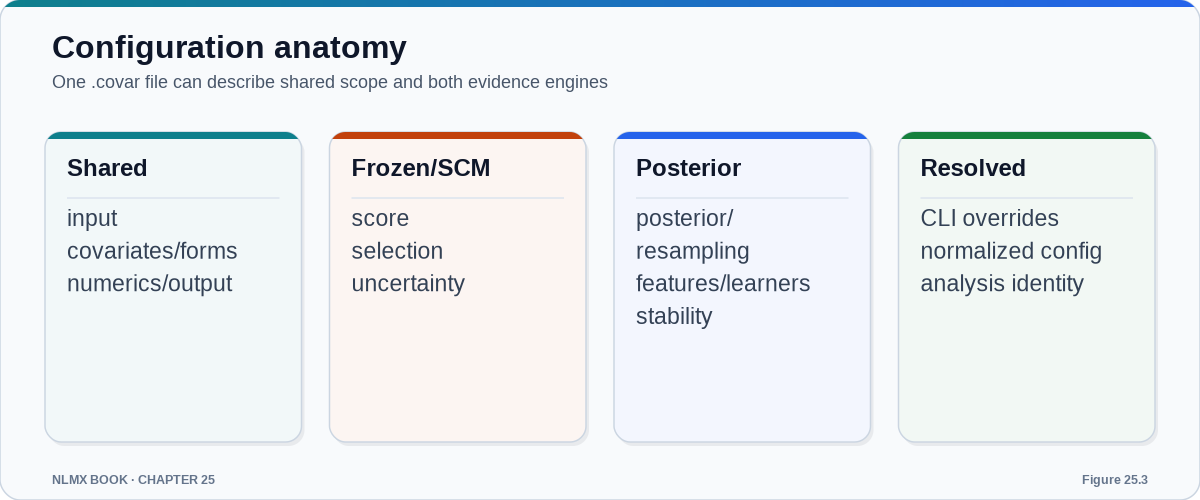
Always preserve normalized_config.covar; it is the definitive record of resolved defaults, aliases, configuration values, and CLI overrides.