41.1 How the case studies are built
What you will learn
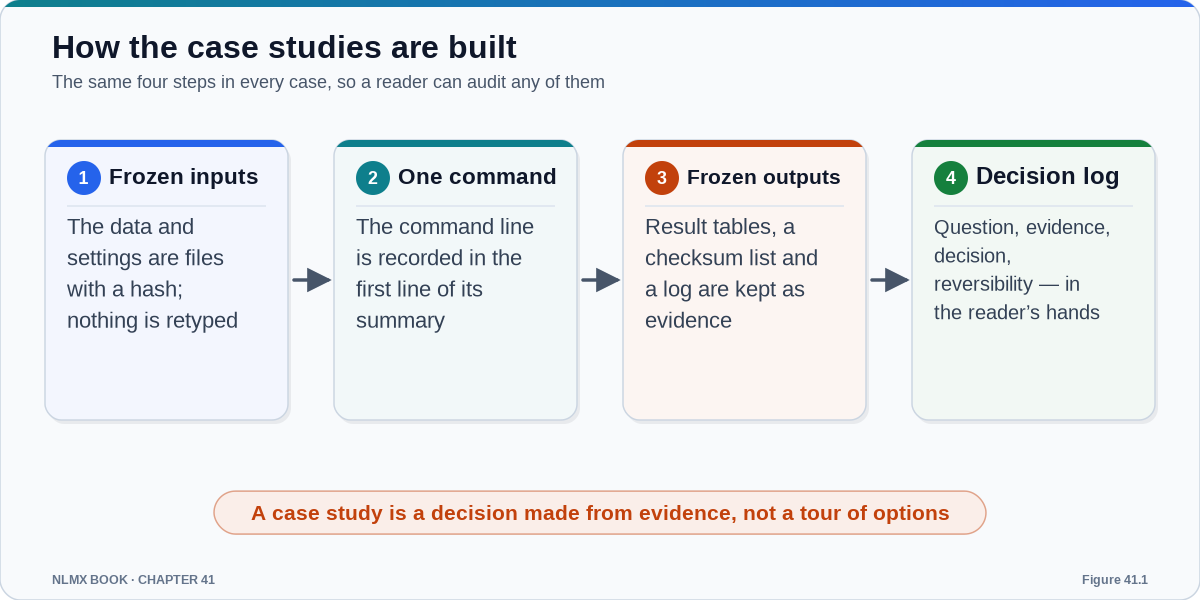
- Read a case study as a decision made from frozen evidence, not as a tour of options.
- Tell an executed value from a worked illustration wherever the two appear.
- Locate the evidence bundle behind each case and re-check a number against it.
- Know why no case here mixes numbers from two bundles.
Prerequisites: Chapter 3, a first hour with nlmx for the command vocabulary, and Chapter 42, validation and testing for what "evidence" means.
Chapters 11 to 40 each explain one command or method. This chapter does the opposite: it takes one question at a time, follows the evidence the program produced for it, and ends on a decision. There are nine cases, 38 pages, and a rule that makes them auditable.
The rule: one case, one bundle
Every case rests on a frozen evidence bundle: a folder of inputs (a data file and a settings or control-stream file), the exact command, and the outputs the program wrote, including its checksum list and log. The bundles live under documents/chNN/ in the book's companion files. They were produced once, and nothing in this chapter re-runs them.
That gives three guarantees.
- Every executed number can be found. A table of estimates on a page is a table in a named file; a reader can open the file and read the same digits.
- Nothing is mixed. The one-compartment oral data of Chapter 20, for example, has 24 subjects and 192 observations; the oral data of Chapter 16 has 24 subjects and 240. They are different studies. A case never takes a number from one bundle to explain another, so a reader cannot be misled into thinking two OFVs are comparable when they come from different data.
- Illustrations are labelled. Where a page works a hypothetical (for example, "suppose the screen had retained a second covariate"), the sentence says so in italics. Everything not marked is read from a bundle.
A note on versions. Output files carry whatever identification string the program wrote when the bundle was frozen. The cases do not quote it: the point of a case is the decision, and a decision should not depend on which build produced a table.
The nine cases
| Case | Question | Bundle | Pages |
|---|---|---|---|
| 1. Data quality | Is this file ready for analysis? | Chapter 11 (clean, defective) |
41.3–41.5 |
| 2. NCA | What are the exposure parameters, and do they scale with dose? | Chapters 14–15 | 41.6–41.9 |
| 3. Initial estimates and structure | Where should the fit start, and which structure does the data support? | Chapters 16–17 | 41.10–41.12 |
| 4. Fitting | Did the model converge, and how much does the method matter? | Chapter 20 | 41.13–41.17 |
| 5. Covariates | Which covariates belong in the model, and how stable is that answer? | Chapters 22–26 | 41.18–41.24 |
| 6. Evaluation | Does the model describe the data it was built from? | Chapter 27 | 41.25–41.27 |
| 7. Simulation and design | What exposure and power will this design give? | Chapters 28–31 | 41.28–41.34 |
| 8. Exposure–response | Is response related to exposure, and how strongly? | Chapters 32–33 | 41.35–41.36 |
| 9. Assistant and report | Can a conversation set up a run, and can the result be reported? | Chapters 34–36A | 41.37–41.38 |
How each page is laid out
Every case page has the same skeleton so that the decision log of the next page (41.2) can be filled in as you read.
- The question the analyst is trying to answer.
- The evidence: the bundle, the command, and the files opened.
- What the numbers say, with each number tied to its file.
- The decision, with a statement of what would have changed it.
- What this case does not show: the limits of a single bundle.
Why frozen evidence, and why now
By Chapter 42 you have seen how the package proves the program is correct. A case study is the complementary move: it shows what a correct program lets you conclude, and what it still leaves to judgement. Several cases deliberately end in a refusal or a failure—a dataset that does not pass the gate (41.3), a covariate result that is unstable (41.22), an estimation that stops at its iteration limit (41.17). A good analyst spends as much time on those as on the clean paths.
How to use the chapter
- Read a case in order if you are learning the workflow: the cases follow the order of an analysis (data → exposure → model → covariates → evaluation → design → response).
- Jump to a case if you have the question. Each page begins with the question it answers.
- Re-check one number per page. Open the file the page names and find the value. After three pages the habit is automatic, and it is the habit that matters when the data are yours.
Review checklist
- Can you name the bundle behind each number you intend to quote?
- Did you keep numbers from different bundles apart?
- Is every hypothetical in your own write-up labelled as one?
Navigation
See the chapter overview, the next page and the complete case-study reference.