40.20 Unsupported NM-TRAN records and constructs
What you will learn
- Use refusal as a safety boundary
- Choose a qualified alternate engine or validated rewrite
- Document ignored records and their workflow consequences
Prerequisites: Chapter 39 troubleshooting, Chapter 36 command reference, and Chapter 38 output reference.
This page is scoped to nlmx 4.16.2 and an external-documentation snapshot of 2026-11-10. Product names describe different system boundaries; a blank or “outside role” is not a quality ranking. Treat every migration as a new implementation until model semantics, analysis population, objective definition, numerical behavior, outputs, and decisions have been independently reconciled.
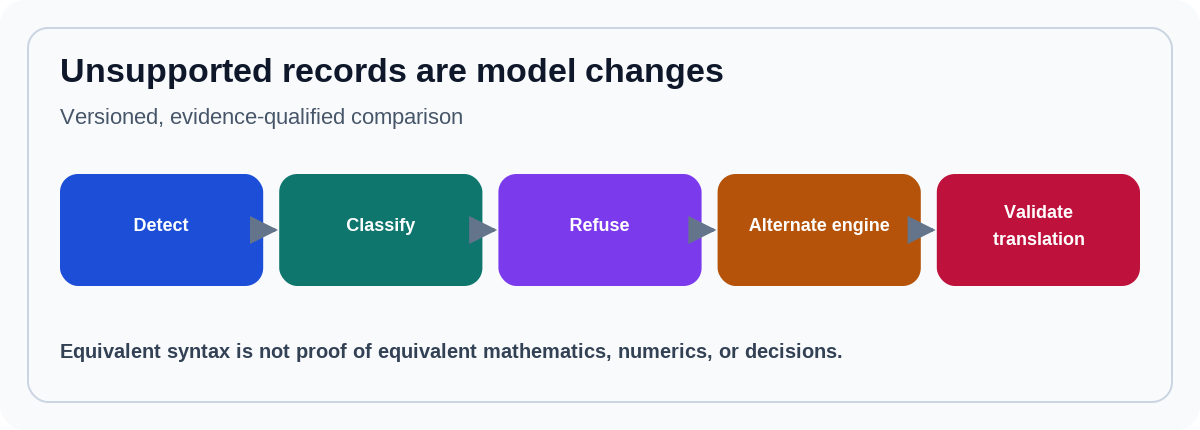
nlmx refuses likelihood/model-changing constructs it cannot faithfully execute: $MIX, $PRIOR, $LEVEL, $AES/$AESINITIAL, parameter-prior record families, $INCLUDE, $BIND, verbatim Fortran, user subroutines, and unsupported ADVAN/TRANS. A refusal is not an invitation to delete the record.
Some records are noted and ignored by fitting: $DESIGN, $NONPARAMETRIC, $INFN, $SIMULATION, and $MSFI. “Ignored” means their intended task did not occur; it does not mean the record is meaningless. For example, a model can fit while its simulation/design/nonparametric instructions remain unexecuted.
Classify each construct: model/likelihood, data, estimation, simulation, design, reporting, or operational. If model/likelihood, keep analysis in a supporting engine unless an independently specified equivalent is created. If workflow-only, invoke the corresponding nlmx command where it truly matches and document differences.
Every rewrite needs original/new identifiers, rationale, mathematical mapping, fixed-parameter unit/profile/likelihood tests, fitted/simulated validation, and approval. Chapter 40's limit inventory is version-scoped; the executable's current refusal remains authoritative.
Triage example
A control stream containing $SIMULATION and $PRIOR has two different issues. $SIMULATION being ignored by fit means fitting can proceed but no requested simulation is performed; run a supported simulation workflow separately if equivalent. $PRIOR changes estimation and is refused, so the model cannot be called equivalent after deleting it. Classify records individually instead of treating every warning/refusal as the same severity.
Review checklist
- Are the exact product versions, task boundaries, inputs, methods, and settings named?
- Were semantics and frozen-parameter results aligned before optimized outputs?
- Is the comparison using a method-appropriate deterministic or stochastic tolerance?
- Are unsupported or analogous features described without implying equivalence?
- Can every claim be reproduced from retained primary evidence?
Navigation
See the previous page, next page, and complete comparison reference.