validate: the numerical preflight
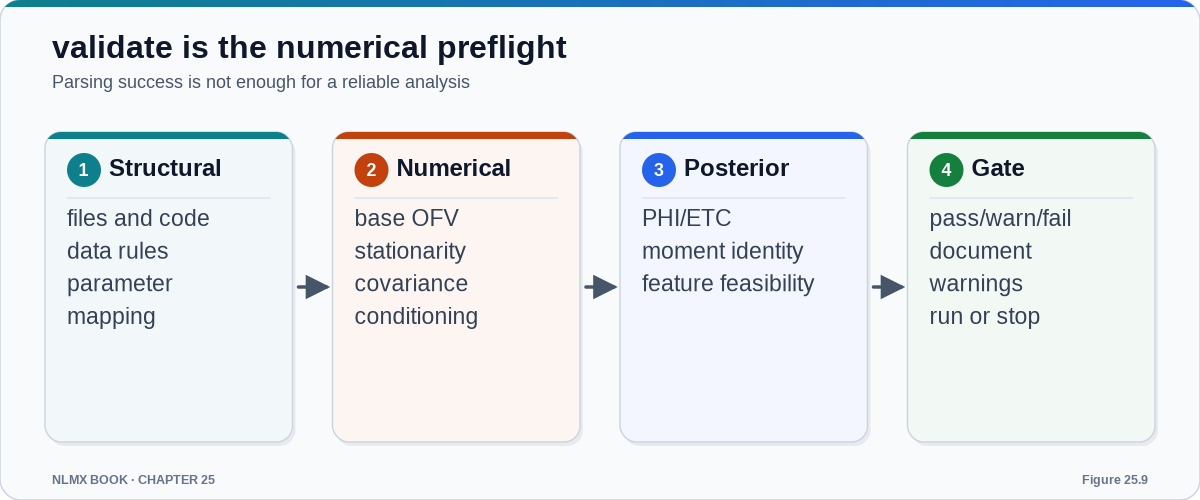
nlmx validate goes beyond parsing. It checks input compatibility and model reconstruction, evaluates the base likelihood where applicable, compares against the recorded OFV within configured tolerance, examines stationarity and covariance conditioning, and evaluates prerequisites needed by the selected engines. Warnings identify qualified concerns; failures stop the workflow.
Posterior preparation additionally depends on PHI/ETC availability or successful reconstruction, posterior covariance quality, subject coverage, the moment identity, and usable feature/learner designs. Frozen evidence depends on derivatives, information construction, stationarity, and candidate feasibility. A validation run with --method both should exercise prerequisites for both sides.
Do not respond to a warning by automatically enabling --strict; first understand and document it. Once the accepted warning set is controlled, strict mode is useful in automated qualification. Preserve validation output and rerun it after any change to data, model, covariance, scope, or numerical settings.
Common mistakes
- Changing the scientific question after seeing the result while presenting it as the original run.
- Reading one engine's summary without checking its prerequisites, failures, normalized settings, and fitted endpoint.
- Treating a generated draft, comparison label, or completed checkpoint as a substitute for model diagnostics and reference-software confirmation.
Page checklist
- The exact command, version, inputs, resolved settings, and output directory are identifiable.
- Engine-specific evidence is interpreted on its own scale before cross-method comparison.
- Recovery state, final refit, diagnostics, and remaining confirmation work are explicit.