23.34 Accuracy envelope and escalation rules
The frozen approximation is strongest when the base is stationary, information is well conditioned, effects are locally modest, candidate coding is regular, conditional modes converge, and score/refit comparisons have been qualified for the model class. Its accuracy weakens with large effects, strong nonlinearity, variance boundaries, high shrinkage, sparse categories, influential subjects, collinearity, large nuisance adjustments, rank loss, approximation mismatch, or a score near a decision threshold.
Define escalation prospectively. A practical policy sends a relationship to likelihood refit when any of the following occurs: uncertain classification; adjusted or conditional p-value near threshold; high clinical consequence; large one-step coefficient; unstable sign/pass probability; material rank/ridge warning; candidate-only/efficient disagreement; observed/OPG disagreement; influential subject; or limited covariate support. Full SCM is appropriate when path agreement itself matters.
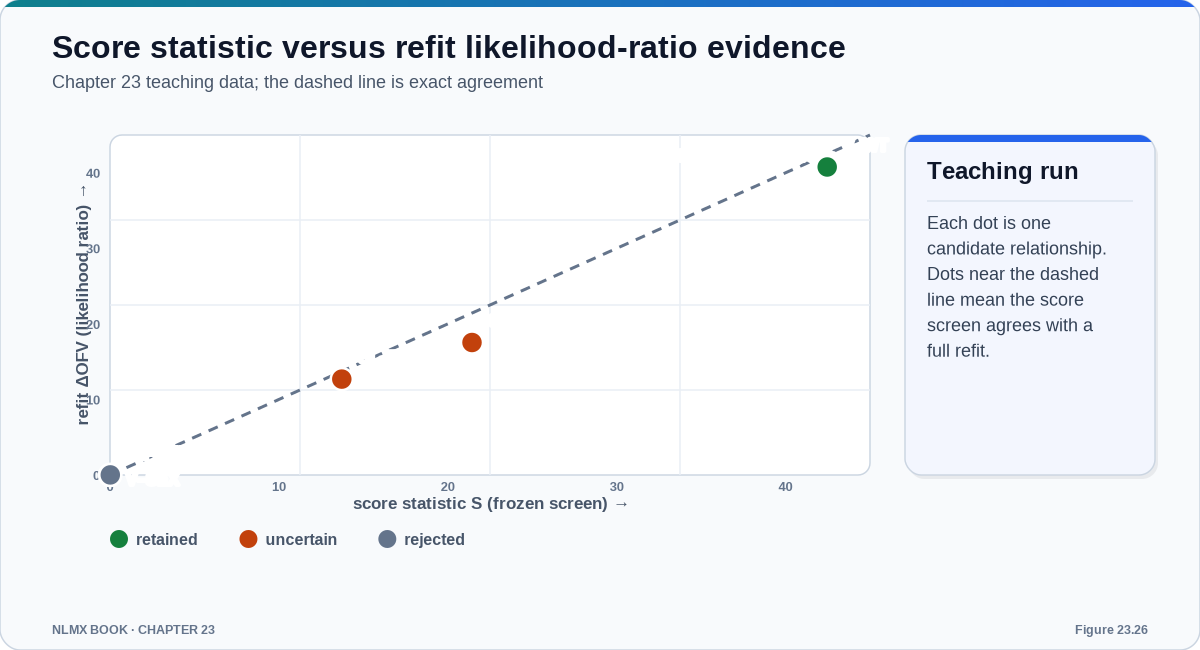
The verified teaching data show useful but imperfect agreement. Score S exceeded refit ΔOFV for the three true effects, yet ranked the important signals correctly and separated null SEX effects. Default frozen backward retention was conservative for the two CL effects relative to SCM. One dataset is an illustration, not performance qualification.
Accuracy claims require many null and alternative scenarios across model classes, designs, effect sizes, missingness, correlations, and numerical conditions.
Common mistakes
- Defining the accuracy envelope after seeing failures.
- Generalizing from one demo dataset.
- Using correlation alone instead of decision agreement and error rates.
- Ignoring null calibration and false-positive behavior.
- Treating a fast method as validated because point estimates look plausible.
Checklist
- Define escalation triggers before analysis.
- Compare scores, ΔOFV, coefficients, and decisions.
- Test null and alternative operating characteristics.
- Stratify performance by model/design difficulty.
- Version accuracy claims and known limits.
Further reading
See the worked run, Chapter 23A for SCM, and Chapter 42 when drafted.